
Difference Between 32D, 34D, 36D, 38D, and 40D Bra Size

Have you ever tried on two bras both labeled “D cup” and wondered why one felt perfectly right while the other felt completely wrong? I know that feeling, and trust me, you are not alone.
Here is the thing most people do not know: a D cup is not a fixed size. It changes depending on the band number in front of it. A 32D and a 40D are both called “D cups,” but they are actually very different in volume, fit, and how they look and feel on your body.
In this guide, I am going to walk you through the real difference between 32D, 34D, 36D, 38D, and 40D bra sizes. I will cover everything from band size and cup volume to sister sizes, body types, and the best bra styles for each size. Whether you are buying your first bra or you have been wearing one for years, this guide is for you.
And if you want to find your perfect size quickly, you can use our free International Bra Size Converter tool. It works for US, UK, EU, and Australian sizing, so no matter where you are, I have got you covered.
Let us dive in.
What Does a D Cup Actually Mean?
A D cup means there is a 4-inch difference between your bust measurement and your band measurement. That is it. It is that simple.
Here is how bra sizing works. Every bra size has two parts:
- The band number (32, 34, 36, 38, or 40) this is your underbust measurement, the area right under your breasts.
- The cup letter (A, B, C, D, etc.) this represents the difference between your bust and your underbust.
So when you see a size like 34D, it means your underbust measures 34 inches (86 cm) and your bust measures 4 inches (10 cm) more than that, which puts you at 38 inches (97 cm) around the fullest part of your chest.
Here is a quick cup size reference so you can see where D sits:
Difference (inches) | Difference (cm) | Cup Size |
1 inch | 2.5 cm | A cup |
2 inches | 5 cm | B cup |
3 inches | 7.5 cm | C cup |
4 inches | 10 cm | D cup |
5 inches | 12.5 cm | DD cup |
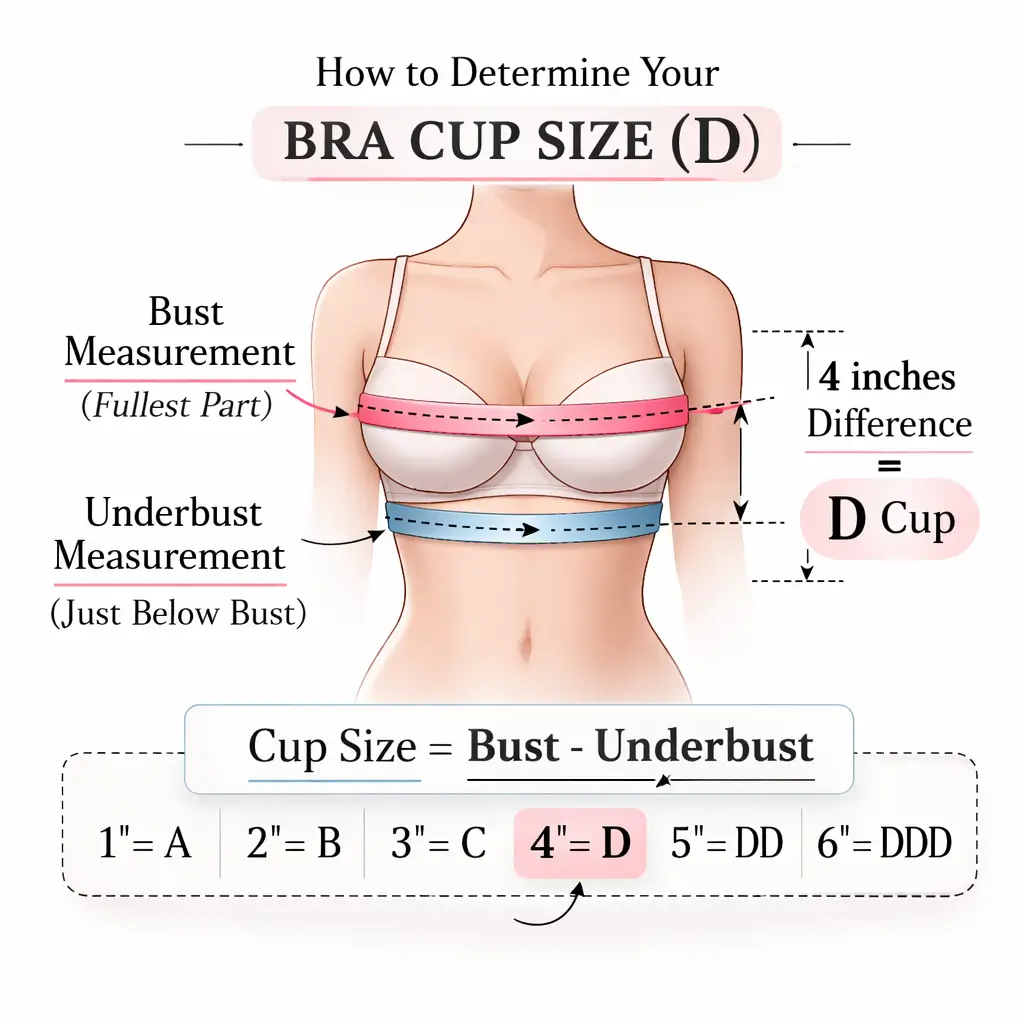
The important thing to understand here is that the cup letter only tells you the proportion of your bust to your band. It does not tell you the actual volume of your breasts on its own. That is why two women can both wear a D cup but look and feel completely different in their bras.
If you want to learn more about how bra sizes work in general, I recommend reading What Do Bra Sizes Mean and What is a D Cup Bra Size for a deeper understanding.
How to Measure Your Bra Size at Home
Before we compare all five D cup sizes, it helps to know your own measurements first. The good news is that measuring your bra size at home is easy and only takes a few minutes. All you need is a soft measuring tape.
Here is how to do it step by step:
Step 1: Measure Your Band Size
Wrap the measuring tape around your ribcage, directly under your breasts. Keep it snug but not tight. Make sure it sits straight all the way around.
- If your measurement is an even number, that is your band size.
- If your measurement is an odd number, round up to the next even number.
For example, if you measure 33 inches (84 cm), your band size is 34.
Step 2: Measure Your Bust Size
Now wrap the measuring tape around the fullest part of your bust, usually across your nipples. Keep it level and do not pull it too tight. Let it sit naturally against your body.
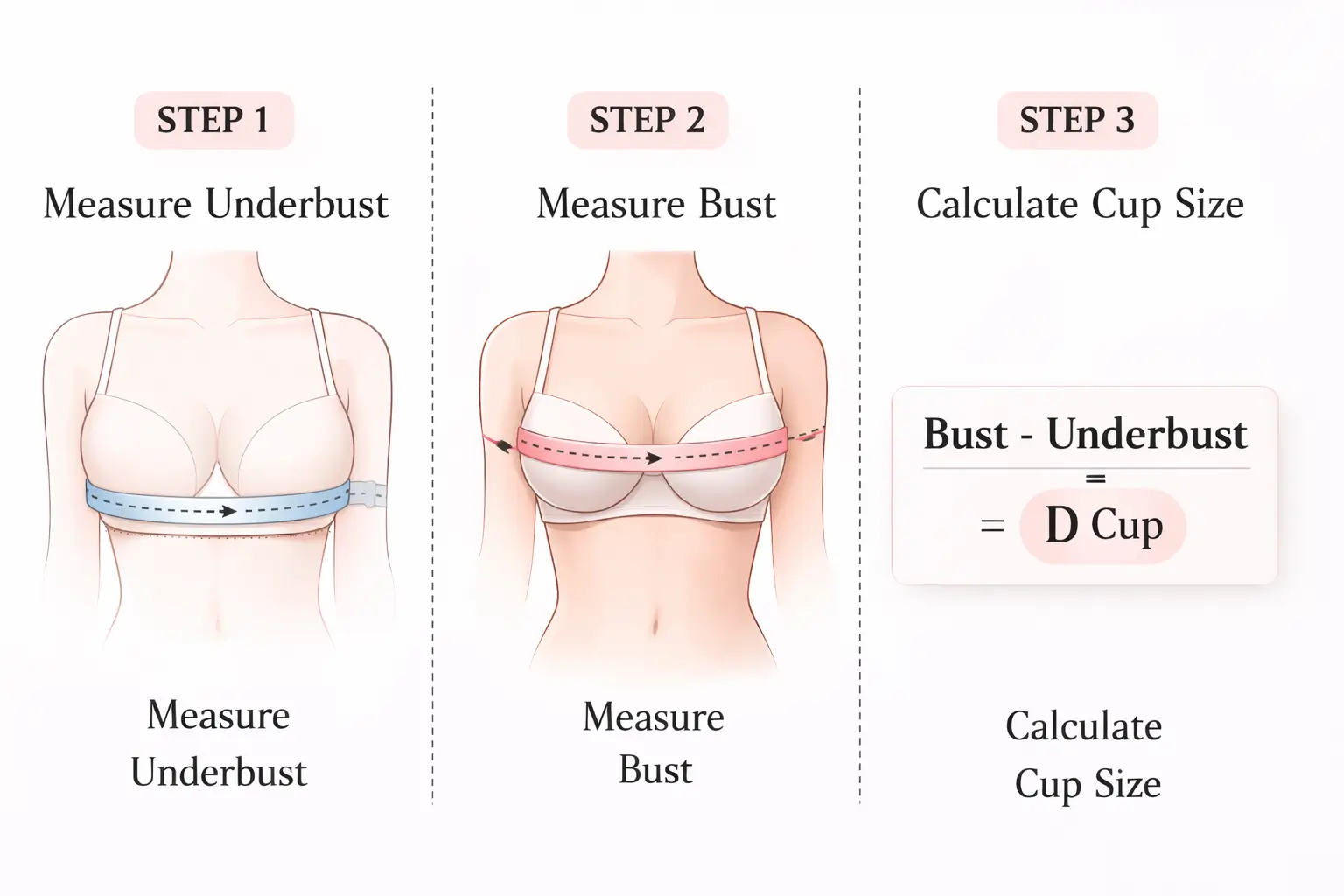
Step 3: Find Your Cup Size
Subtract your band measurement from your bust measurement. The difference tells you your cup size.
Difference (inches) | Difference (cm) | Cup Size |
1 inch | 2.5 cm | A cup |
2 inches | 5 cm | B cup |
3 inches | 7.5 cm | C cup |
4 inches | 10 cm | D cup |
5 inches | 12.5 cm | DD cup |
Quick Example:
- Underbust: 34 inches (86 cm)
- Bust: 38 inches (97 cm)
- Difference: 4 inches (10 cm) = D cup
- Your size: 34D
It is that simple! I always recommend measuring yourself every six months because your body changes over time, and your bra size can change too.
Already have your measurements? Use our free International Bra Size Converter to find your perfect size instantly. It works for US, UK, EU, and Australian sizing all in one place.
You can also read Bra Cup Sizes Explained if you want a full breakdown of every cup size from A to G.
Are All D Cups the Same Size?
No, absolutely not. This is one of the biggest misconceptions in bra sizing, and I want to clear it up right now.
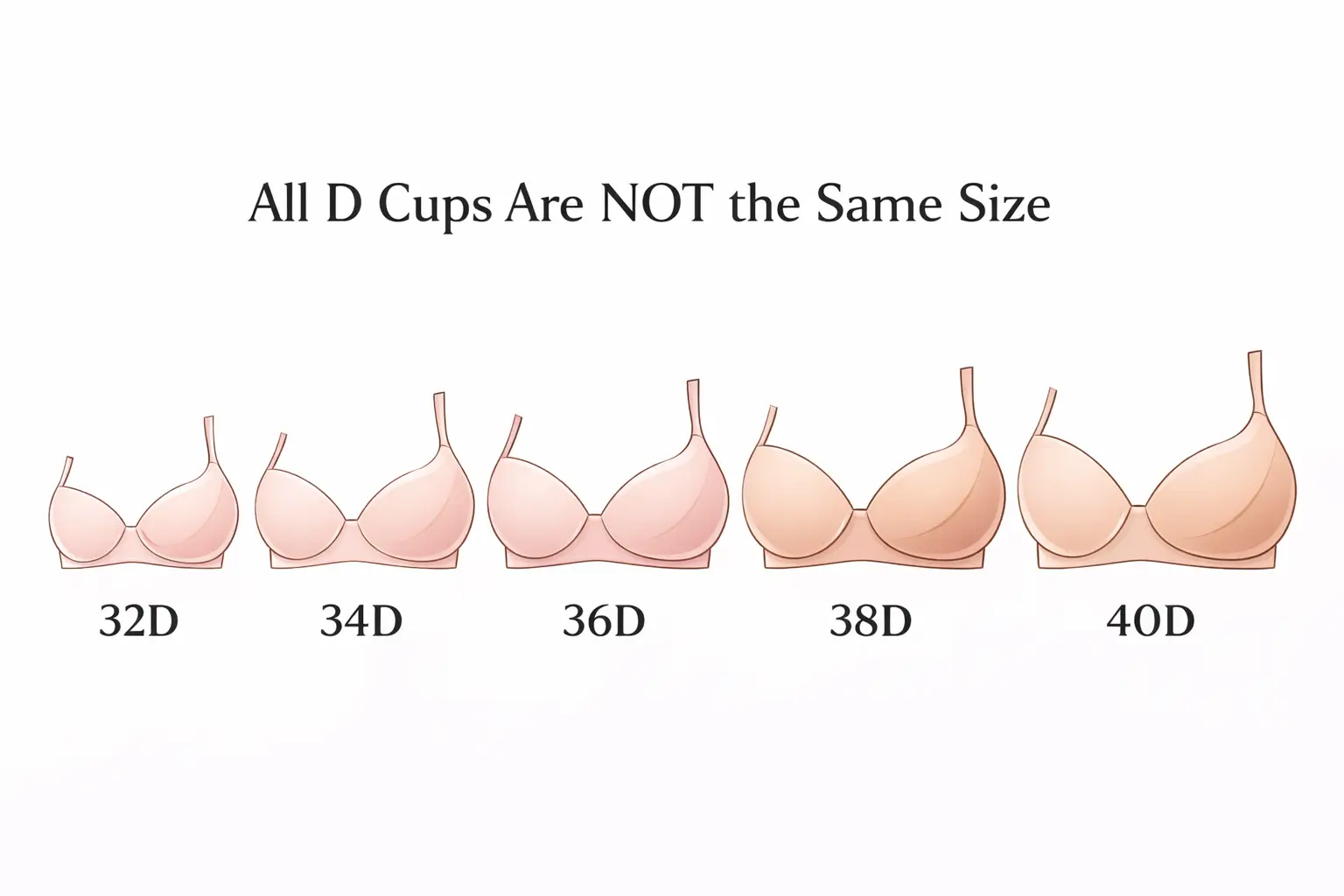
Even though 32D, 34D, 36D, 38D, and 40D all share the same cup letter, they are not the same size at all. The cup volume gets bigger as the band number increases. So a 40D holds significantly more breast tissue than a 32D, even though both are called “D cups.”
Think of it this way. Imagine pouring the same amount of water into two different sized glasses. The water level looks different in each glass even though the amount is the same. Bra sizing works in a similar way. The cup letter tells you the proportion, but the band number determines the actual volume.
Here is a simple way to picture the difference:
- A 32D is a smaller, more projected cup on a narrow frame
- A 34D is slightly larger with a balanced, natural shape
- A 36D is noticeably fuller with more width across the chest
- A 38D is a high-volume cup that needs strong support
- A 40D is the largest of the five, with the most breast tissue and the widest cup shape
This is exactly why bra shopping can feel so frustrating sometimes. You pick up two bras with the same label and they fit completely differently. Now you know why.
In the next section, I am going to show you a full side-by-side comparison of all five sizes so you can see the differences clearly.
Full Comparison: 32D vs 34D vs 36D vs 38D vs 40D Bra Size
Now that you understand how D cup sizing works, let me show you a clear side-by-side comparison of all five sizes. I put together two tables so you can see the measurements and the best styles for each size all in one place.
Table 1: Key Measurements and Body Type
Bra Size | Band (inches) | Band (cm) | Bust (inches) | Bust (cm) | Cup Volume | Best For |
32D | 32 in | 81 cm | 36 in | 91 cm | Smallest | Petite / Slim frame |
34D | 34 in | 86 cm | 38 in | 97 cm | Small-Medium | Athletic / Average |
36D | 36 in | 91 cm | 40 in | 102 cm | Medium | Medium / Curvy |
38D | 38 in | 97 cm | 42 in | 107 cm | Large | Fuller figure |
40D | 40 in | 102 cm | 44 in | 112 cm | Largest | Plus-size / Broad |
Table 2: Support Level and Best Bra Styles
Bra Size | Support Needed | Best Bra Styles | Approx. Clothing Size |
32D | Light to Moderate | Plunge, Bralette, Push-up | XS to S |
34D | Moderate | T-shirt, Balconette, Strapless | S to M |
36D | Moderate to High | Full cup, Underwired, Minimizer | M to L |
38D | High | Wide-band, Full coverage, Racerback | L to XL |
40D | Very High | Structured, Longline, Full coverage | XL and above |
These two tables give you a quick and clear picture of how different these five sizes really are. As the band number goes up, the cup volume increases, the support needed grows, and the bra styles that work best change too.
A few important things to keep in mind when reading these tables:
- The clothing sizes listed are approximate. Bra size and clothing size do not always match perfectly, and every body is different.
- Cup volume is relative. A 40D holds much more breast tissue than a 32D even though they share the same cup letter.
- Support needs increase with band size because larger cups carry more weight and need stronger construction to keep you comfortable all day.
If you are shopping across different countries, I recommend using our free International Bra Size Converter to convert your size between US, UK, EU, and Australian sizing quickly and easily.
Size-by-Size Breakdown
The tables above give you the numbers, but I want to go deeper now. In this section, I am going to break down each size individually so you can understand exactly what each one feels like, who it fits best, and what to look for when shopping.
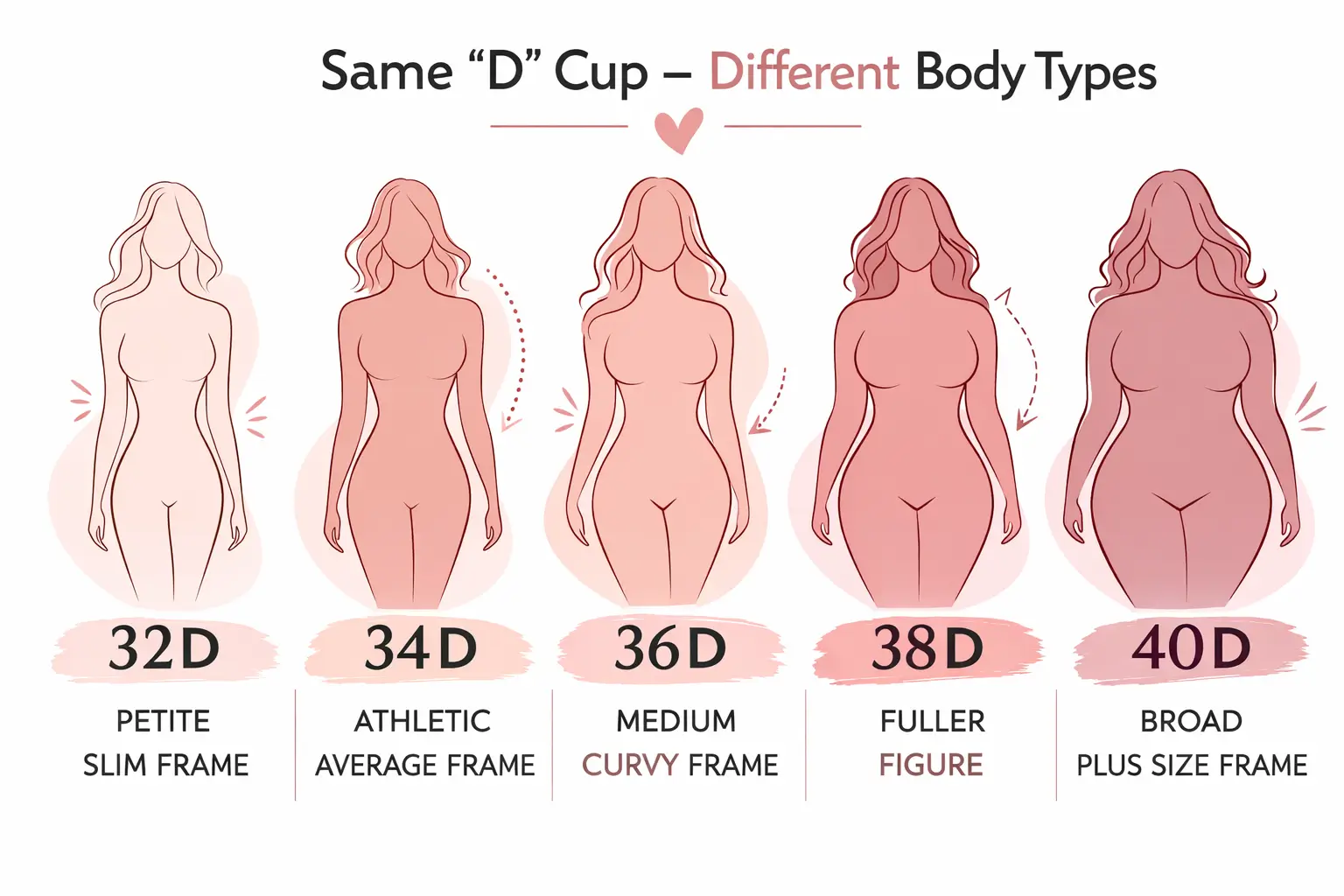
32D Bra Size
The 32D is designed for women with a petite or slim frame and a narrow ribcage. If you wear XS or S in tops, there is a good chance this size fits you well.
Who it fits: Petite women with a narrow torso and slim shoulders.
How it looks: On a smaller frame, a 32D tends to look quite projected and prominent. Because the chest is narrower, the breast volume appears more forward-facing rather than spread out.
Cup volume: The smallest among the five D cup sizes. However, it still carries a noticeable amount of volume for the frame size, which is why many women find 32D looks fuller than they expected.
Common fit issues: The band can feel tight if you are between sizes. Always make sure the band sits flat against your ribcage without digging in.
Best bra styles: Plunge bras, push-up bras, bralettes, and wireless bras all work beautifully at this size. You do not need heavy structural support, so lighter styles are perfectly comfortable.
34D Bra Size
The 34D is one of the most commonly worn bra sizes in the US, UK, Canada, and Australia. It strikes a great balance between fit, comfort, and availability.
Who it fits: Women with an athletic build, an hourglass figure, or an average frame. This size works well for S to M clothing sizes.
How it looks: A 34D gives a balanced, natural shape. The breasts appear proportionate to the body without looking too large or too small.
Cup volume: Small to medium volume. There is enough projection to fill most cup styles beautifully.
Common fit issues: This size is widely available, so fit issues are less common. However, if your band feels loose on the tightest hook, it may be time to size down in the band.
Best bra styles: T-shirt bras, balconette bras, strapless bras, and contour bras all work very well. This size is incredibly versatile and easy to shop for.
36D Bra Size
The 36D is built for women with a medium to curvy frame and a broader ribcage. It is the point where support starts to become more important.
Who it fits: Women with a medium to fuller build, broader shoulders, and a curvier body. This size typically suits M to L clothing sizes.
How it looks: A 36D appears fuller and wider across the chest compared to smaller D cups. The breasts tend to look more distributed rather than projected.
Cup volume: Medium to high volume. There is noticeably more breast tissue here than in a 32D or 34D.
Common fit issues: The cups can sometimes gap at the top if the cup shape does not match your breast shape. Full cup styles tend to solve this problem easily.
Best bra styles: Underwired bras, full cup bras, minimizer bras, and side support bras are all great choices. These styles provide the right coverage and keep everything in place comfortably.
38D Bra Size
The 38D is built for fuller figures and requires a good level of structural support. At this size, the engineering of the bra becomes just as important as the style.
Who it fits: Women with a fuller or plus-size body, broader shoulders, and a wider ribcage. This size suits L to XL clothing sizes.
How it looks: A 38D appears less projected and more horizontally distributed across the chest. The breasts sit wider rather than forward-facing.
Cup volume: High volume. A 38D carries significantly more breast tissue than smaller D cups, and this weight needs to be properly supported.
Common fit issues: Straps can dig into the shoulders if the band is not doing its job properly. Always make sure the band is snug enough to carry most of the weight, not just the straps.
Best bra styles: Wide-band bras, full coverage bras, racerback styles, and posture bras are all excellent options. Look for bras with padded straps and strong underwire for the best support.
40D Bra Size
The 40D is the largest of the five D cup sizes and requires the highest level of support. Comfort and structure are the top priorities at this size.
Who it fits: Women with a full-figured body, broad shoulders, and a wide ribcage. This size suits XL and above in clothing.
How it looks: A 40D is wide and full across the chest. The breast volume is distributed broadly rather than projected forward, giving a softer, fuller appearance.
Cup volume: The largest among the five. A 40D holds the most breast tissue and carries the most weight, which means the right bra makes a huge difference to how you feel throughout the day.
Common fit issues: Finding adequate support is the biggest challenge at this size. Back pain and shoulder strain are common signs that your bra is not supporting you properly.
Best bra styles: Structured full coverage bras, longline bras, minimizer bras, and wide-band bras are the best choices. I would recommend avoiding bralettes or wireless styles unless they are specifically designed for full-figure support.
If you want to explore how your D cup size compares to a DD, I recommend reading The Difference Between D and DD Bras for a full breakdown.
Is a 40D Bigger Than a 38D?
Yes, a 40D is bigger than a 38D. Even though both sizes share the same D cup letter, the 40D has a larger band size, which means it also has a greater cup volume.
Here is why this happens. In bra sizing, the cup volume is not fixed. It grows proportionally with the band size. So as the band number increases by 2 inches, the cup gets wider and deeper to match the larger frame. This means a 40D cup holds more breast tissue than a 38D cup, even though they are both called D cups.
Here is a quick side-by-side comparison to make it clear:
Feature | 38D | 40D |
Band Size | 38 inches (97 cm) | 40 inches (102 cm) |
Bust Size | 42 inches (107 cm) | 44 inches (112 cm) |
Cup Volume | Large | Largest |
Support Needed | High | Very High |
Best For | Fuller figure | Plus-size / Broad frame |
So if you are deciding between a 38D and a 40D, the right choice comes down to your actual measurements. If your underbust measures 40 inches, the 40D will fit you better in the band and give you the right cup volume for your frame.
I always say the same thing to anyone shopping for a new bra: go by your measurements, not by what size you think you should be. Your measurements never lie.
To learn more about how cup sizes relate to each other, check out The Difference Between D and DD Bras for a detailed guide.
What Is the Difference Between 32D and 40D?
The difference between 32D and 40D is significant. These two sizes are on opposite ends of the D cup spectrum, and while they share the same cup letter, they are worlds apart in terms of band size, cup volume, appearance, and support needs.
Here is a detailed side-by-side comparison:
Feature | 32D | 40D |
Band Size | 32 inches (81 cm) | 40 inches (102 cm) |
Bust Size | 36 inches (91 cm) | 44 inches (112 cm) |
Cup Volume | Smallest | Largest |
Appearance | Projected, forward-facing | Wide, distributed across chest |
Support Needed | Light to Moderate | Very High |
Best For | Petite / Slim frame | Plus-size / Broad frame |
Approx. Clothing Size | XS to S | XL and above |
As you can see, the band size alone differs by 8 inches (20 cm). That is a huge difference in terms of how the bra fits around your torso.
Here is how the two sizes differ in the key areas:
Band Size A 32D has a narrow, firm band that sits snugly around a slim ribcage. A 40D has a much wider band that wraps around a fuller, broader torso. The band is responsible for providing most of the support in a bra, so the wider band of a 40D carries a lot more weight.
Cup Volume Even though both sizes are D cups, the actual volume of breast tissue they hold is very different. A 32D holds the least volume among the five sizes, while a 40D holds the most. Think of it like two differently sized bowls. They are both called bowls, but one holds much more than the other.
Appearance On a petite frame, a 32D tends to look quite prominent and projected because the narrow chest gives the breasts less width to spread across. On a broader frame, a 40D looks fuller and more distributed, with the breast tissue spreading wider across the chest.
Support Needs A 32D can be worn comfortably in lighter bra styles like bralettes and plunge bras. A 40D needs strong structural support with wide bands, padded straps, and firm underwire to keep you comfortable throughout the day.
If you are shopping in the UK or Australia, it is worth knowing that these measurements translate the same way across sizing systems. The band and cup relationship stays consistent whether you are shopping in the US, UK, EU, or Australia. You can use our free International Bra Size Converter to check your size across different systems instantly.
For a deeper look at how cup sizes work across the board, I also recommend reading Bra Cup Sizes Explained on our blog.
Sister Sizes: What Is a 40D Bra Equivalent To?
A 40D is equivalent to a 42C or a 38DD in terms of cup volume. These are called sister sizes, and understanding them can completely change the way you shop for bras.
What Are Sister Sizes?
Sister sizes are different bra size combinations that hold roughly the same cup volume. When you go up one band size, you go down one cup size to keep the volume the same. And when you go down one band size, you go up one cup size for the same reason.
For example:
- A 40D and a 38DD hold the same cup volume, but the 38DD has a tighter band
- A 40D and a 42C also hold the same cup volume, but the 42C has a looser band
This is incredibly useful when your usual size is out of stock, or when a bra fits perfectly in the cup but feels too tight or too loose in the band. Instead of giving up on that bra, you can simply try its sister size.
Do You Go Down a Cup Size If You Go Up a Band Size?
Yes, absolutely. This is exactly how sister sizing works. If you go up one band size, you go down one cup size to maintain the same volume. If you go down one band size, you go up one cup size.
Full Sister Size Chart for All Five D Cup Sizes
Here is a complete sister size chart for all five sizes we are covering in this guide:
Your Size | Go Up Band (same volume) | Go Down Band (same volume) |
32D | 34C | 30DD |
34D | 36C | 32DD |
36D | 38C | 34DD |
38D | 40C | 36DD |
40D | 42C | 38DD |
A Few Things to Keep in Mind About Sister Sizes
Sister sizes share the same cup volume, but they do not fit the same way. Here is what changes when you switch to a sister size:
- Going up in band size gives you a looser band and a slightly smaller cup shape. This works if your current band feels too tight.
- Going down in band size gives you a tighter band and a slightly larger cup shape. This works if your current band feels too loose.
Sister sizing is a helpful trick, but it is always best to wear your true size whenever it is available. Your true size gives you the best combination of band support and cup fit.
To learn more about how D and DD sizes compare to each other, I recommend reading The Difference Between D and DD Bras and Double D Breast Size for a full picture.
And if you want to find your sister size quickly without doing the math yourself, our free International Bra Size Converter can help you figure it out in seconds.
Is 32D Small or Medium?
A 32D is generally considered a small to medium bra size. The band size of 32 is on the smaller end of the spectrum, which makes it a petite size overall. However, the D cup adds a noticeable amount of volume for that frame, which is why many women find that a 32D looks and feels more prominent than they expected.
It Depends on the Frame
The honest answer is that “small” and “medium” are relative terms when it comes to bra sizing. Here is how to think about it:
- The band (32) is considered small. A 32-inch underbust measurement falls on the petite to slim end of the sizing range.
- The cup (D) is considered medium in terms of cup letter. A D cup sits right in the middle of the common cup size range, above A, B, and C but below DD, E, and F.
So when you put them together, a 32D is a small band with a medium cup. On a petite frame, this combination tends to look quite full and projected because there is less chest width to distribute the volume across.
How Does a 32D Compare to Other Sizes?
To give you a clearer picture, here is how 32D sits in the broader sizing range:
Size | Band | Cup | Overall |
32B | Small | Small | Small overall |
32C | Small | Small-Medium | Small-Medium overall |
32D | Small | Medium | Small band, Medium cup |
34D | Medium | Medium | Medium overall |
36D | Medium-Large | Medium | Medium-Large overall |
As you can see, a 32D sits right between small and medium depending on how you look at it. The band is small but the cup adds enough volume to push it into medium territory for many women.
What Body Type Suits a 32D?
A 32D suits women with a petite to slim frame, narrow shoulders, and a smaller ribcage. If you wear XS to S in tops and have a naturally fuller bust relative to your frame, a 32D is likely a great fit for you.
I want to be clear though: there is no “right” body type for any bra size. Every woman is different, and the best size is simply the one that fits your measurements and feels comfortable on your body.
For more information on D cup sizing and what it means for different body types, check out What is a D Cup Bra Size on our blog.
Are 38D Breasts Big?
Yes, 38D breasts are considered large. The combination of a wide 38-inch band and a D cup means there is a significant amount of breast volume at this size. However, whether 38D looks or feels “big” depends a lot on your overall body frame and proportions.
It Is All About Proportion
Here is something I want every woman to understand: breast size is always relative to the body it is on. A 38D on a broader, fuller frame can look completely proportionate and natural. On a smaller frame, the same volume would look much larger. This is why two women can wear the same bra size and look very different.
So rather than thinking about whether 38D is “big” in absolute terms, it helps to think about it in relation to your own body.
How Does 38D Compare in Terms of Volume?
To give you a sense of where 38D sits in the volume range, here is a quick comparison:
Bra Size | Cup Volume | How It Generally Looks |
32D | Smallest | Projected and prominent on a petite frame |
34D | Small-Medium | Balanced and proportionate on an average frame |
36D | Medium | Fuller and wider on a medium to curvy frame |
38D | Large | Full and distributed on a fuller figure |
40D | Largest | Wide and heavy on a broad, full-figured frame |
As you can see, 38D sits firmly in the large category when compared to other D cup sizes. It carries a noticeable amount of breast tissue and requires a good level of support to stay comfortable throughout the day.
Are 38D Breasts Heavy?
Yes, 38D breasts do carry a meaningful amount of weight. On average, each breast at this size weighs approximately 1.1 to 1.5 pounds (500 to 680 grams), which means the combined weight can be around 2.2 to 3 pounds (1 to 1.4 kg). This is why proper bra support is so important at this size. Without the right bra, that weight can cause shoulder strain, back pain, and general discomfort throughout the day.
What Is the Sister Size to 38D?
The sister sizes for 38D are 40C (same volume, looser band) and 36DD (same volume, tighter band). If you ever find that a 38D fits well in the cup but not in the band, these sister sizes are worth trying.
I always remind women that feeling comfortable and supported is what matters most, regardless of what the label says. A well-fitted bra at any size should feel almost invisible throughout the day.
For more on D cup sizing and what it means across different band sizes, visit What is a D Cup Bra Size and Bra Cup Sizes Explained on our blog.
Is D Cup Large?
A D cup is considered medium to large, but the honest answer is that it depends entirely on the band size attached to it. A D cup on a 32 band is very different from a D cup on a 40 band, and that difference matters a lot when we talk about what “large” actually means in bra sizing.
Where Does D Cup Sit in the Cup Size Range?
Here is a quick look at where D sits among all common cup sizes:
Cup Letter | Difference | Size Category |
A | 1 inch (2.5 cm) | Small |
B | 2 inches (5 cm) | Small-Medium |
C | 3 inches (7.5 cm) | Medium |
D | 4 inches (10 cm) | Medium-Large |
DD | 5 inches (12.5 cm) | Large |
E | 6 inches (15 cm) | Large |
F | 7 inches (17.5 cm) | Very Large |
As you can see, D cup sits right at the medium to large boundary. It is above A, B, and C but below DD, E, and F. So in the full range of cup sizes, D is not at the extreme end at all.
The Common Misconception About D Cup
One of the biggest misconceptions I come across is that a D cup is always large. This simply is not true. Many women picture a very large bust when they hear “D cup,” but in reality a 32D is a relatively modest size on a petite frame. It is the band size that puts the cup volume in context.
Here is a simple way to think about it:
- A 32D is a medium bust on a petite body
- A 34D is a medium bust on an average body
- A 36D is a fuller bust on a medium to curvy body
- A 38D is a large bust on a fuller body
- A 40D is a very full bust on a broad body
So the same cup letter can mean something very different depending on the band it is paired with.
Is D Cup Too Big?
Not at all. A D cup is a completely normal and common size worn by millions of women across the US, UK, Canada, and Australia every day. The most important thing is not whether D is big or small in a general sense. What matters is whether your bra fits your measurements and keeps you comfortable and supported throughout the day.
For a full breakdown of every cup size and what they mean, I recommend reading Bra Cup Sizes Explained on our blog. And if you want to understand the difference between a D and a DD specifically, The Difference Between D and DD Bras is a great place to start.
Do You Go Down a Cup Size If You Go Up a Band Size?
Yes, you do. This is one of the most useful rules to understand in bra sizing, and once it clicks, shopping for bras becomes so much easier.
Here is the rule in simple terms: if you go up one band size, you go down one cup size to keep the same cup volume. And if you go down one band size, you go up one cup size for the same reason. This is the foundation of sister sizing, which I covered in detail earlier in this guide.
Why Does This Happen?
It happens because cup size is proportional to band size, not fixed on its own. As the band gets bigger, the cup naturally gets wider and deeper too. So to maintain the same actual volume of breast tissue in the cup, the cup letter has to decrease when the band increases.
Here is a practical example using 34D:
If Your Size Is | And You Go Up the Band | Your Sister Size Is |
34D | Up one band size | 36C |
34D | Up two band sizes | 38B |
34D | Down one band size | 32DD |
34D | Down two band sizes | 30E |
All four sizes in that table hold roughly the same cup volume. The difference is in how the band fits around your torso.
When Should You Use This Rule?
This rule is most helpful in three situations:
Situation 1: The cup fits but the band is too tight. Try going up one band size and down one cup size. For example, if 34D fits in the cup but the band digs in, try 36C instead.
Situation 2: The cup fits but the band is too loose. Try going down one band size and up one cup size. For example, if 34D fits in the cup but the band rides up, try 32DD instead.
Situation 3: Your size is out of stock. Use a sister size as a temporary alternative. The cup volume will be the same, so the fit will be close even if it is not perfect.
Understanding this rule has helped so many women I know find a better fitting bra without going through the frustration of starting their search all over again. It is one of those simple tricks that makes a real difference.
For more on sister sizing and how D and DD sizes relate to each other, check out The Difference Between D and DD Bras and Double D Breast Size on our blog.
Is 36C the Same as 34D?
Yes, 36C and 34D are sister sizes, which means they hold the same cup volume. If you wear a 34D and try on a 36C, the amount of breast tissue the cup holds will be roughly the same. However, the way the bra fits on your body will be different because the band sizes are different.
What Is the Same and What Is Different?
Here is a clear breakdown of what 36C and 34D share and where they differ:
Feature | 34D | 36C |
Band Size | 34 inches (86 cm) | 36 inches (91 cm) |
Bust Size | 38 inches (97 cm) | 39 inches (99 cm) |
Cup Volume | Same | Same |
Band Fit | Firmer and tighter | Looser and more relaxed |
Cup Shape | Slightly deeper | Slightly wider |
Best For | Average frame, needs firm band support | Broader frame, prefers a relaxed band |
When Would You Switch Between These Two Sizes?
There are two common situations where switching between 34D and 36C makes sense:
Situation 1: The 34D cup fits perfectly but the band feels too tight. In this case, try a 36C. The cup volume stays the same but the band gives you a little more room around your ribcage. This is a very common adjustment that many women make, especially if their band measurement falls between 34 and 36 inches.
Situation 2: The 36C cup fits perfectly but the band feels too loose. In this case, try a 34D. The cup volume is the same but the band will be firmer and give you better support. A snug band is important because it does most of the supporting work in a bra.
Is 36C the Same as 34D in Every Country?
Yes, this sister size relationship holds true across US, UK, Canadian, and Australian sizing systems. The proportional relationship between band and cup stays consistent no matter which sizing system you are shopping in. However, if you are converting between US and UK sizes specifically, it is always a good idea to double-check because cup letter naming can differ slightly between systems.
If you want to understand how US and UK sizing compare to each other, I recommend reading Difference Between US and UK Bra Sizing on our blog. And for quick size conversions across all systems, our free International Bra Size Converter tool has you covered.
Is a DD Bra Bigger or Smaller Than a D?
A DD bra is bigger than a D bra. A DD cup is one full cup size larger than a D cup, which means it holds more breast tissue and has a greater cup volume. This is true across all band sizes, whether you are comparing 32D to 32DD, 34D to 34DD, or 40D to 40DD.
How Much Bigger Is a DD Than a D?
The difference comes down to measurements. A D cup represents a 4-inch (10 cm) difference between your bust and your underbust. A DD cup represents a 5-inch (12.5 cm) difference. So a DD cup is exactly 1 inch (2.5 cm) larger than a D cup in terms of bust to underbust difference.
Here is a clear comparison:
Cup Size | Bust to Underbust Difference (inches) | Bust to Underbust Difference (cm) | Size Category |
C | 3 inches | 7.5 cm | Medium |
D | 4 inches | 10 cm | Medium-Large |
DD | 5 inches | 12.5 cm | Large |
E | 6 inches | 15 cm | Large |
F | 7 inches | 17.5 cm | Very Large |
Is 32DD Bigger Than 32D?
Yes, a 32DD is bigger than a 32D. They share the same band size of 32 inches, but the DD cup holds more volume than the D cup. So if you find that your 32D cups are overflowing or feeling too small, moving up to a 32DD is the right next step.
Is DD the Same in the US and UK?
This is a great question and one that confuses a lot of women who shop across different countries. In the US, the cup sizes go A, B, C, D, DD, DDD. In the UK and Australia, the cup sizes go A, B, C, D, DD, E. So a US DD and a UK DD are actually the same size. However, a US DDD is equivalent to a UK E cup. It is a small but important difference to know about, especially if you are ordering bras online from international retailers.
For a full breakdown of how US and UK cup sizes compare, I recommend reading Difference Between US and UK Bra Sizing and The Difference Between D and DD Bras on our blog. Both articles go into a lot more detail and will help you shop with confidence no matter where you are buying from.
Find Your Perfect Bra Size in Seconds
Still not 100% sure about your size after reading all of this? That is completely okay. Bra sizing can feel overwhelming sometimes, and I get that.
That is exactly why I built the free International Bra Size Converter tool right here on My Bra Size Converter. It is quick, simple, and works for US, UK, EU, and Australian sizing all in one place. No complicated math, no guesswork, and no frustration.
Here is what you can do with it:
- Convert your bra size between US, UK, EU, and Australian sizing instantly
- Find your size across different international sizing systems
- Shop with confidence whether you are buying from a local store or an international retailer online
All you need is your underbust and bust measurements, and the tool does the rest for you in seconds.
Whether you are a 32D shopping from the UK, a 38D in Australia, or a 40D in the US, our free converter is designed to help every woman find her perfect fit quickly and easily.
Click here to use the free International Bra Size Converter now
You deserve a bra that fits perfectly and feels comfortable all day long. Let me help you find it.
Frequently Asked Questions
Here are the most common questions I get asked about 32D, 34D, 36D, 38D, and 40D bra sizes. I have answered each one as clearly and simply as possible so you can find the answer you need quickly.
Yes, 38D breasts are considered large. The wide 38-inch band combined with a D cup means there is a significant amount of breast volume at this size. However, on a fuller or broader frame, a 38D can look completely proportionate and natural. Size is always relative to the body it is on.
On average, each breast at a 38D size weighs approximately 1.1 to 1.5 pounds (500 to 680 grams). Combined, that is roughly 2.2 to 3 pounds (1 to 1.4 kg) of weight. This is why wearing a properly supportive bra at this size is so important. Without the right support, that weight can cause shoulder strain and back pain over time.
Yes, a 36DD and a 38D are sister sizes, which means they hold the same cup volume. If you normally wear a 38D but find the band too loose, a 36DD will give you the same cup volume with a firmer band. The fit will feel slightly different, but the cup coverage will be very similar.
The sister sizes to 38DD are 40D (same volume, looser band) and 36E or 36DDD (same volume, tighter band). If your 38DD fits well in the cup but not in the band, these sister sizes are worth trying. Remember that going up one band size means going down one cup size, and going down one band size means going up one cup size.
Yes, 36D is considered a fuller bust size. On a medium to curvy frame, a 36D looks natural and proportionate. On a slimmer frame, it would appear quite full. Overall, 36D sits in the medium to large category and is one of the most commonly worn bra sizes among women in the US, UK, Canada, and Australia.
If you wear a 32D, your bust measurement is approximately 36 inches (91 cm). This is calculated by adding the D cup difference of 4 inches (10 cm) to your band size of 32 inches (81 cm). So your underbust measures around 32 inches and your bust measures around 36 inches at the fullest point.
On average, each breast at a 32D size weighs approximately 0.7 to 1 pound (320 to 450 grams). Combined, that is roughly 1.4 to 2 pounds (640 to 900 grams). This is lighter than larger D cup sizes because the 32 band represents a smaller frame with less overall breast tissue volume.
Yes, a 32D is smaller than a 34D. The 32D has a narrower band and a smaller cup volume than the 34D. Even though both are D cups, the 34D holds more breast tissue because the larger band size means a proportionally larger cup. If you are between these two sizes, always go by your underbust measurement to find the right band size.
Yes, a 36DD is bigger than a 32DD. Even though both sizes share the DD cup letter, the 36DD has a larger band size which means it also has a greater cup volume. The cup volume grows with every increase in band size, so a 36DD holds noticeably more breast tissue than a 32DD.
A 34D is generally considered a medium bra size. The 34-inch band is right in the middle of the common band size range, and the D cup adds a moderate amount of volume. On an average frame, a 34D looks balanced and proportionate. It is one of the most widely available and commonly worn sizes in the US, UK, Canada, and Australia.
Not necessarily. A bra band size of 40 inches refers to your underbust measurement and has no direct connection to your clothing size. A woman who wears a size 40 bra band could wear anywhere from a size 10 to a size 18 in clothing depending on her overall body shape and proportions. Bra sizing and clothing sizing are two completely separate systems.
Yes, a 40-inch bust measurement is considered large. However, it is important to remember that the bust measurement alone does not tell the whole story. What matters is the combination of your bust and underbust measurements together. For example, a 40-inch bust with a 36-inch underbust gives you a 36D, while a 40-inch bust with a 38-inch underbust gives you a 38B. The cup size depends on the difference, not just the bust number alone.
A 32D suits women with a petite to slim frame, narrow shoulders, and a smaller ribcage. If you wear XS to S in tops and have a naturally fuller bust relative to your frame size, a 32D is likely a great fit for you. That said, there is no single “correct” body type for any bra size. The best size is always the one that fits your measurements and feels comfortable on your body.
This is a fun question and one I hear a lot. Generally speaking, a B or C cup is often described as a handful. However, this is very subjective and depends on the size of the hand in question. What feels like a handful to one person may not feel the same to another. In bra sizing terms, a handful does not correspond to any specific cup size, so it is always best to go by your actual measurements rather than informal descriptions.
Yes, a 32DD is bigger than a 32D. They share the same band size of 32 inches, but the DD cup holds one full cup size more volume than the D cup. A 32DD has a bust to underbust difference of 5 inches (12.5 cm) compared to 4 inches (10 cm) for a 32D. If your 32D cups feel too small or your breasts are spilling over the top, moving up to a 32DD is the natural next step.
Still have questions about your bra size? Use our free International Bra Size Converter to find your perfect size across US, UK, EU, and Australian sizing instantly.
Conclusion
We have covered a lot of ground in this guide, and I hope it has made bra sizing feel a whole lot less confusing for you. Let me wrap everything up with the key takeaways so you can walk away feeling confident and informed.
Key Takeaways
- A D cup is not a fixed size. The cup volume grows with every increase in band size, which means a 32D and a 40D are very different sizes even though they share the same cup letter.
- Band size matters just as much as cup size. The band is responsible for providing most of the support in a bra, so getting the right band size is just as important as getting the right cup.
- Sister sizes are your best friend. If your usual size is out of stock or the band does not fit quite right, knowing your sister sizes gives you more options without sacrificing cup volume.
- Cup volume increases with band size. As the band number goes up, the cup gets wider and deeper to match the larger frame. This is why two D cups can look and feel completely different.
- Your measurements are the most reliable guide. No label, no clothing size, and no informal description can tell you your bra size better than your own underbust and bust measurements.
Final Thoughts
I want every woman reading this to feel empowered when she shops for a bra. Whether you wear a 32D, a 34D, a 36D, a 38D, or a 40D, your size is your size and it is perfect for your body. What matters most is that your bra fits well, feels comfortable, and supports you properly throughout the day.
Bra sizing can feel complicated at first, but once you understand how band size and cup size work together, it all starts to make sense. And I am always here to help.
If you want to find your perfect size quickly and easily, use our free International Bra Size Converter tool. It works for US, UK, EU, and Australian sizing and takes just a few seconds to use.
And if you want to keep learning about bra sizing, I recommend reading What Do Bra Sizes Mean next. It is a great companion to this guide and will help you build an even stronger understanding of how bra sizing works.
You deserve a bra that fits you perfectly. Go find it.