
Difference Between 32DD, 34DD, 36DD, 38DD and 40DD Bra Sizes
If you have ever picked up two bras with “DD” on the tag and wondered why they feel completely different on your body, you are not alone. I get this question all the time, and honestly, it confused me too when I first started learning about bra sizing.
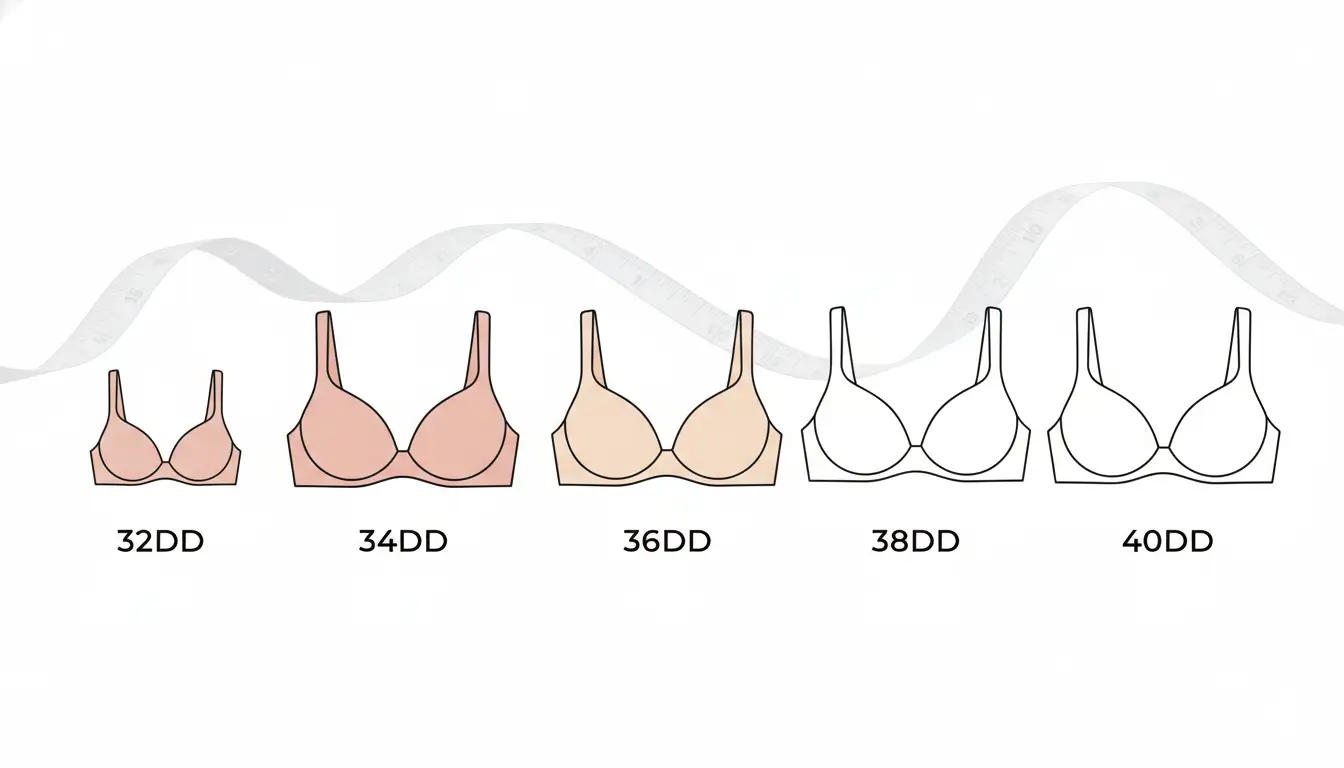
Here is what most women do not know: all DD bras share the same cup letter, but that does not make them the same size. The band number changes everything. A 32DD and a 40DD are completely different in terms of cup volume, fit, support, and even how they look on your body.
So if you have ever asked yourself any of these questions:
- Why does my DD bra feel too small even though it is the right cup size?
- Is a 38DD bigger than a 36DD?
- What does “DD equivalent” even mean?
- How do I know if I should go up a cup size or a band size?
Then you are in the right place.
In this guide, I am going to walk you through everything you need to know about the difference between 32DD, 34DD, 36DD, 38DD, and 40DD bra sizes. I will cover real measurements, sister sizes, body types, bra styles, fit tips, and answer every question you might have about DD sizing.
By the end of this guide, you will have a clear picture of which size works for your body and exactly why it works. And if you want to double-check your size or convert it to another sizing system, you can use our free International Bra Size Converter tool anytime.
Let us get started.
What Does DD Mean in Bra Sizing?
Before I compare these five sizes, let me quickly explain what a bra size actually means. I think this is important because a lot of women skip this part and end up confused later.
A bra size has two parts:
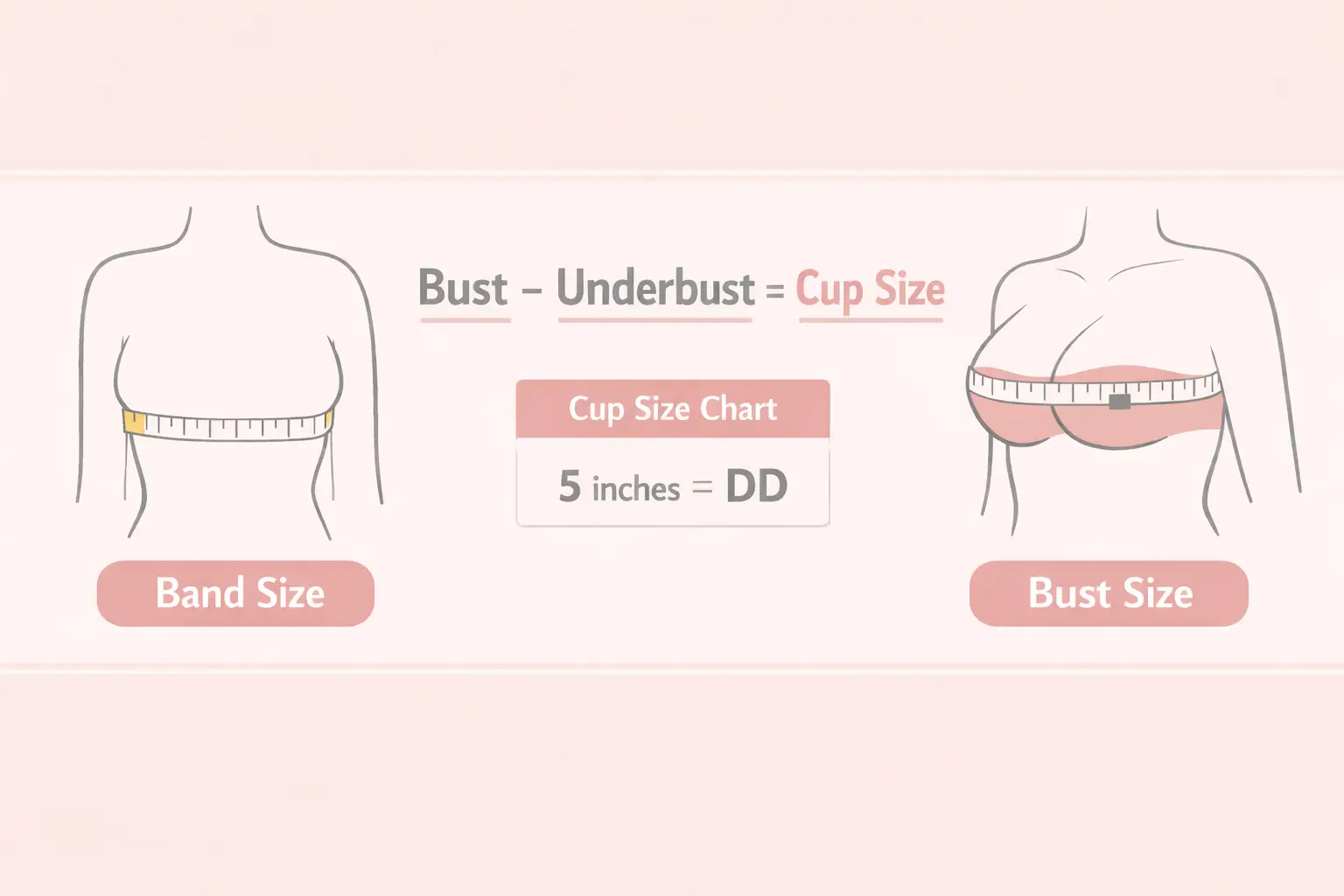
- The number is your band size. It represents the measurement around your ribcage, just under your bust. Common band sizes are 32, 34, 36, 38, and 40.
- The letter is your cup size. It represents the difference between your band measurement and your full bust measurement.
For a DD cup, that difference is 5 inches. So if your underbust measures 34 inches and your bust measures 39 inches, the difference is 5 inches, which makes you a 34DD.
Simple enough, right? But here is where it gets interesting.
Does DD Mean the Same Thing Across All Band Sizes?
No, it does not. And this is the most important thing I want you to take away from this section.
The letter “DD” tells you the difference between measurements, not the actual volume of the cup. As your band size increases, your cup volume increases too, even if the letter stays the same.
Think of it this way. A 32DD cup is built for a smaller ribcage. A 40DD cup is built for a much wider ribcage. The cup has to be physically larger to wrap around that bigger frame and still hold 5 inches of difference. So the actual amount of breast tissue a 40DD holds is much greater than what a 32DD holds.
This is why two women can both wear a “DD” and look completely different. It is not about the letter. It is about the full size together.
If you want to learn more about what bra sizes mean in general, I recommend reading our detailed guide on what do bra sizes mean and our bra cup sizes explained post. Both will give you a really solid foundation.
Are DD Breasts Considered Big?
This is a question I see asked a lot, and the honest answer is: it depends on your band size.
A 32DD on a petite frame can look very full and prominent. A 40DD on a broader frame may look more proportionate and balanced. The cup letter alone does not tell the whole story. Your band size and body frame play a huge role in how your bust looks and feels.
What I always say is this: do not focus on whether a size sounds “big” or “small.” Focus on whether it fits your body correctly. A well-fitted bra in any size will always look and feel better than the wrong size in any other.
The Core Difference Between 32DD, 34DD, 36DD, 38DD and 40DD Bra Sizes
Now let us get into the heart of this guide. I want to break down each size individually so you can clearly see how they differ from one another.
The primary difference between 32DD, 34DD, 36DD, 38DD, and 40DD is the band size, which is the circumference around the ribs. While all five sizes share a DD cup, the actual cup volume increases as the band size goes up. This means a 40DD has a larger cup and holds more breast tissue than a 32DD.
Measurements at a Glance
Here is a simple comparison table to show you exactly how these sizes differ in real measurements:
| Bra Size | Band (inches) | Bust (inches) |
|---|---|---|
| 32DD | 32 | 37 |
| 34DD | 34 | 39 |
| 36DD | 36 | 41 |
| 38DD | 38 | 43 |
| 40DD | 40 | 45 |
Cup Volume by Size:
- 32DD: Smallest DD volume
- 34DD: Moderate volume
- 36DD: Full bust volume
- 38DD: Fuller bust volume
- 40DD: Largest DD volume
As you can see, every time the band size goes up by 2 inches, the bust measurement also goes up by 2 inches. That is not a small change. It affects how the bra fits under your clothes, how much support you need, and how your bust looks overall.
Breaking Down Each Size
Let me walk you through each size one by one so you get a clear picture.
32DD Bra Size
A 32DD is designed for a smaller, narrower frame. The cups are relatively shallow compared to larger band sizes, and the breast volume it holds is the least among all five DD sizes we are comparing. If you have a petite or slim build with a smaller ribcage, this size is likely a great fit for you. The cups tend to sit closer together, which gives a more projected and rounded look.
34DD Bra Size
A 34DD is a step up in both band width and cup volume. The cups become slightly wider and deeper compared to a 32DD. This size works well for women with an athletic or hourglass figure. It strikes a nice balance between a snug band fit and enough cup space to feel comfortable all day long.
36DD Bra Size
At 36DD, the cup is now holding noticeably more volume. The band fits a medium to wider torso and provides good stability throughout the day. This size is very common among women with an average to fuller build. It is also a size many women move into after weight gain, pregnancy, or hormonal changes.
38DD Bra Size
A 38DD brings in even more cup volume and requires stronger structural support. Bras in this size typically feature wider bands, stronger side wings, and thicker straps to handle the extra weight. At this size, breast tissue tends to spread more across the chest rather than project forward. If you are finding that your 36DD band is digging in or your cups are overflowing, a 38DD might be the right next step.
40DD Bra Size
A 40DD is the broadest frame in our comparison. The cup volume is the highest among all five sizes, and bras at this level are usually built with reinforced design features like side boning, molded cups, and full coverage panels. Breast distribution at this size tends to be more horizontal than forward-projecting. Support at this level is not just about comfort. It is also about posture and long-term back health.
How Does Cup Volume Really Change?
I want to make this crystal clear because it is something a lot of women find surprising.
Even though all five sizes use the letter “DD,” they are not the same cup size in terms of actual volume. The cup volume grows with every band size increase. So a 40DD cup holds considerably more breast tissue than a 32DD cup, even though they share the same letter.
This is why you should never shop by cup letter alone. Always look at the full size together, band and cup as one unit. To make this easier, you can use our free International Bra Size Converter to check your size across different sizing systems in seconds.
Is 38DD a Large or XL?
A 38DD is generally considered a large (L) to extra-large (XL) size, depending on the brand and sizing system being used. The band size 38 falls into the plus-size or full-bust category for most lingerie brands, and the DD cup adds to that fuller fit classification.
But let me give you a more complete picture because “large” and “XL” mean different things depending on where you shop.
How Brands Typically Size 38DD
Most lingerie brands classify their bra sizes into general size categories like small, medium, large, and XL. Here is how a 38DD typically fits into those categories:
| Brand Type | How They Classify 38DD |
|---|---|
| US Lingerie Brands | Large to XL |
| UK Lingerie Brands | Large to XL |
| Specialty Full-Bust Brands | Standard full-bust size |
| General Clothing Brands | XL to XXL |
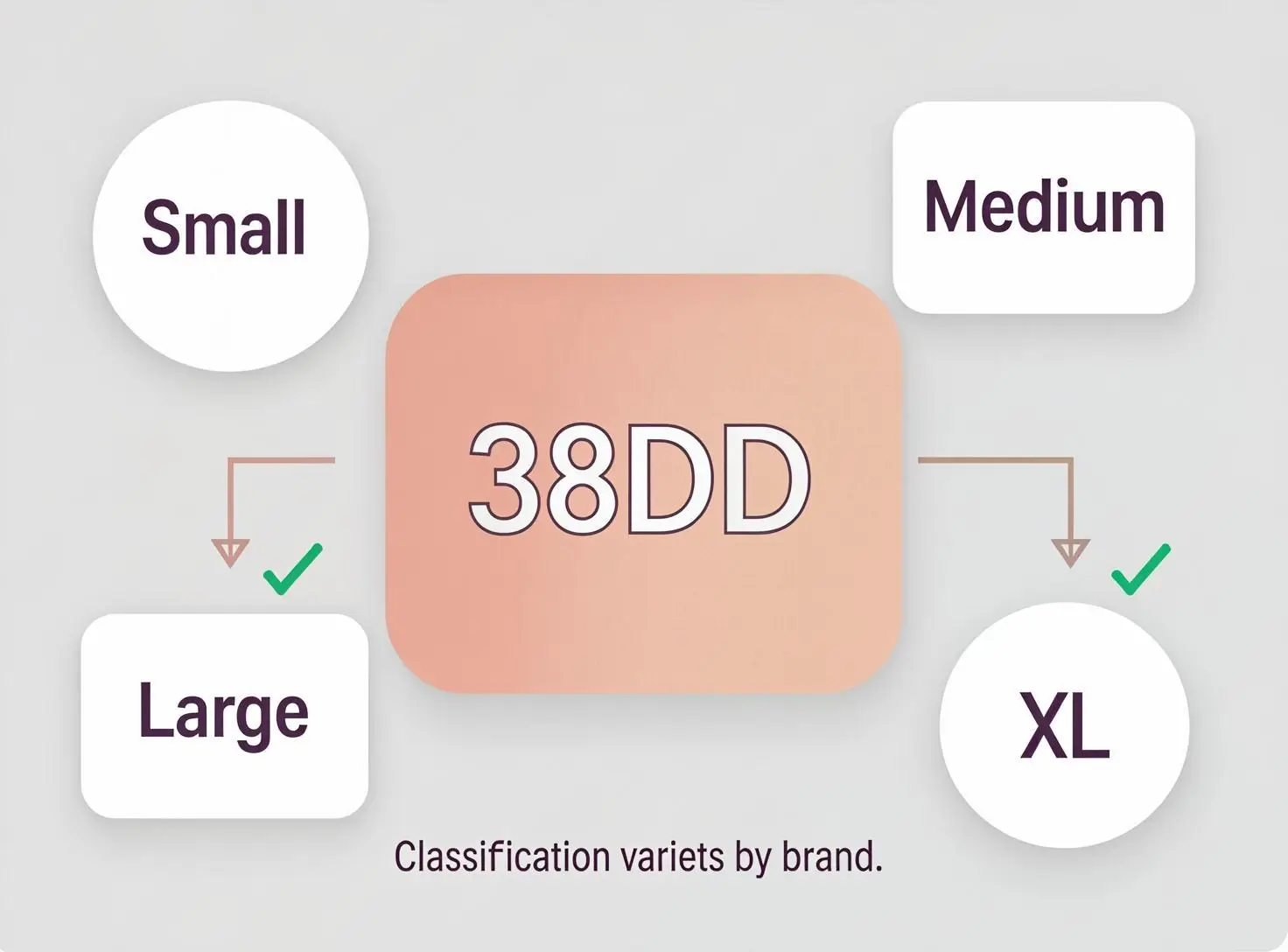
The reason there is a range here is that different brands use different sizing standards. A specialty full-bust brand like Panache or Freya will treat 38DD as a completely normal, standard size. A general clothing brand may label the same size as XL or even XXL.
Is 38DD Considered a Big Size?
Yes, a 38DD is considered a fuller bust size. The band size 38 indicates a wider ribcage, and the DD cup adds significant breast volume on top of that. Together, they create a size that requires more structural support, wider straps, and a more reinforced bra construction compared to smaller sizes.
However, I want to be clear about something. “Big” is a relative term. A 38DD on one woman’s body will look and feel completely different on another woman’s body. What matters most is not the label but how well the bra fits and supports you.
Are 38D Breasts Considered Big?
While we are on the topic, I also want to quickly address 38D because I see this question come up a lot alongside 38DD.
A 38D is one cup size smaller than a 38DD. The band size is the same at 38 inches, but the cup holds slightly less volume. A 38D has a 4-inch difference between the underbust and bust measurement, while a 38DD has a 5-inch difference. So yes, both are considered fuller bust sizes, but a 38DD is larger in cup volume than a 38D.
How Heavy Are 38D and 38DD Breasts?
Breast weight varies from woman to woman depending on tissue density, body composition, and other factors. However, as a general estimate, each breast in a 38DD size can weigh anywhere between 1.5 to 2.5 pounds or more. This is why proper support is so important at this size. A bra that does not fit correctly can lead to shoulder pain, back pain, and poor posture over time.
If you are unsure whether your current bra is giving you the support you need, I recommend checking your measurements with our free International Bra Size Converter to make sure you are wearing the right size.
Is a 34DD Bigger Than a 32DD?
Yes, a 34DD is bigger than a 32DD, but not in the way most people think. The cup letter is the same, DD, but the 34DD has a wider band and a larger cup volume than the 32DD. Let me break this down so it makes complete sense.
Band Size Difference
The most obvious difference is the band size. A 34DD has a 34-inch band, while a 32DD has a 32-inch band. That 2-inch difference means the 34DD is designed for a slightly wider ribcage. If you wear a 32DD and the band feels too tight or leaves red marks on your skin, moving up to a 34DD might give you the comfort you need.
Cup Volume Difference
Here is the part that surprises most women. Even though both sizes use the letter DD, the 34DD cup holds more volume than the 32DD cup. This is because the cup has to be physically wider and deeper to maintain that 5-inch bust-to-band difference on a larger frame.
So in simple terms:
- 32DD: Smaller band, smaller cup volume, designed for a narrower frame
- 34DD: Wider band, larger cup volume, designed for a slightly broader frame

How Common Is a 34DD Bra Size?
A 34DD is actually one of the more common bra sizes, especially in the United States and United Kingdom. It sits right in the middle of the DD size range we are discussing, and it is widely available in most lingerie stores and online retailers. If you wear a 34DD, you will generally have a good selection of styles, colors, and brands to choose from.
Is 34DD Considered a Plus Size?
This depends on the brand. Some brands consider any band size above 36 to be plus size, which means a 34DD would not fall into that category for most labels. However, some general clothing brands may treat DD cups as part of their fuller bust or plus-size range regardless of band size.
In the specialist lingerie world, a 34DD is simply a standard full-bust size. Brands like Freya, Panache, and Curvy Kate carry 34DD as a core size in their regular collections.
Why Does a 32DD Sometimes Look Bigger Than a 34DD?
This is something I find really fascinating about bra sizing. A 32DD can actually appear larger than a 34DD on the body, even though it holds less volume. The reason is proportions.
On a narrower frame, the breast tissue has less width to spread across, so it projects more forward and appears rounder and fuller. On a slightly wider frame like a 34DD, the same amount of tissue spreads a little more across the chest, which can make it look slightly less projected.
Other factors that affect how size looks on the body include breast shape, tissue density, posture, and muscle tone. So never judge a size by how it looks on someone else. Focus on what fits and feels right on your own body.
To understand how sister sizes connect 32DD and 34DD, keep reading. I cover the full sister size system in detail in an upcoming section of this guide. You can also check out our post on the difference between D and DD bras for more context on how cup sizes relate to each other.
Is 38DD Bigger Than 36DD?
Yes, a 38DD is bigger than a 36DD in terms of both band size and cup volume. The band is 2 inches wider, and the cup holds more breast tissue. But the real difference between these two sizes goes beyond just measurements. It is also about how much support each size needs and how the bra is constructed to deliver that support.
Measurement Comparison
| Feature | 36DD | 38DD |
|---|---|---|
| Band Size | 36 inches | 38 inches |
| Bust Size | 41 inches | 43 inches |
| Cup Volume | Full bust | Fuller bust |
Are 36DD and 38DD the Same?
No, they are not the same. While they are close in size and some women do switch between the two using sister sizing, they are distinct sizes with different band widths and cup volumes. A 36DD band is snugger and provides more lift through tension. A 38DD band is wider and distributes weight more evenly across the back.
If your 36DD band feels too tight and leaves marks on your skin, but your cups fit well, moving to a 38DD is worth trying. However, keep in mind that when you go up in band size, you may need to go down a cup size to maintain the same cup volume. This is where sister sizing comes in, and I will cover that in full detail in the sister sizes section coming up.
How Does Support Differ Between 36DD and 38DD?
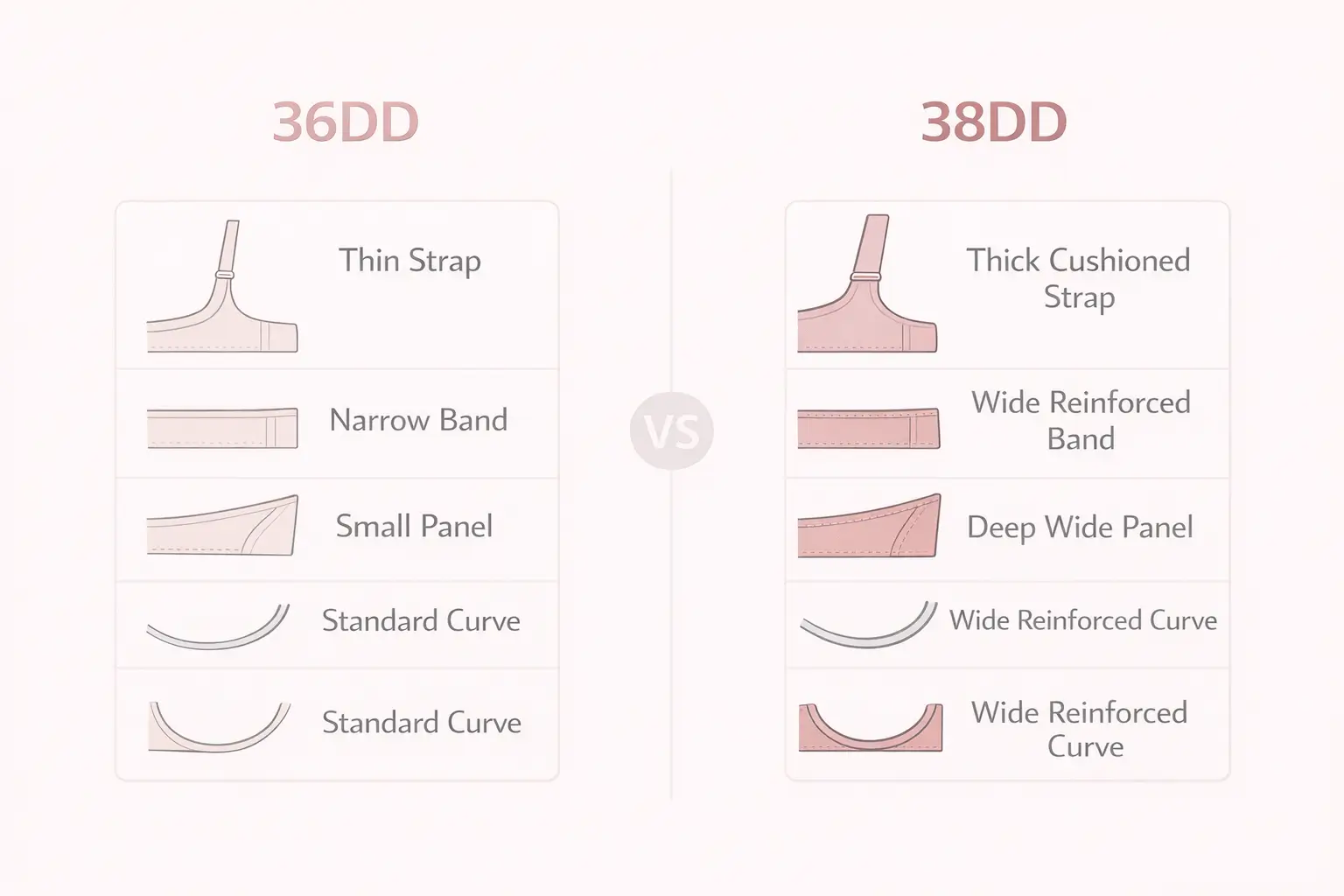
Support is where these two sizes really start to feel different on the body. Here is how the support changes as you move from 36DD to 38DD:
Straps: A 38DD bra typically comes with thicker, more cushioned straps to handle the extra weight and prevent digging into the shoulders.
Band: The 38DD band is wider and often reinforced with additional rows of hooks and eyes. This helps spread the load more evenly across your back.
Side Wings: The side panels on a 38DD are deeper and wider, which helps contain the breast tissue from the sides and prevents spillage.
Underwire: The underwire on a 38DD is wider and more curved to properly encase the breast tissue without poking or digging.
Cup Construction: The cups on a 38DD are often seamed or structured to provide shape and lift that a lighter-weight bra would not need to engineer as carefully.
If you are currently wearing a 36DD and experiencing any of these issues, such as straps digging in, back pain, or side spillage, your body might be telling you it is time to try a 38DD.
What Breast Size Is Considered Big?
Since we are comparing these two fuller sizes, I want to address this question directly. There is no universal definition of what counts as “big” when it comes to breast size. However, in the lingerie industry, sizes from DD and above are generally considered to be in the full-bust category. Both 36DD and 38DD fall into this category.
What matters more than the label is how your bra fits and functions. A well-fitted 36DD can provide just as much comfort and support as a well-fitted 38DD. The right size is always the one that works best for your unique body. For more on understanding cup sizes in detail, take a look at our guide on bra cup sizes explained.
How Big Is My Bust If I Wear a 32DD?
If you wear a 32DD, your bust measurement is approximately 37 inches. This is calculated by taking your band size of 32 inches and adding the 5-inch DD cup difference. So 32 plus 5 equals 37 inches around the fullest part of your bust.
But let me walk you through how to measure yourself properly at home, because getting an accurate measurement is the foundation of finding your perfect bra size.
How to Measure Your Bust Size at Home
You only need a soft measuring tape and a few minutes to do this. Here is what I recommend:
Step 1: Measure Your Underbust (Band Size)
Wrap the measuring tape snugly around your ribcage, just under your bust. Make sure the tape is level all the way around and parallel to the floor. Round to the nearest even number. That number is your band size.
Step 2: Measure Your Bust (Cup Size)
Wrap the measuring tape loosely around the fullest part of your bust. Keep the tape parallel to the floor and do not pull it too tight. Write down that number.
Step 3: Calculate Your Cup Size
Subtract your band measurement from your bust measurement. The difference tells you your cup size:
| Difference | Cup Size |
|---|---|
| 1 inch | A |
| 2 inches | B |
| 3 inches | C |
| 4 inches | D |
| 5 inches | DD |
| 6 inches | DDD or E |
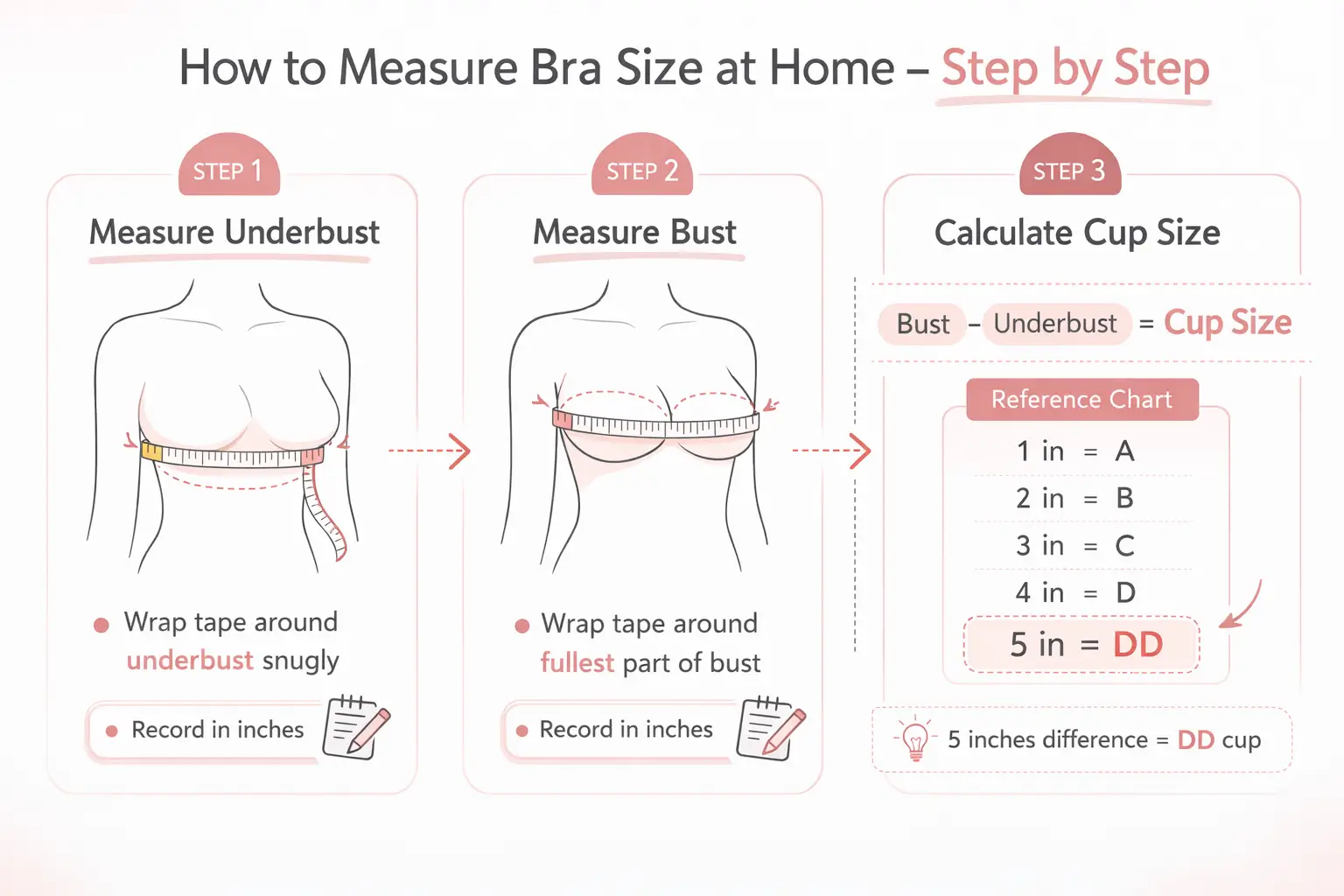
So if your underbust is 32 inches and your bust is 37 inches, the difference is 5 inches, which gives you a 32DD.
Bust Measurements for Each DD Size
Here is a quick reference so you can see your approximate bust measurement for each DD size in our comparison:
| Bra Size | Bust Measurement |
|---|---|
| 32DD | 37 inches |
| 34DD | 39 inches |
| 36DD | 41 inches |
| 38DD | 43 inches |
| 40DD | 45 inches |
What Is My Bust Size If I Wear a 36DD?
If you wear a 36DD, your bust measurement is approximately 41 inches. The same formula applies. Your band size of 36 inches plus the 5-inch DD cup difference gives you a bust measurement of 41 inches.
Does Weight Affect Bra Size?
Yes, weight can absolutely affect your bra size, and this is something I think every woman should know. When your body weight changes, your ribcage measurement and bust measurement can both change too. This means your band size and cup size can shift even if you feel like your body has not changed dramatically.
Here are some common situations where your bra size might change due to weight:
- Weight gain: Your band size may increase as your ribcage expands, and your cup size may go up as your bust grows.
- Weight loss: Your band size may decrease, and your cup size may go down or stay the same depending on where your body loses weight first.
- Pregnancy and postpartum: Your bust can change significantly during and after pregnancy, sometimes by several cup sizes.
- Hormonal changes: Your menstrual cycle, menopause, and certain medications can cause temporary or permanent changes in breast size.
- Muscle gain: Building muscle in your chest and back area can affect your underbust measurement and change your band size.
This is why I always recommend measuring yourself every six months or any time you feel like your bra is not fitting the way it used to. You can also use our free International Bra Size Converter to quickly check your size and convert it to other sizing systems if you shop from international brands.
For a deeper understanding of how bra sizes work and what the numbers and letters mean together, check out our full guide on what do bra sizes mean.
What Size Is 36DD Equivalent To? (Full Sister Sizes Guide)
A 36DD is equivalent to a 34DDD (or 34E) in a smaller band, or a 38D in a larger band. These are called sister sizes, and understanding them is one of the most useful bra fitting skills you can have.
What Are Sister Sizes?
Sister sizes are bra sizes that share the same cup volume but have different band sizes. When you go up one band size, you go down one cup size to keep the same volume. When you go down one band size, you go up one cup size.
Here is a simple way to think about it. Imagine you are pouring water into different shaped containers. The amount of water stays the same, but the shape of the container changes. Sister sizes work the same way. The cup volume stays roughly the same, but the band width and cup shape change to fit a different frame.
Why Is Sister Sizing Important?
Sister sizing is important for several reasons:
- Sometimes your exact size is out of stock and you need an alternative that still fits well
- You may find that a sister size feels more comfortable even if your measurements suggest a different size
- Shopping from international brands often requires knowing your sister sizes because sizing systems vary by country
- Understanding sister sizes helps you make smarter decisions when trying on bras without a fitting room
Full Sister Size Chart for All Five DD Sizes
Here is a complete sister size table for every size we are covering in this guide:
32DD Sister Sizes:
| Go Down a Band | Your Size | Go Up a Band |
|---|---|---|
| 30DDD (30E) | 32DD | 34D |
34DD Sister Sizes:
| Go Down a Band | Your Size | Go Up a Band |
|---|---|---|
| 32DDD (32E) | 34DD | 36D |
36DD Sister Sizes:
| Go Down a Band | Your Size | Go Up a Band |
|---|---|---|
| 34DDD (34E) | 36DD | 38D |
38DD Sister Sizes:
| Go Down a Band | Your Size | Go Up a Band |
|---|---|---|
| 36DDD (36E) | 38DD | 40D |
40DD Sister Sizes:
| Go Down a Band | Your Size | Go Up a Band |
|---|---|---|
| 38DDD (38E) | 40DD | 42D |
Is a 32DD the Same as a 36C?
This is a question I see asked a lot, and the answer is yes, in terms of cup volume, a 32DD and a 36C hold approximately the same amount of breast tissue. They are sister sizes two steps apart. However, the band fit is completely different. A 32DD has a much snugger band than a 36C. So while the cup volume is similar, the overall fit and feel on your body will be very different.
If you have a smaller ribcage, the 32DD will give you better support because the band is doing more of the work. If you have a wider ribcage, the 36C will fit your frame better.
Is 34DD the Same as 36D?
Yes, a 34DD and a 36D are sister sizes. They hold approximately the same cup volume. The difference is that the 34DD has a snugger band and the 36D has a looser band. If your 34DD band feels too tight but your cups fit perfectly, try a 36D. You will get a similar cup fit with a more comfortable band.
Is a DD Cup Size Bigger Than an E Cup?
This is a great question and one that confuses a lot of women, especially when shopping across different countries. In the US sizing system, DD and E are essentially the same cup size. Many American brands use DD while many UK and European brands use E for the same cup measurement.
So if you are shopping from a UK brand and you normally wear a US DD, you would look for an E cup in UK sizing. The cup volume is the same. Only the letter differs.
For a full breakdown of how US and UK sizing compares, our guide on the difference between US and UK bra sizing covers everything you need to know. And if you shop from European or Australian brands, our International Bra Size Converter tool will convert your size instantly.
Is DDD Larger Than DD?
Yes, DDD is larger than DD. A DDD cup has a 6-inch difference between the band measurement and the bust measurement, while a DD cup has a 5-inch difference. That makes DDD one full cup size larger than DD.
However, this is where things get a little confusing depending on which country you are shopping in. Let me break it down clearly.
DD vs DDD: What Is the Actual Difference?
Here is a simple comparison of DD and DDD cup sizes:
| Cup Size | Bust to Band Difference |
|---|---|
| D | 4 inches |
| DD | 5 inches |
| DDD | 6 inches |
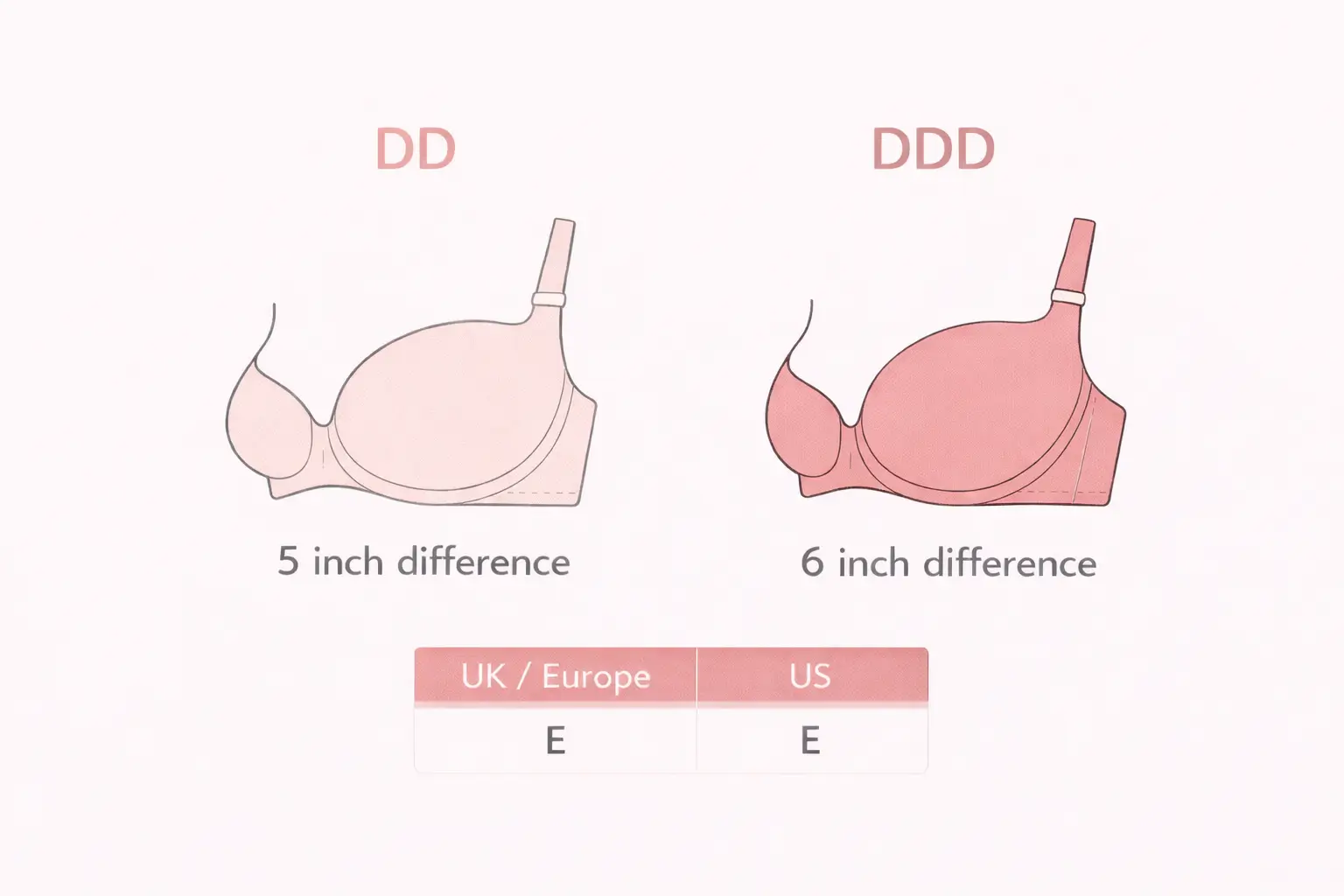
So if you currently wear a 36DD and you find that your cups are overflowing or you have breast tissue spilling over the top or sides, it might be time to try a 36DDD.
Is DDD the Same as E?
Yes, in most cases DDD and E refer to the same cup size. Here is how it breaks down by country:
| Sizing System | Cup After DD |
|---|---|
| US | DDD |
| UK | E |
| Europe | E |
| Australia | E |
So if you wear a US 36DDD and you are shopping from a UK brand, you would look for a 36E. The cup volume is identical. Only the letter is different.
This is one of the most common points of confusion I see among women who shop internationally. Our International Bra Size Converter tool makes this conversion simple and instant, so you never have to guess when shopping from a foreign brand.
What Is the Rarest Bra Size?
Since we are talking about sizes beyond DD, I want to address this question here. The rarest bra sizes tend to be those at the extreme ends of the sizing spectrum. Very small band sizes with large cups, such as 28G or 28H, and very large band sizes with small cups, such as 48A or 50B, are considered rare because they are less common in the general population and harder to find in stores.
Most mainstream lingerie brands focus their production on the most commonly sold sizes, which tend to fall in the 32 to 38 band range with A to DD cups. Sizes outside of this range are often only available from specialist full-bust or petite-bust brands.
What Is the Rarest Breast Size?
Similarly, the rarest breast sizes in terms of natural occurrence tend to be very large cup sizes such as H, I, J, and beyond, as well as very small cup sizes like AA. These sizes exist and are completely normal, but they are statistically less common. Women with these sizes often need to shop from specialist brands to find bras that fit correctly.
If you fall outside of standard sizing ranges, I highly recommend using our International Bra Size Converter to find your equivalent size across different brands and sizing systems. It can save you a lot of time and frustration when shopping. You can also read our detailed post on what is a D cup bra size and double D breast size to understand more about how these cup sizes compare to each other.
Does Weight Affect Bra Size?
Yes, weight absolutely affects your bra size, and I think this is one of the most important things every woman should understand about her body. Your bra size is not a fixed number that stays the same forever. It can and does change throughout your life, and weight is one of the biggest reasons why.
How Weight Gain Affects Your Bra Size
When you gain weight, your body stores fat in different areas depending on your genetics and hormones. For many women, the breasts and ribcage are among the first places where weight gain shows up. Here is what typically happens:
- Your underbust measurement increases, which means your band size goes up
- Your bust measurement increases, which can push your cup size up by one or more letters
- The combination of both changes means your overall bra size can shift significantly even with moderate weight gain
For example, a woman who wears a 34DD might find that after gaining weight she needs a 36DD or even a 36DDD to get the same comfortable fit.
How Weight Loss Affects Your Bra Size
Weight loss works in the opposite direction. As your body loses fat, your ribcage and bust measurements can both decrease. Here is what to watch for:
- Your band may feel loose and ride up at the back
- Your cups may feel gappy or wrinkled at the top
- Your straps may slip off your shoulders more easily
These are all signs that your bra size has changed and it is time to remeasure yourself.
Other Factors That Change Your Bra Size
Weight is not the only thing that affects your bra size. Here are other common reasons your size might change:
| Factor | How It Affects Your Size |
|---|---|
| Pregnancy | Band and cup size both increase, sometimes dramatically |
| Postpartum | Size fluctuates as hormones settle and breastfeeding begins or ends |
| Menstrual cycle | Temporary swelling can make your bra feel tighter around your period |
| Menopause | Hormonal shifts can change breast tissue density and size |
| Medication | Certain medications like birth control can increase breast size |
| Muscle gain | Building chest and back muscle can increase your underbust measurement |
| Aging | Loss of skin elasticity can change the shape and projection of your bust |
How Often Should You Measure Your Bra Size?
I recommend measuring yourself at least every six months. If you have gone through any of the changes listed above, measure yourself sooner. It is a simple process that takes just a few minutes and can make a huge difference in your daily comfort.
You can use our free International Bra Size Converter to measure and convert your size quickly. If you want to understand more about what your measurements mean and how they translate into a bra size, our guide on what do bra sizes mean is a great place to start.
Is It Better to Go Up a Cup Size or Band Size?
This is one of the most common fitting questions I hear, and the answer depends on what fitting problem you are trying to solve. Going up a cup size and going up a band size fix two very different issues. Understanding the difference will save you a lot of time and frustration when shopping.
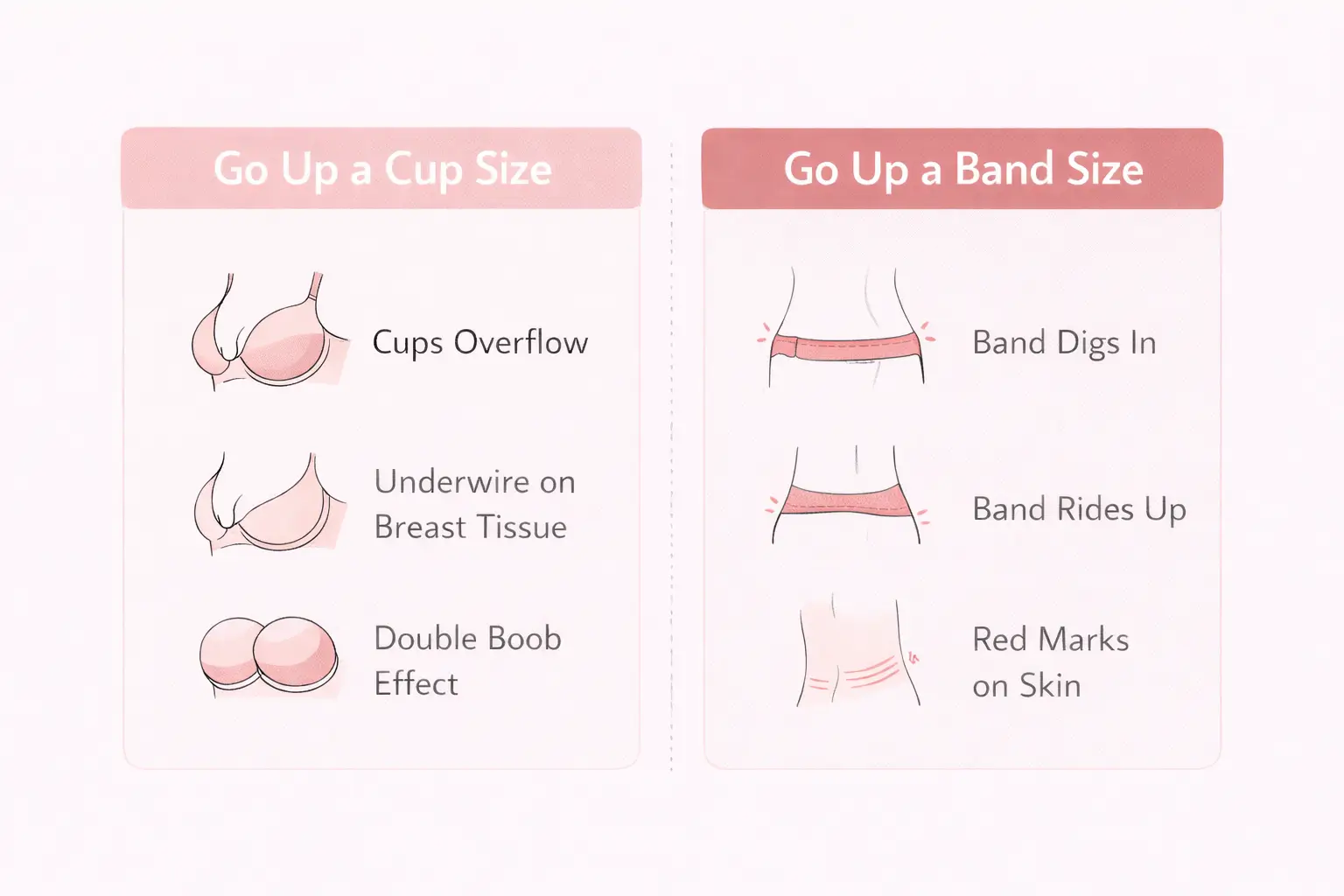
When Should You Go Up a Cup Size?
You should go up a cup size when your cups are too small for your breast tissue. Here are the signs that your cups are too small:
- Your breasts spill over the top or sides of the cups
- The underwire sits on your breast tissue instead of your ribcage
- You see a “double bubble” or “double boob” effect where the cup cuts into your breast
- The center gore of the bra does not lie flat against your sternum
- Your cups feel tight or uncomfortable across the bust
If you are experiencing any of these issues, try going up one cup size while keeping your band size the same. So if you wear a 36DD, try a 36DDD next.
When Should You Go Up a Band Size?
You should go up a band size when your band is too tight for your ribcage. Here are the signs that your band is too small:
- The band digs into your skin and leaves red marks
- You can not fit two fingers comfortably under the band at the back
- The band rides up at the back instead of sitting level
- You feel restricted or uncomfortable around your ribcage when breathing
- The bra feels tight even on the loosest hook
If you are experiencing any of these issues, try going up one band size while going down one cup size to maintain the same cup volume. So if you wear a 36DD, try a 38D instead. This is sister sizing in action.
Is It Better for a Bra to Be Tight or Loose?
Neither extreme is good, and I want to be clear about this. A bra that is too tight will cause discomfort, pain, and even skin irritation. A bra that is too loose will not provide the support your body needs and can lead to poor posture and back pain over time.
Here is what a correctly fitted bra should feel like:
| Bra Part | How It Should Feel |
|---|---|
| Band | Snug but not tight. You should fit two fingers under it comfortably |
| Cups | Smooth with no spillage, gaping, or wrinkling |
| Straps | Secure but not digging in. You should fit one finger under each strap |
| Underwire | Flat against your ribcage and not sitting on any breast tissue |
| Center Gore | Lying flat against your sternum between the cups |
A good rule of thumb I always share is this. Your band should do about 80 percent of the support work, and your straps should do the remaining 20 percent. If your straps are doing most of the work, your band is probably too loose.
How Do You Know If You Need a Bigger Cup or a Bigger Band?
Here is a quick reference guide to help you decide:
| Problem You Are Having | What to Try |
|---|---|
| Cups overflow or spill | Go up one cup size |
| Band digs in or leaves marks | Go up one band size, down one cup size |
| Straps dig into shoulders | Go up one cup size or adjust strap length |
| Cups wrinkle or gape | Go down one cup size |
| Band rides up at the back | Go down one band size, up one cup size |
| Underwire pokes or digs | Try a wider underwire style or go up one cup size |
If you are still unsure after trying these adjustments, I recommend using our free International Bra Size Converter to double check your measurements and find the right starting point. You can also read our guide on the difference between D and DD bras to understand how cup sizes progress and what to expect when you move between them.
Best Bra Styles for Each DD Size
Finding the right bra size is only half the battle. The other half is finding the right bra style for your size, your body shape, and your lifestyle. I want to walk you through the best bra styles for each DD size so you can shop with confidence and get the most out of every bra you buy.
32DD: Best Bra Styles
A 32DD sits on a smaller, narrower frame with a projected bust. The best styles for this size focus on shape, lift, and definition without overwhelming a petite frame.
- Plunge Bra: Works beautifully with deep necklines and accentuates the natural projection of the bust on a narrow frame.
- Balconette Bra: Lifts and shapes the bust with a flattering wide-set neckline that suits most clothing styles.
- T-Shirt Bra: A smooth, seamless option that works well under fitted tops and dresses without any visible lines.
- Bralette with Support: A wire-free option for casual days. Look for structured bralettes with inner support panels rather than basic stretch styles.
34DD: Best Bra Styles
A 34DD works well with styles that balance lift and comfort. This size has a little more volume than a 32DD so it benefits from slightly more structured options.
- Full Cup Bra: Provides full coverage and excellent support, perfect for everyday wear and longer days.
- Underwired T-Shirt Bra: Combines the smooth finish of a T-shirt bra with the structure of an underwire for reliable support.
- Push-Up Bra: Enhances cleavage and works well for special occasions or lower necklines.
- Sports Bra with Encapsulation: For active women, an encapsulation sports bra that supports each breast individually works much better than a basic compression style.
36DD: Best Bra Styles
A 36DD needs styles that combine good coverage with reliable support. At this size, the bra has to work harder to keep everything comfortable and in place throughout the day.
- Underwired Full Cup Bra: My top recommendation for everyday wear at this size. It provides full coverage, strong underwire support, and a smooth silhouette.
- Minimizer Bra: A great option if you want to create a more streamlined look under tailored or fitted clothing.
- Soft Cup Nursing Bra: For new mothers at this size, a well-structured nursing bra with an underwire option offers good support during breastfeeding.
- Side Support Bra: Designed to bring breast tissue forward and inward for a lifted, centered look. Excellent for 36DD frames.
38DD: Best Bra Styles
At 38DD, support becomes the top priority. The bust carries more weight and the bra needs to be engineered to handle that load comfortably across the band, straps, and cups.
- Full Coverage Underwired Bra: This is the gold standard for 38DD. Look for styles with wide side wings, reinforced underwire, and cushioned straps.
- Minimizer Bra: Helps reduce the visual projection of the bust and makes it easier to wear fitted tops and button-down shirts.
- High Impact Sports Bra: For workouts, choose a high impact sports bra specifically designed for DD plus sizes. Brands like Panache Sport and Shock Absorber are excellent options.
- Longline Bra: Provides extra band coverage and distributes weight more evenly across the torso, which can be great for back support.
40DD: Best Bra Styles
A 40DD needs the most structural support of all five sizes we are comparing. Comfort, coverage, and durability are the key things to look for at this size.
- Full Coverage Banded Bra: Look for styles with a wide, reinforced band, multiple hook and eye closures, and deep side panels for maximum support and containment.
- Minimizer Bra: Even more useful at this size. A good minimizer can make a significant difference in how clothes fit and how comfortable you feel throughout the day.
- Front Closure Bra: A practical option that is easy to put on and off while still providing good support at this size.
- Posture Bra: Designed to pull the shoulders back gently and redistribute breast weight away from the lower back. A great option for women who experience back or shoulder pain.
Quick Style Reference Table
Here is a summary of the best bra styles for each size at a glance:
| Bra Size | Top Recommended Styles |
|---|---|
| 32DD | Plunge, Balconette, T-Shirt, Supportive Bralette |
| 34DD | Full Cup, Underwired T-Shirt, Push-Up, Encapsulation Sports |
| 36DD | Underwired Full Cup, Minimizer, Side Support |
| 38DD | Full Coverage Underwired, Minimizer, High Impact Sports, Longline |
| 40DD | Full Coverage Banded, Minimizer, Front Closure, Posture Bra |
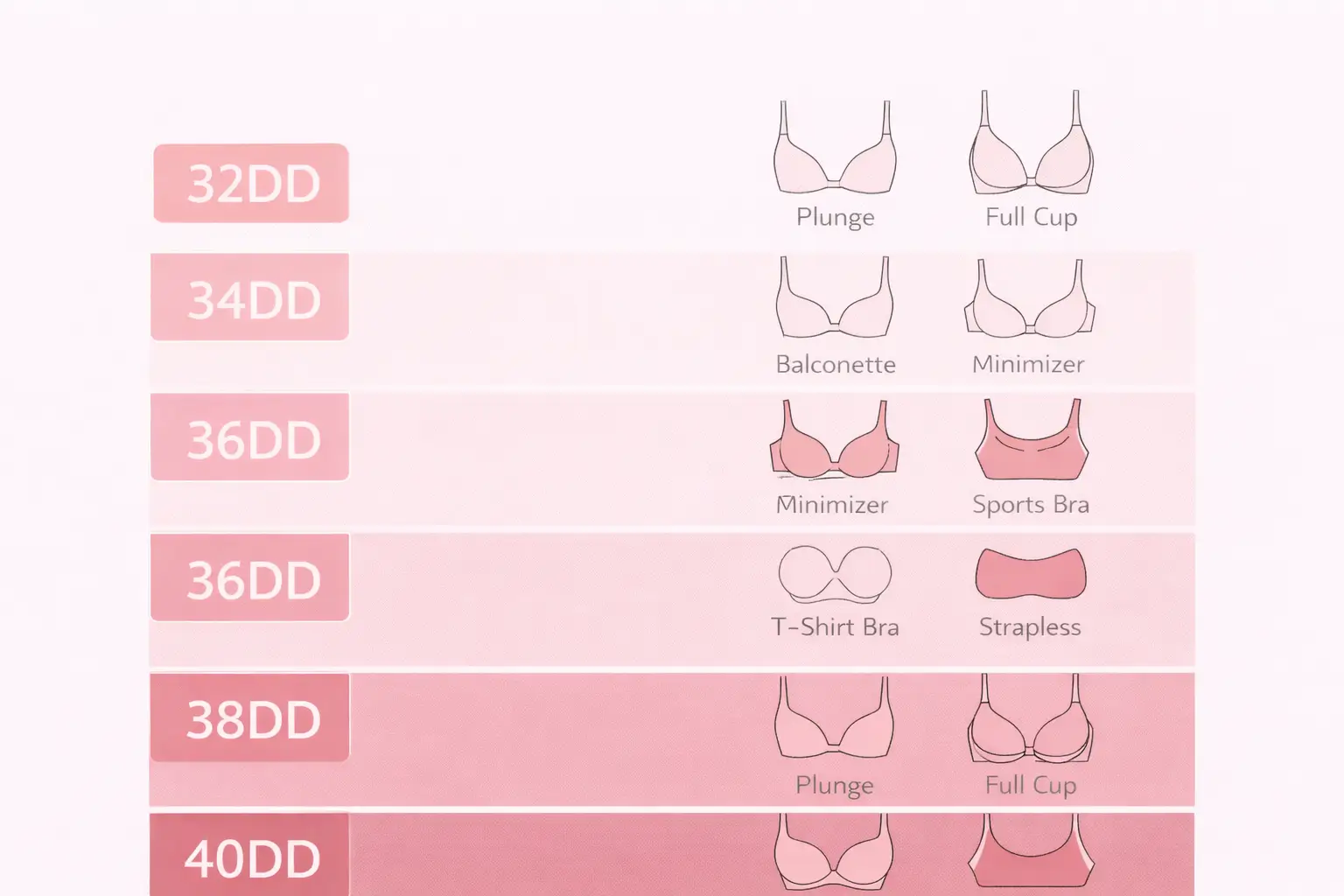
Choosing the right style makes just as much difference as choosing the right size. A well-chosen style in your correct size will feel comfortable, look great under your clothes, and give you the support your body deserves all day long.
Frequently Asked Questions About DD Bra Sizes
Here I have gathered the most commonly asked questions about DD bra sizes and answered each one clearly and directly. If you had a question that was not covered in the sections above, you will most likely find the answer here.
A 38DD is generally classified as a large to extra-large size depending on the brand. In specialist lingerie brands, it is treated as a standard full-bust size. In general clothing or department stores, it may be labeled as XL or XXL. Always check the specific brand’s size chart before buying.
DD breasts are considered full bust in the lingerie industry. However, how big they look depends entirely on your band size and body frame. A 32DD on a petite frame will look very different from a 40DD on a broader frame, even though both are technically DD.
A 42DD has a band size of 42 inches and a bust measurement of approximately 47 inches. This is a larger full-bust size that requires strong structural support, wide bands, reinforced underwire, and deep cups. It sits above the range we covered in this guide but follows the same sizing principles.
Yes, 38D is considered a full-bust size. The band size of 38 indicates a wider ribcage, and the D cup adds significant volume. A 38D is one cup size smaller than a 38DD, with a 4-inch bust-to-band difference compared to 5 inches for DD.
The weight of DD breasts varies depending on the band size and individual body composition. As a general estimate, each breast in a DD size can weigh between 1 and 2.5 pounds. At larger band sizes like 38DD or 40DD, each breast can weigh even more. This is why proper bra support is so important for long-term comfort and posture.
A 34DD is one of the more commonly sold bra sizes in the United States and United Kingdom. It is widely available in most lingerie stores, department stores, and online retailers. Women in this size generally have a good selection of styles and brands to choose from.
Most specialist lingerie brands do not consider 34DD a plus size. Plus sizing in bras typically begins at band size 38 or above for most brands. However, some general retailers may categorize DD cups as part of a fuller bust or plus size range regardless of band size. Always refer to the specific brand’s size guide for clarity.
In the lingerie industry, any cup size from DD and above is generally considered full bust. However, “big” is a relative term that depends on your body frame, band size, and personal perspective. What looks large on a smaller frame may look completely proportionate on a broader frame.
In terms of cup volume, yes. A 32DD and a 36C are sister sizes and hold approximately the same amount of breast tissue. However, the band fit is completely different. A 32DD has a much snugger band than a 36C. The right choice depends on your actual ribcage measurement.
Yes, a 34DD and a 36D are sister sizes with approximately the same cup volume. The 34DD has a snugger band and the 36D has a slightly looser band. If your 34DD cups fit well but the band feels too tight, trying a 36D is a smart next step.
The rarest bra sizes tend to be those at the extreme ends of the spectrum, such as very small band sizes with large cups like 28G or 28H, and very large band sizes with small cups like 48A or 50B. These sizes are less common in the general population and harder to find in mainstream stores.
A 36-inch chest measurement on a female is considered average to slightly above average. It falls within the standard sizing range for most lingerie and clothing brands. Whether it feels or looks big depends largely on your height, body frame, and proportions.
In US sizing, DD and E are essentially the same cup size. Many American brands use DD while UK and European brands use E for the same cup measurement. So if you are shopping from a UK brand and you normally wear a US DD, look for an E cup. The volume is the same.
No, they are not the same. A 36DD has a narrower band and smaller cup volume than a 38DD. They are close in size and some women use them as sister sizes, but they are distinct fits. If your 36DD band is too tight, moving to a 38D rather than a 38DD may give you a better overall fit.
Neither. A correctly fitted bra should feel snug but comfortable. The band should sit level around your body, the cups should contain all breast tissue without spillage or gaping, and the straps should sit securely without digging in. Your band does about 80 percent of the support work, so getting the band size right is the most important step.
Sister sizing is important because it gives you fitting flexibility. If your exact size is out of stock, a sister size can give you a similar cup volume in a different band width. It also helps when shopping from international brands that use different sizing systems. Understanding sister sizes means you are never stuck without options.
If your cups overflow or your underwire sits on breast tissue, go up a cup size. If your band digs in or leaves marks, go up a band size and down a cup size to maintain the same volume. For a full breakdown of this topic, revisit the fitting section earlier in this guide.
Conclusion
I hope this guide has given you a clear and complete picture of the difference between 32DD, 34DD, 36DD, 38DD, and 40DD bra sizes. The most important thing I want you to take away from everything we covered is this: the DD label alone does not define your size. Your band size and cup size work together as one unit, and both matter equally when it comes to fit, comfort, and support.
Here is a quick recap of everything we covered:
- A 32DD and a 40DD are very different sizes despite sharing the same cup letter
- Cup volume increases as band size increases, even when the cup letter stays the same
- Sister sizes give you flexibility when shopping and help you find the best fit
- Your bra size can change due to weight, hormones, pregnancy, and age
- The right bra style for your size is just as important as the size itself
- A well-fitted bra should feel snug but never tight, and your band should do 80 percent of the support work
Finding your perfect bra size does not have to be complicated. All it takes is knowing your measurements and understanding how the sizing system works. And I am here to make that as easy as possible for you.
Ready to Find Your Perfect Size?
If you want to make sure you are wearing the right size, or if you need to convert your size for shopping from international brands, I invite you to try our free International Bra Size Converter tool. It is completely free, easy to use, and gives you accurate size conversions across US, UK, European, Australian, and other sizing systems in seconds.
You deserve a bra that fits perfectly. Let us help you find it.
Keep Learning
If you found this guide helpful, here are some more resources from My Bra Size Converter that I think you will love:
- What Do Bra Sizes Mean – A complete beginner friendly guide to understanding bra sizing
- Bra Cup Sizes Explained – Everything you need to know about cup sizes from A to G and beyond
- The Difference Between D and DD Bras – A detailed comparison of D and DD cup sizes
- What Is a D Cup Bra Size – A full guide to the D cup size
- Double D Breast Size – Everything explained about DD breast size
- What Does C Mean in Bra Size – A clear guide to the C cup size
- Difference Between US and UK Bra Sizing – Shop confidently from any brand in the world