

I’ll never forget the first time I tried to order a bra from a French online boutique. I saw a gorgeous 85C and thought, “Perfect, I’m a 38C in UK sizes, close enough.” Wrong. So wrong. When that package arrived and I opened it, the bra was comically huge. The band wrapped around me twice, and the cups gaped so badly I could have stored a watermelon in each one. That’s when I learned the hard way that European bra sizes and UK bra sizes are definitely not the same thing, and a simple number swap won’t cut it.
If you’ve ever found yourself staring at a European bra tag wondering what on earth a ’75D’ translates to in UK sizing, you’re in the right place. The confusion is totally normal. The sizing systems across the continent and the British Isles operate on completely different logic—centimeters versus inches, different cup progressions, and unique alphabetic sequences. It’s enough to make anyone want to give up and stick to t-shirt bras forever. But the good news? Once you understand the basic differences between these two sizing systems, converting between them becomes straightforward. Even better news? There are tools that do the math for you instantly, like our bra size converter.
Whether you are shopping for lingerie on a trip to Paris, ordering from a German retailer online, or just trying to decipher a label in a department store, getting the fit right is essential for comfort and health. Wearing the wrong size leads to digging in straps, back pain, and that dreaded “quad boob” spillage. Let’s dive into the nitty-gritty of how to translate your measurements accurately so you can shop with confidence.
Understanding the Fundamental Differences
To really get the hang of converting European to UK bra sizes, you have to understand why they are different in the first place. It all comes down to the units of measurement. Here in the UK, we hold onto the imperial system for lingerie, meaning we measure in inches. Most of continental Europe uses the metric system, meaning they measure in centimeters. It sounds simple enough, but when you translate inches to centimeters, the rounding differences create completely different numbering systems for the band.
Here’s the deal. In the UK, your band size is determined by your underbust measurement in inches. If you measure 34 inches around your ribcage, you are likely a 34 band. It’s a direct correlation. In the European system, however, your band size is your underbust measurement in centimeters, but they round it to the nearest multiple of 5. So if you measure 89 cm, you round down to an 85. If you measure 92 cm, you round up to a 95.
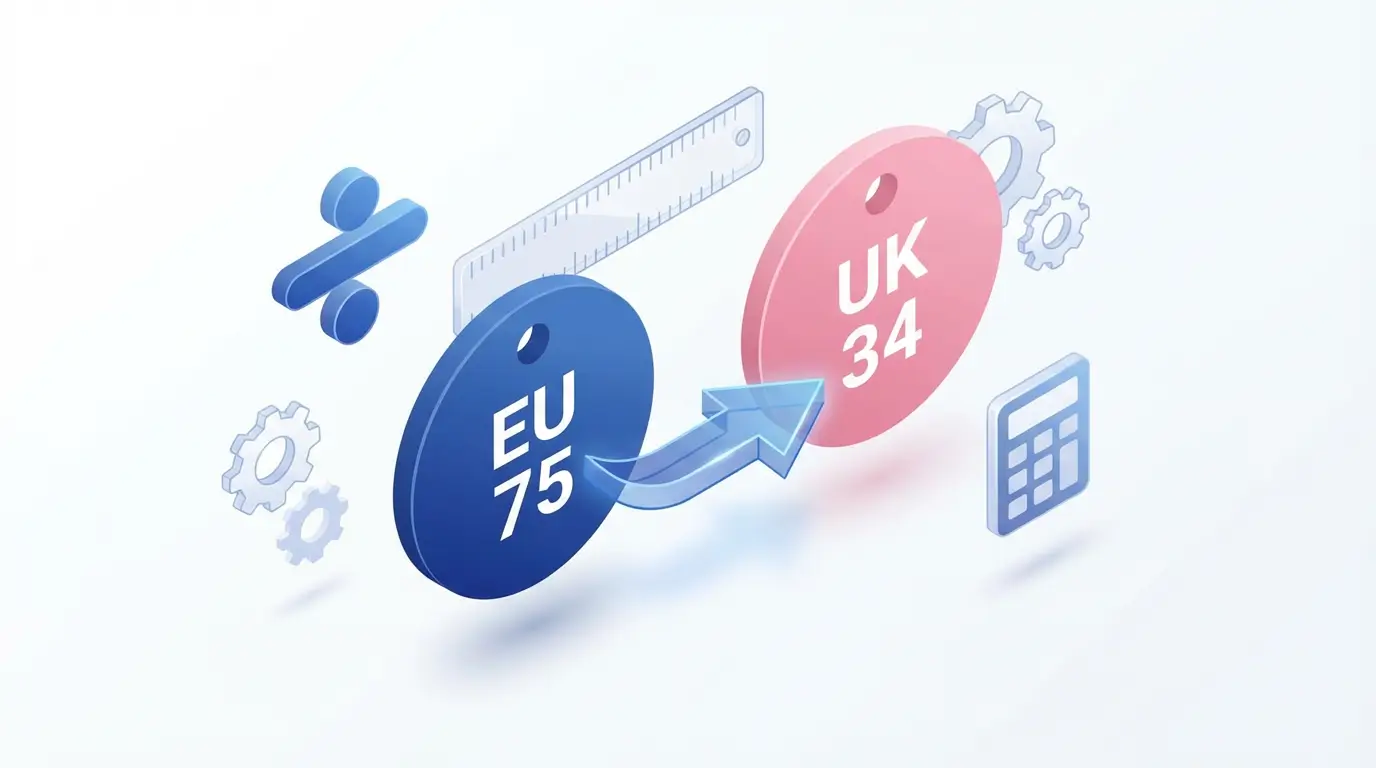
Because 2.54 cm equals one inch, the European band sizes progress in steps that are roughly equivalent to 2 inches, but because they work in 5 cm increments (which is roughly 1.97 inches), there is a tiny, tiny difference. For most of us, that tiny difference doesn’t matter much, but it explains why the numbers look so different. A European 75 is roughly a UK 34. A European 80 is roughly a UK 36.
When I first moved from Paris to London, I spent weeks wearing bras that just didn’t feel right because I was ignoring this distinction. I was treating the numbers as interchangeable. Once I realized that a 75 band in France is physically trying to be the same thing as a 34 band in the UK, the lightbulb went on. The cups are where it gets even more complicated, though. In the UK, we use a 1-inch difference between the band and the bust to determine cup size. In Europe, they often use a 2-centimeter difference. Since 2 cm is less than an inch, the cup volumes shift slightly as you go up the ladder. This is why a UK E cup is not the same volume as a European E cup. Usually, the UK cup is larger because it requires more inches of difference.
Band Size Conversion Made Simple
Let’s tackle the band first because that is the foundation of a good fit. If the band doesn’t fit, nothing else matters. The band provides 80% of the support, after all. Converting your band size from European to UK is mostly a matter of simple math, or memorization if you prefer.
The general rule of thumb is to take your European band size and convert it using the “subtract 5, then divide by 2” method to get the UK inches. Or, if you want to keep it even simpler, just memorize the common equivalents. Here is the breakdown most fitters use:
A European 65 band converts to a UK 30. A European 70 band converts to a UK 32. A European 75 band converts to a UK 34. Moving up, a European 80 becomes a UK 36, an 85 becomes a 38, a 90 becomes a 40, a 95 becomes a 42, and a 100 becomes a UK 44.
I remember helping a client named Sarah who was furious about a set of bras she ordered from a Spanish brand. She insisted she was a 34 band, so she ordered a size 85 because “80 was too small and 90 was too big.” She didn’t realize that in Spanish (and general EU) sizing, she actually needed an 80 to get that UK 36 equivalent she was looking for. She was sizing up because the number looked “bigger,” but the fit was all wrong.
A common mistake I see constantly is assuming that because a European number is higher (like 95 vs 42), the bra is physically bigger. It actually represents roughly the same circumference, just labeled differently. It’s vital to look at the unit of measurement on the tape measure. If your underbust measures 34 inches, don’t look for a bra that says 34 on the label if it’s a European brand. You need to hunt for the 75 (or maybe an 80 if you prefer a looser fit).
When you are shopping, keep an eye out for the specific origin of the brand. French, Spanish, Belgian, and Italian brands all typically use this centimeter-based system. German brands do as well. If you are ever in doubt, you can always use our [bra size converter](https://mybrasizeconverter.site/) to double-check your math. It saves so much time and prevents the headache of return labels. For a deeper dive into UK specific standards, check out our English bra sizes UK bra sizes guide.
Cup Size Conversion Complexities
If band conversion is a walk in the park, cup conversion is the haunted house at the end of the street. This is where most people get tripped up, and honestly, it’s not their fault. The systems are inconsistent. In the UK, we are very fond of using double letters to denote cup sizes. We have AA, then A, B, C, D, DD, E, F, FF, G, GG, H, HH, and so on. In Europe, they generally stick to single letters: A, B, C, D, E, F, G, H.
Because the progression of volume is different—Europe jumps 2 cm per cup, UK jumps 1 inch (2.54 cm)—the letters drift apart as the sizes get larger. If you are a smaller cup size, an A, B, or C might actually be quite similar between the systems. But once you get past a D cup, things get wild.
Here is the general rule you need to tattoo on your brain: A European cup is usually one volume smaller than the UK cup equivalent, but because the UK uses double letters, the letters don’t match up directly.
For example, if you wear a UK DD cup, you are likely to wear a European E cup. See what happened there? The European size skipped the ‘DD’ entirely because they don’t usually use double letters. So the volume that requires two steps (D to DD) in the UK is handled by just one step (D to E) in Europe.
Let me give you a real-world scenario. Imagine you are a UK 34F. You go on holiday to Italy and find a beautiful lingerie boutique. You pick up a bra labeled 75F. You think, “Jackpot, same numbers!” But when you try it on, your boobs are popping out everywhere. Why? Because a European F is actually much smaller than a UK F. A European F is only equivalent to a UK E. To get your UK 34F volume in Italian sizing, you would actually need to look for a European G.
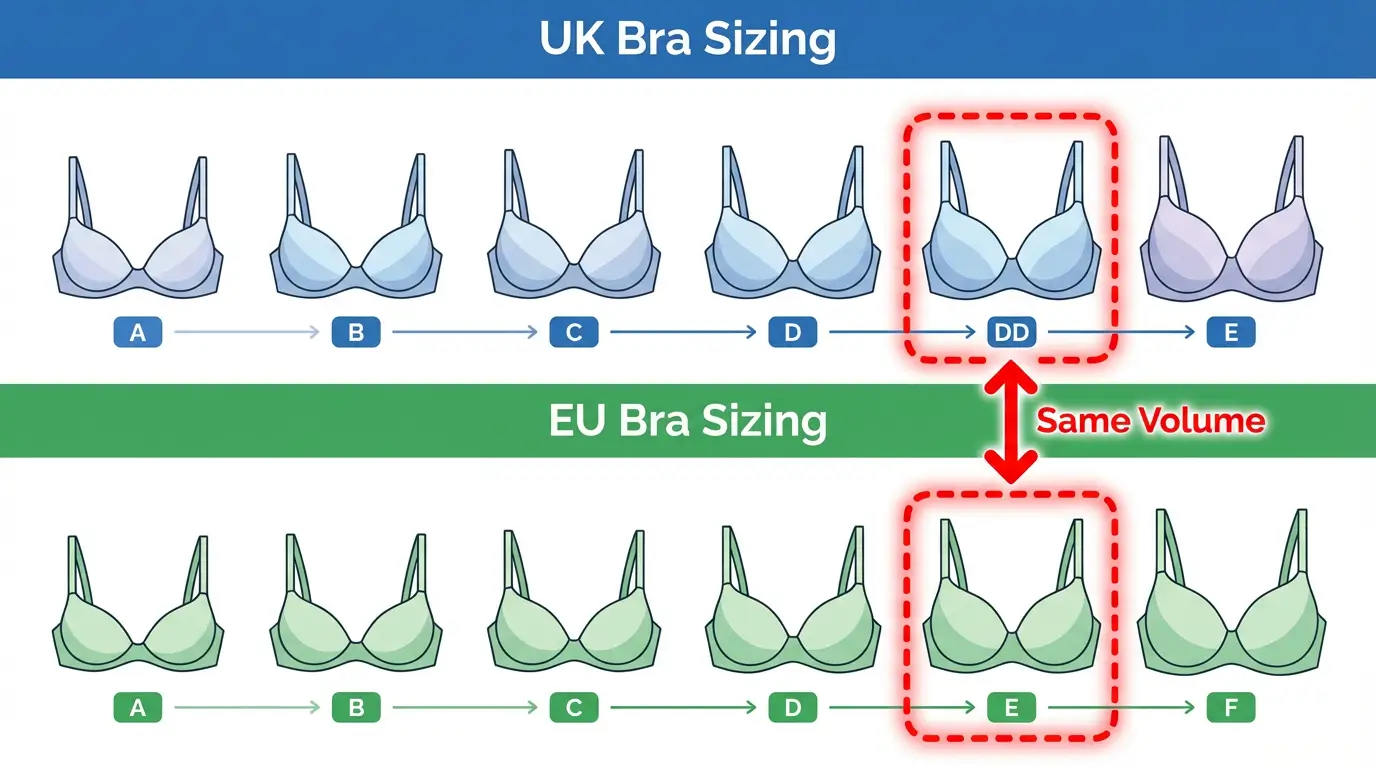
This works the other way too. If you are buying a UK bra based on your European size, you have to go *up* a letter. If you are a European 75G, you are likely a UK 34F. If you are a European 80H, you are looking for a UK 34GG.
It sounds complicated, but once you grasp the fact that the single European letter covers the volume of a UK letter plus the double letter preceding it in some cases, it clicks. Or, you can just use our UK cup size conversion guide to visualize it. I’ve seen so many women wearing the wrong cup size because they assumed the alphabet was universal. I once met a woman who was wearing a UK bra in a size that was four cup sizes too small because she directly translated her French size without accounting for this difference. She was shocked when I put her in the correct size and her back pain immediately vanished. To avoid this confusion entirely, you can always use a dedicated conversion calculator before you checkout.
Complete Conversion Chart
Sometimes you just want to look at a table and find your match without doing mental gymnastics. I get it. While I recommend using a tool for pinpoint accuracy, having a reference chart is super helpful when you are browsing in a store or scrolling through a catalogue without internet access.
Below is a cheat sheet for the most common sizes. Remember, this is a guide. Brand variations exist—Chantelle might fit differently than Freya—but this is the standard conversion used across the industry.
The Band Equivalents:
- EU 65 = UK 30
- EU 70 = UK 32
- EU 75 = UK 34
- EU 80 = UK 36
- EU 85 = UK 38
- EU 90 = UK 40
- EU 95 = UK 42
- EU 100 = UK 44
The Cup Volume Matrix (UK vs EU):
If you are a UK 30A, look for EU 65A.
If you are a UK 30B, look for EU 65B.
If you are a UK 30C, look for EU 65C.
If you are a UK 30D, look for EU 65D.
If you are a UK 30DD, look for EU 65E.
If you are a UK 30E, look for EU 65F.
If you are a UK 30F, look for EU 65G.
If you are a UK 30FF, look for EU 65H.
If you are a UK 30G, look for EU 65I.
Moving up to a UK 34 band (EU 75):
- UK 34A = EU 75A
- UK 34B = EU 75B
- UK 34C = EU 75C
- UK 34D = EU 75D
- UK 34DD = EU 75E
- UK 34E = EU 75F
- UK 34F = EU 75G
- UK 34FF = EU 75H
- UK 34G = EU 75I
For those in the UK 38 (EU 85) range:
- UK 38D = EU 85D
- UK 38DD = EU 85E
- UK 38E = EU 85F
- UK 38F = EU 85G
- UK 38FF = EU 85H
- UK 38G = EU 85I
And for the UK 42 (EU 95) and UK 44 (EU 100) range:
- UK 42D = EU 95D
- UK 42DD = EU 95E
- UK 44D = EU 100D
You can see the pattern here. The bands are straightforward, but the cups require you to “jump” a letter in your mind depending on where you are in the alphabet. Whenever I look at this chart, I’m reminded of why the international bra size converter is so popular. It removes the margin for human error, especially when you are tired or in a rush.
How to Measure Yourself Correctly
Before you even think about converting numbers, you need to know your starting point. And I’m not talking about the size you think you are, or the size you’ve been wearing since you were sixteen. I’m talking about your current measurements. Our bodies change. Weight fluctuates, hormones shift, post-pregnancy bodies are different, and simply aging affects our tissue distribution.
To find your true size, you need a soft tape measure and a mirror. Ideally, you should do this while wearing an unpadded, non-wired bra or just a tight vest. This gives you the most natural, supported shape without adding extra volume from padding.
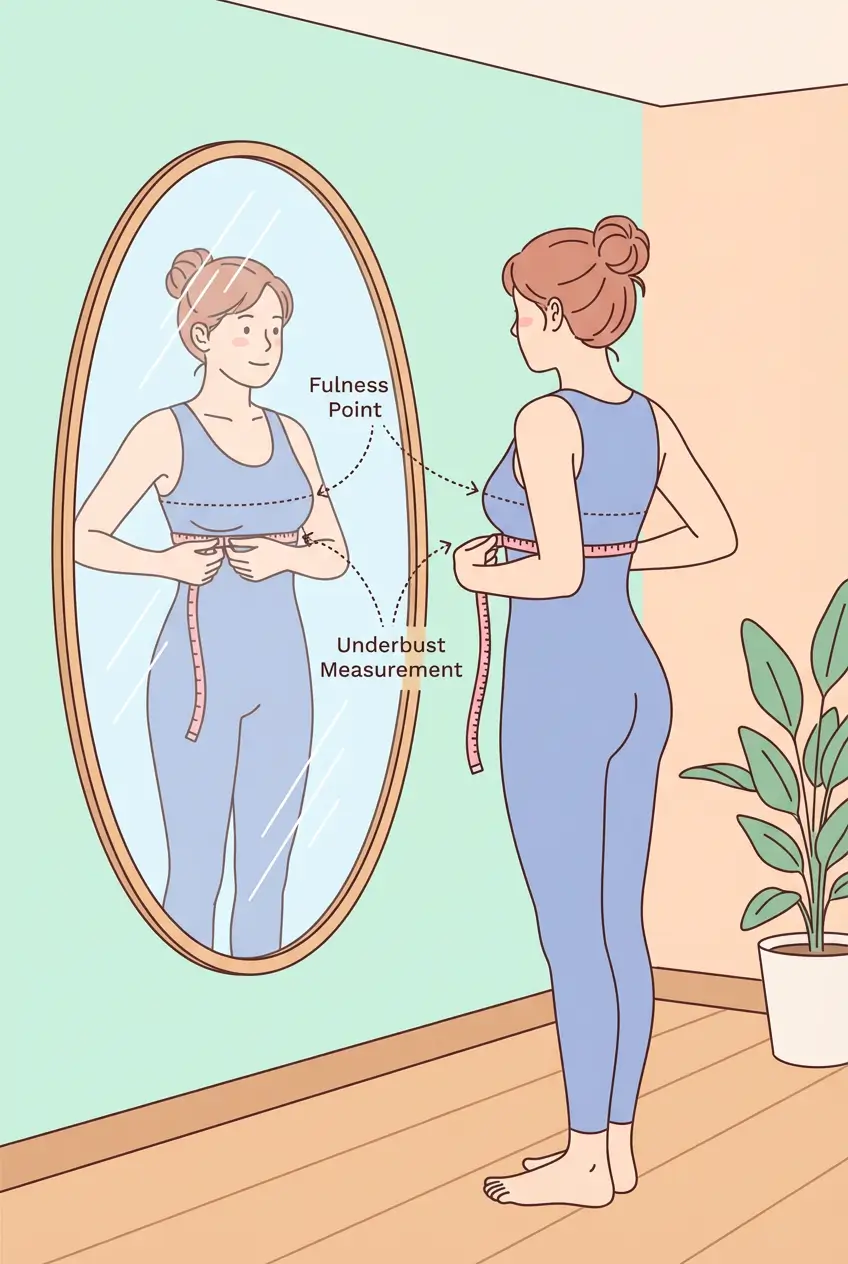
First, let’s measure your underbust. This is for your band. Wrap the tape measure around your ribcage, directly under your bust. It should be snug and parallel to the floor. You want it to be as tight as possible without being uncomfortable or causing your skin to bulge. Breathe out. Do not hold your breath. If the measurement is an odd number, like 31 inches, you usually round down to the nearest even number in the UK system (so 30). If you are looking for European sizing, take that inch measurement and multiply it by 2.54 to get centimeters. For instance, 31 inches is about 78.74 cm. In European sizing, you would round this to an 80 band.
Next, measure your fullest part of the bust. Lean forward slightly so your breast tissue falls naturally, then stand up straight. Wrap the tape measure around the fullest part of your bust, usually at the nipple level. Keep it snug but not tight—don’t compress the breast tissue. This measurement in inches is your overbust.
Now, the calculation. The difference between your underbust and overbust determines your cup size in the UK system.
- 1-inch difference = A cup
- 2-inch difference = B cup
- 3-inch difference = C cup
- 4-inch difference = D cup
- 5-inch difference = DD cup
…and so on.
For European sizing, you look at the difference in centimeters.
- ~10-12 cm difference = A cup
- ~12-14 cm difference = B cup
- ~14-16 cm difference = C cup
- ~16-18 cm difference = D cup
- ~18-20 cm difference = E cup (which is the DD equivalent)
I cannot stress this enough: do not use the old “add four or five inches to your underbust” method. That method is outdated and results in a band that is far too loose and offers zero support. Modern bands are designed to fit snugly on the loosest hook so they can be tightened as the elastic stretches over time.
Once you have these two numbers (underbust and bust), you can plug them into our bra size converter. It calculates the difference for both systems instantly, saving you from doing math in your head.
Shopping Tips for European Sizes in the UK
Shopping for lingerie should be fun, but when you are dealing with cross-border sizing, it can turn into a logistical nightmare. I’ve learned a few tricks over the years to make the process smoother, especially when buying European brands like Simone Pérèle, PrimaDonna, or Empreinte while living in the UK.
First, always check the sizing chart on the specific brand’s website. Do not rely on Amazon’s or ASOS’s generic conversion charts, as they are often wrong. A brand like Curvy Kate (UK) will have a totally different fit profile compared to a brand like Aubade (France). If you are buying from a specialist retailer that stocks both UK and EU brands, pay attention to the origin of the item.
When you are shopping online, read the reviews. This is gold. Look for reviews that mention the fit, specifically if the bra runs small or large in the cup or band. If you see multiple reviews saying “the band runs tight,” consider sizing up in the band and using sister sizing to adjust the cup. Remember sister sizing? If you are a UK 34D and the band is tight, a UK 36C (or EU 80C) would have the same cup volume but a larger band.
I also recommend buying from retailers that have good return policies, especially for your first order of a new brand. High-street stores like Marks & Spencer or John Lewis are great for trying things on in person, but if you are ordering that specific Belgian lace balconette from a boutique, order two sizes. Order the size you think you are, and the sister size up or down. It’s easier to return one than to wait weeks for an exchange.
Another tip is to look at the material. European brands often use different fabrics like lace with no stretch, or rigid mesh, compared to UK brands which might use more power mesh. A rigid lace band will fit differently than a stretchy one. If the band has no elastane or spandex, you might need to go up a band size for comfort.
Also, be aware of “vanity sizing.” Some brands label a bra as a UK 34 when the measurements actually align with a UK 32. This is less common in specialist brands but rampant in fast fashion. If you put the bra on and the center gore (the bit between the cups) does not lie flat against your chest, it is the wrong size. If the band rides up your back, it is too big. If the straps dig in, the band is likely too big and not doing its job, forcing the straps to carry the weight.
If you are used to US sizing, this can add another layer of confusion. We have a guide on converting American bra size to UK, which is helpful to read in conjunction with this information if you shop globally.
Common Mistakes and How to Avoid Them
In my years of helping women find the perfect fit, I’ve noticed the same errors popping up again and again. Avoiding these can save you money, discomfort, and a lot of frustration.
The biggest mistake is assuming the cup letter is a fixed volume. We tend to think “D cup is huge” or “A cup is small,” but a 30D is actually quite small in terms of volume compared to a 40D. The cup is relative to the band. When converting from Europe to the UK, you must consider the relationship between the two. Do not just convert the band and keep the letter the same. That is the quickest route to a bad fit. As we discussed, a European E is not a UK E.
Another error is ignoring the “sister size” concept when your converted size isn’t available. Let’s say you converted your size and found out you are a UK 32G (EU 70G). The brand is sold out of the 32G. Instead of giving up or buying the wrong size, look for the sister size. You would go up a band size to 34 and down a cup volume to F. So, you would look for a UK 34F (or EU 75F). The volume of the cup remains the same, but the band is larger.
Also, please stop using the “plus 4” method I mentioned earlier. I see it in advice columns all the time, and it drives me crazy. If you measure 29 inches underbust, add 4 to get 33, round up to 34… you are now wearing a band that is 5 inches too big for you. Your bra will ride up, your straps will fall down, and you won’t get any support. Stick to your snug measurement.
Finally, don’t guess. I know it’s tempting to just “eye it” and guess that you’re a medium or a large, or to pick a size based on what you wear in a sports bra. But a push-up bra fits differently than a sports bra. A balconette fits differently than a full-cup. Different styles have different fits. A professional fitting is always best if you can get one, but if not, accurate measurements are your best friend.
Using a specialized tool like our international bra size converter eliminates the guesswork. It accounts for the double letters, the cm-to-inch discrepancies, and the volume differences. It takes the user error out of the equation. I’ve seen women go from hating their bras to feeling confident and supported just by correcting these common conversion mistakes.
Conclusion
Navigating the world of lingerie sizing doesn’t have to be a headache. Whether you are converting “Europe to UK bra size” for the first time or the fiftieth, the key is understanding that these two systems speak different languages. The UK speaks in inches and double letters, while Europe speaks in centimeters and single letters. Once you understand the core logic—that a European 75 is a UK 34, and a European E is a UK DD—you open up a whole new world of beautiful lingerie that fits you perfectly.
Don’t be discouraged if it takes a little trial and error to get it right. Even experts sometimes need to try on a few sizes to find the perfect match, especially when switching between brands. Remember that your body is unique, and a size tag is just a starting point, not a verdict on your shape.

If you are feeling overwhelmed or just want to be 100% sure before you make a purchase, I highly recommend using our free bra size converter. It’s designed to take the stress out of the math so you can focus on finding styles that make you feel amazing. Go ahead and measure yourself today, input those numbers, and see your true size in both systems. You deserve a bra that fits like a glove, no matter which side of the Channel it came from. Happy shopping
Frequently Asked Questions (FAQs)
Since I started writing about bra fitting, my inbox has been flooded with questions about the specific quirks of European sizing versus UK sizing. It’s a topic that confuses everyone, from beginners to people who have been buying lingerie for years. Here are the answers to the questions I get asked the most.
Absolutely not, and this is the number one mistake I see people making. While a UK 34 and a European 75 might fit the same body, the numbers and letters on the label represent completely different systems. The UK uses inches and a cup alphabet that includes double letters (like DD, FF, GG). Europe uses centimeters and generally sticks to single letters (A, B, C, D, E, F). Because of the difference in measurement units and the way volume is calculated, a UK 34D is not the same size as a European 34D. If you treat them as identical, you will end up with the wrong fit.
If you don’t have our bra size converter handy, you can use a quick mental trick. For the band, take your European size (like 80), subtract 5, and then divide by 2. So, 80 minus 5 is 75, divided by 2 is 37.5, which rounds up to a UK 38.
For the cup, you have to think in terms of volume, not just letters. Remember that a European cup size is generally one step “smaller” in terms of letter progression than the UK equivalent. So, if you see a European E cup, you need to look for a UK DD. If you see a European F cup, look for a UK E. It feels backwards at first, but it works!
No, they are not the same volume. This is because most European sizing systems do not use double letters. When you go up from a D cup in the UK, you go to a DD. In Europe, you simply go to E. Therefore, a European E cup is roughly equivalent to a UK DD cup. If you usually wear a UK DD and you buy a bra labeled “DD” from a French or Italian brand, it will likely be too small for you because that “DD” label usually doesn’t exist or fits like a UK E. Always check the specific cup size conversion guide if you are unsure.
Generally, yes. Most continental European countries—including France, Spain, Belgium, Italy, and Germany—use the metric centimeter-based system (65, 70, 75, 80) and the single-letter cup progression. However, there can be slight variations between manufacturers. For example, some French brands might fit slightly tighter in the band than a German brand. Always treat the “European” label as a general guideline, but check the specific brand’s size chart if they have one available.
Converting the numbers correctly is just the first step. Unfortunately, sizing isn’t just about math; it’s also about shape and style. A plunge bra fits differently than a full-cup bra. A lace band with no stretch fits tighter than a mesh band with high elastane.
If you have converted your size using our international bra size converter and it still feels wrong, you might need to try “sister sizing.” For example, if the band feels too tight but the cups feel perfect, go up a band size and down a cup size (e.g., from a UK 34F to a UK 36E). This keeps the same cup volume but gives you more room around the ribcage. Fit issues are rarely about your body being “wrong” and more about the specific cut of the bra not suiting your shape.
Please, don’t! The “add 4 inches” method is an old myth that results in a band that is much too loose. Modern bras are designed with elastic technology that means the band needs to fit snugly on the loosest hook. Adding inches to your underbust measurement will leave you with a bra that rides up your back and provides zero support. This applies to both UK and European sizing. Stick to your raw, snug underbust measurement to find your true band size.
You don’t need to do the math in your head or carry a calculator around with you. We have built a free tool specifically to handle these complexities. You can find it right here on our site at My Bra Size Converter. Just input your measurements or the size you see on the label, and it will instantly show you the accurate conversion. It takes the guesswork out of shopping across borders.