
If you’ve ever stood in a fitting room holding two bras—one labeled D and the other DD—you’re not alone in wondering: What’s actually different between these two sizes? Bra sizing confusion is incredibly common, especially when it comes to the jump from D to DD. Many women assume DD means “double the size” or represents some dramatic threshold into “big bra” territory. Others have been told they wear a DD simply because it was the largest size available at their local store—not because it actually fit them.
The truth is far simpler yet frequently misunderstood: DD is just one cup size larger than D, representing approximately one additional inch of difference between your bust and underbust measurements. Yet this small numerical difference carries outsized cultural baggage, historical quirks in sizing systems, and real-world fitting implications that deserve proper explanation.
Let’s clear up the confusion once and for all—so you can find bras that actually fit your body instead of conforming to arbitrary letter labels.
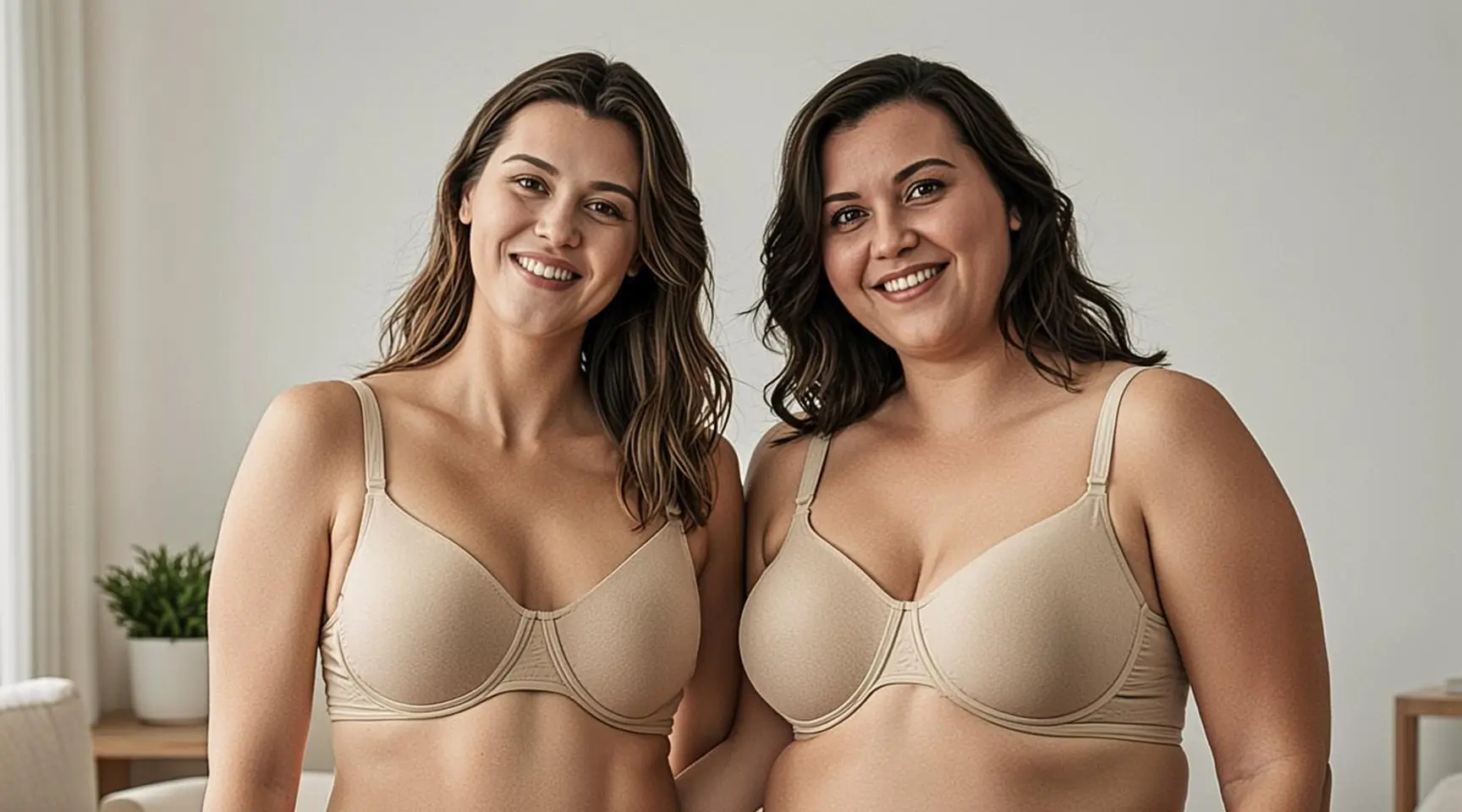
Difference Between D and DD Bras (Quick Answer)
- A DD cup is exactly one size larger than a D cup in the same band—typically a 1-inch (2.5 cm) increase in bust-to-underbust difference.
- D cups generally represent a 4-inch (10 cm) difference between bust and underbust measurements; DD cups represent about 5 inches (12.7 cm).
- Cup size is always relative to band size—30DD holds significantly less volume than 38DD despite sharing the same cup letter.
- DD sizing exists due to historical letter duplication in the US system; in UK sizing, DD is often labeled as E.
- Fit depends on breast shape, density, and brand construction—not just the cup letter on the tag.
The Difference Between D And DD Bras Explained
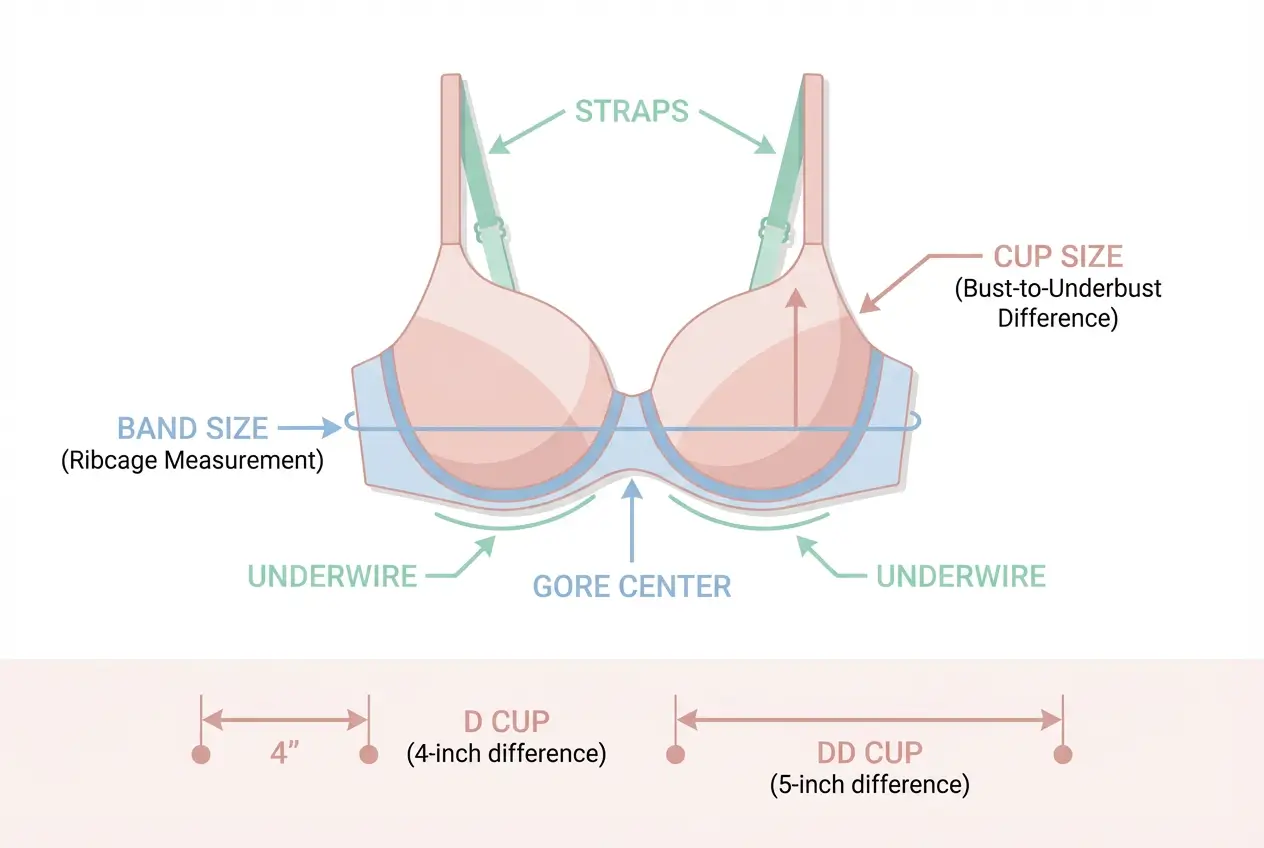
Understanding bra sizing starts with recognizing its two fundamental components: band size and cup size. These must always be considered together—they’re interdependent measurements, not independent values.
Your band size (the number: 32, 34, 36, etc.) represents the circumference around your ribcage, just beneath your bust. This measurement provides roughly 80-90% of your bra’s actual support.
Your cup size (the letter: A, B, C, D, DD, etc.) represents the difference between your bust measurement (around the fullest part of your breasts) and your underbust measurement. Crucially, cup size is relative—it changes proportionally with band size.
Here’s why this matters for D vs. DD:
- In a 34 band: A D cup fits a bust that’s 4 inches larger than the underbust (34″ + 4″ = 38″ bust). A DD cup fits a bust that’s 5 inches larger (34″ + 5″ = 39″ bust).
- In a 38 band: That same D cup now accommodates a 42″ bust; the DD accommodates a 43″ bust.
The cup letter alone tells you nothing about absolute breast volume. A 30DD contains far less volume than a 40DD—yet both are “DD cups.” This relativity is why professional fitters emphasize measuring both band and bust carefully before shopping.
The progression between cup sizes remains consistent across the alphabet:
- A to B = +1 inch difference
- B to C = +1 inch difference
- C to D = +1 inch difference
- D to DD = +1 inch difference
- DD to DDD/E = +1 inch difference
There is no “double” volume jump at DD—just the same incremental increase that exists between every consecutive cup size. The double letter is purely a labeling convention, not a measurement multiplier.
Why Double Letters Exist (DD Explained)
So why does the industry use “DD” instead of simply continuing with “E”? The answer lies in bra sizing history and regional differences between measurement systems.
When Maidenform and other early lingerie manufacturers standardized sizing in the 1920s–1940s, they established a system where each cup letter represented a one-inch difference between bust and band measurements. The original progression was straightforward: A, B, C, D.
As demand grew for larger cup sizes beyond D, American manufacturers faced a dilemma. Rather than introduce “E” (which carried negative connotations in mid-20th century marketing—”DD” sounded more appealing than “E” to consumers), many US brands began duplicating letters: DD, DDD, DDDD.
Meanwhile, European and UK brands largely maintained a continuous alphabetical progression: D, E, F, FF, G, GG, and so on. This created—and continues to create—significant confusion in international bra shopping:
| Region/System | After D Cup Comes... | Equivalent To US |
|---|---|---|
| US Standard | DD | E |
| US Alternative | DDD | F |
| UK/European | E | DD |
| UK/European | F | DDD/FF |
Important note: Not all brands follow these conventions consistently. Some US brands skip E entirely; others use DD and E interchangeably for the same size. This inconsistency is precisely why understanding your actual measurements matters more than memorizing letter equivalents.
The “DD” label inherited an undeserved reputation as a “huge” size simply because, for decades, it represented the largest cup most mainstream retailers stocked. Women needing larger sizes were often misfitted into DDs not because they measured as DD, but because nothing larger existed on the sales floor—a practice that perpetuated the myth that DD was exceptionally large rather than simply the next size up from D.
D vs DD Measurements Breakdown
The following table shows the standard bust-to-underbust differences for D and DD cups across common band sizes. Remember: these are guidelines—actual fit varies by brand, style, and your unique breast shape.
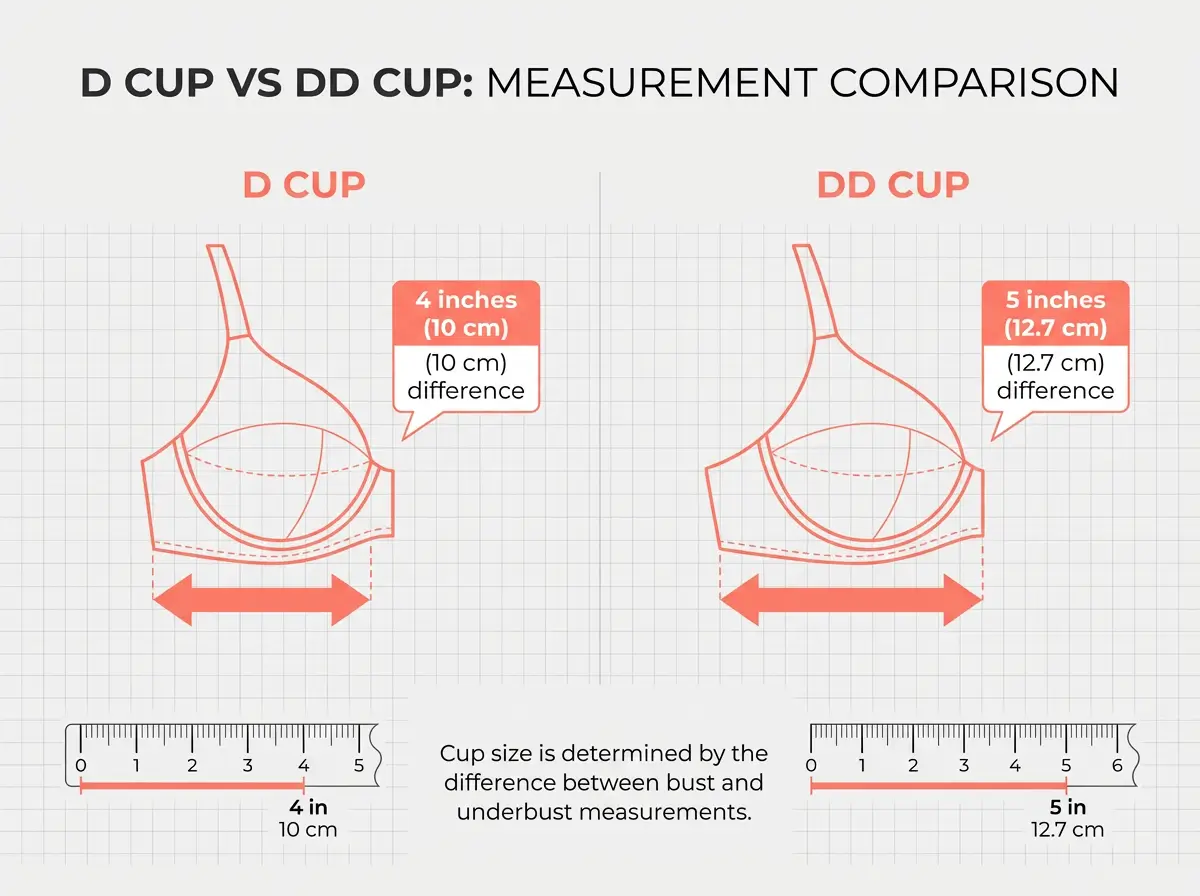
| Cup Size | Bust – Underbust Difference | Approximate Centimeters |
|---|---|---|
| D Cup | ~4 inches | ≈10 cm |
| DD Cup | ~5 inches | ≈12.7 cm |
Example in practice:
- If your underbust measures 32 inches and your bust measures 36 inches (4″ difference), you’d typically start with a 32D.
- If your underbust measures 32 inches and your bust measures 37 inches (5″ difference), you’d typically start with a 32DD.
⚠️ Critical disclaimer: These measurements represent industry guidelines, not universal standards. Brand variation is significant—what fits as a 34DD in Panache might fit as a 34E in Freya or a 34F in a different brand altogether. Always prioritize how the bra feels on your body over strict adherence to measurement charts. For precise international conversions, our UK cup size conversion guide breaks down these differences by region.
DD Cup Sizes Explained (DD Is Not a Size Alone)
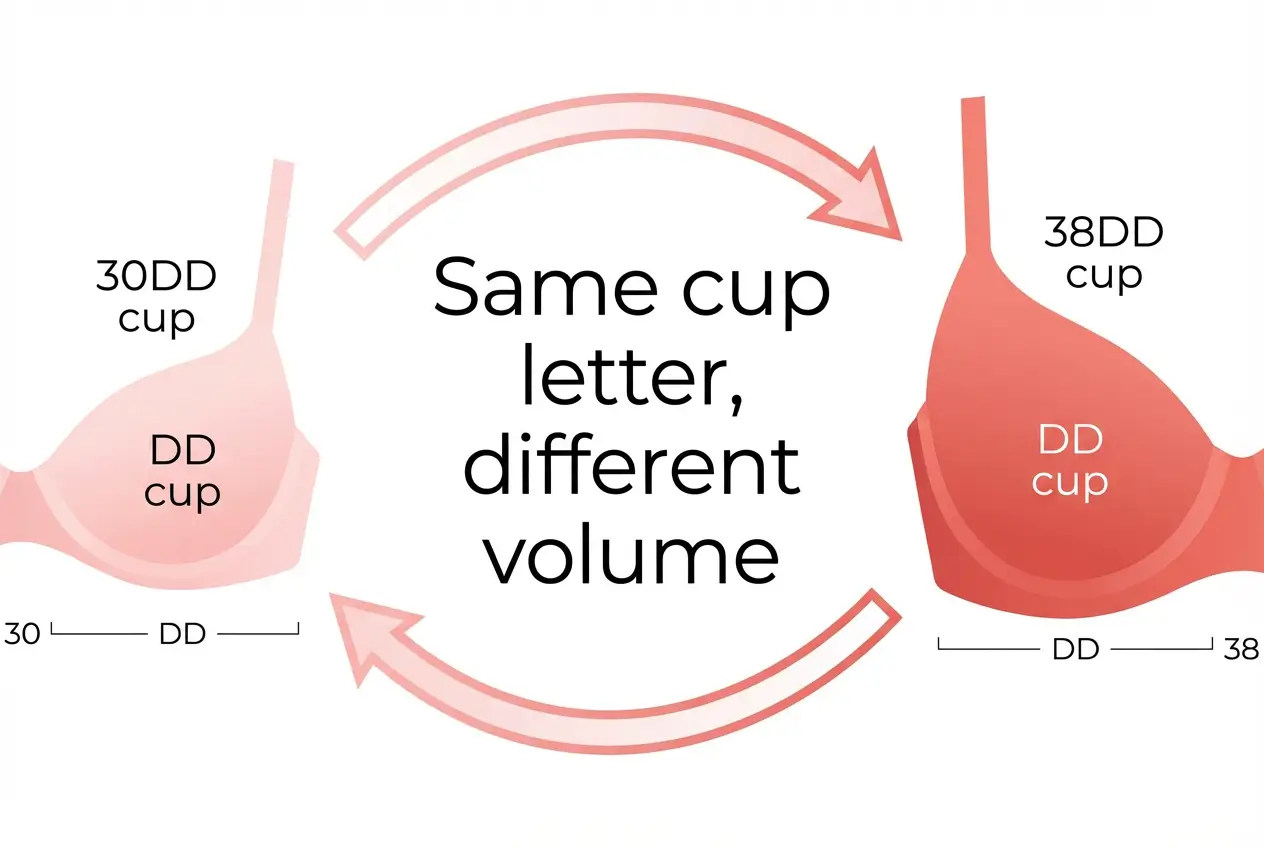
Here’s a fundamental truth many women miss: There is no such thing as a “DD size” by itself. DD only has meaning when paired with a band size.
Consider these two bras:
- 30DD: Underbust ≈30″, Bust ≈35″
- 38DD: Underbust ≈38″, Bust ≈43″
Though both are “DD cups,” the 38DD holds dramatically more breast volume than the 30DD. The woman wearing 30DD likely has a petite frame with proportionally fuller bust; the 38DD wearer likely has a larger frame with similar proportional fullness—or possibly a fuller bust on a larger frame.
This relativity explains why sister sizing works. Sister sizes share equivalent cup volume while adjusting band tightness:
| Equivalent Cup Volume (Sister Sizes) |
|---|
| 28E = 30DD = 32D = 34C |
| 30E = 32DD = 34D = 36C |
| 32E = 34DD = 36D = 38C |
If your 34DD cups fit perfectly but the band feels loose, your sister size 36D might provide better support while maintaining the same cup volume. Conversely, if the band is snug but cups gap, try 32DDD/E.
Understanding this concept transforms bra shopping—you’re no longer locked into one “size” but can navigate options that accommodate your unique proportions. Our guide to English bra sizes explores sister sizing strategies in greater depth.
Beyond the Letter: Real Fit Factors
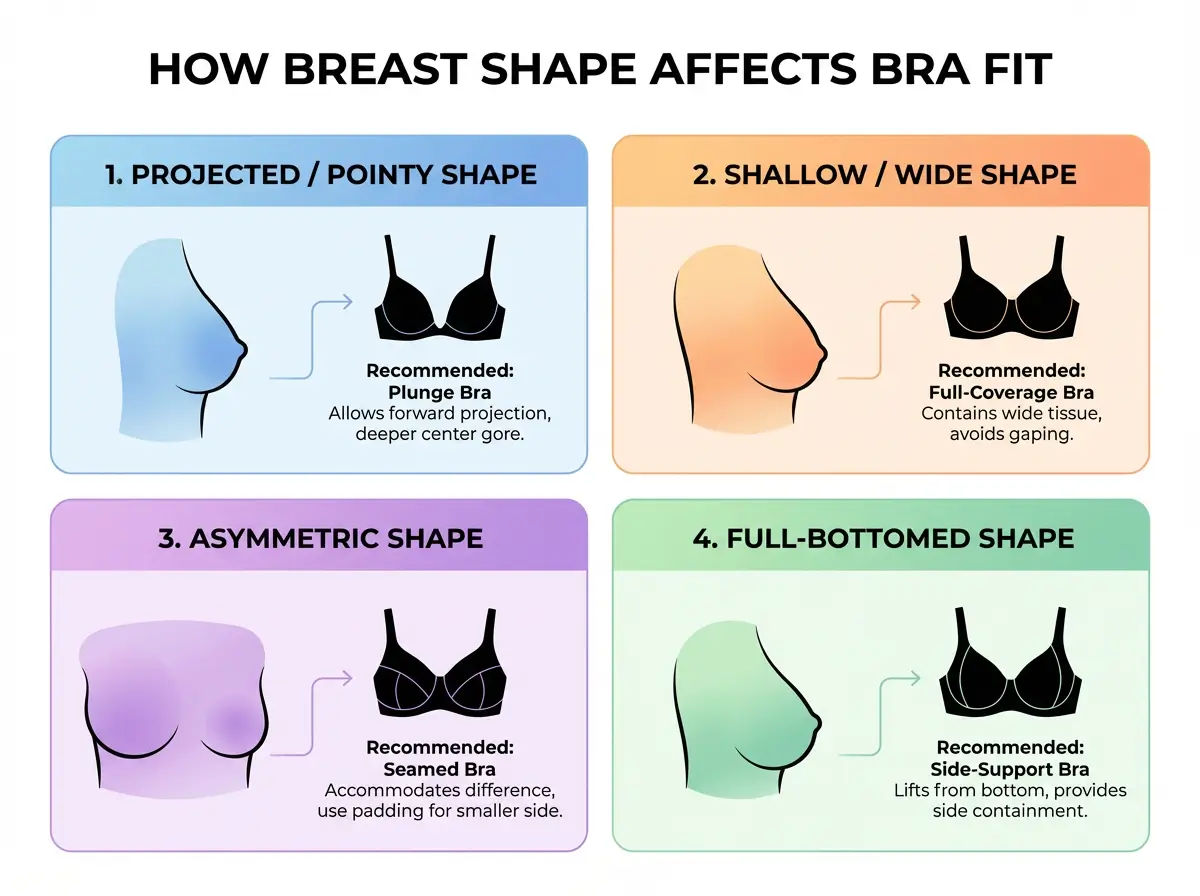
Measurements provide an excellent starting point, but they don’t capture everything that affects bra fit. Several nuanced factors determine whether a D or DD will work better for your body—regardless of what the tape measure suggests:
Breast shape matters more than volume alone. Women with shallow, wide-set breasts might find molded D cups create gaps at the top, while the same volume in a seamed DD cup with better side support eliminates gapping. Conversely, projected (“pointy”) breasts might overflow a standard D cup but fit perfectly in a specially designed D with forward projection—even if measurements suggest DD.
Breast tissue density influences fit dramatically. Two women with identical 34DD measurements might need completely different bras: one with soft, malleable tissue requiring full encapsulation, another with denser tissue needing firmer support panels.
Style construction changes everything. A plunge bra’s angled cups hold less volume than a full-coverage style in the same labeled size. Balconette bras lift differently than T-shirt bras. What fits as a DD in one style might fit as a D or DDD in another—even within the same brand.
Brand variation is unavoidable. Victoria’s Secret, known for inconsistent sizing, might label a cup as DD that Panache or Freya would label E or even F. This isn’t deception—it’s different grading systems. Specialist brands focusing on DD+ sizes typically use more precise grading with smaller incremental changes between sizes.
This complexity is why professional fittings remain valuable and why our International Bra Size Converter accounts for regional sizing differences when helping you translate measurements across brands and countries.
DD+ Sizes vs A–D Sizes: Construction Differences
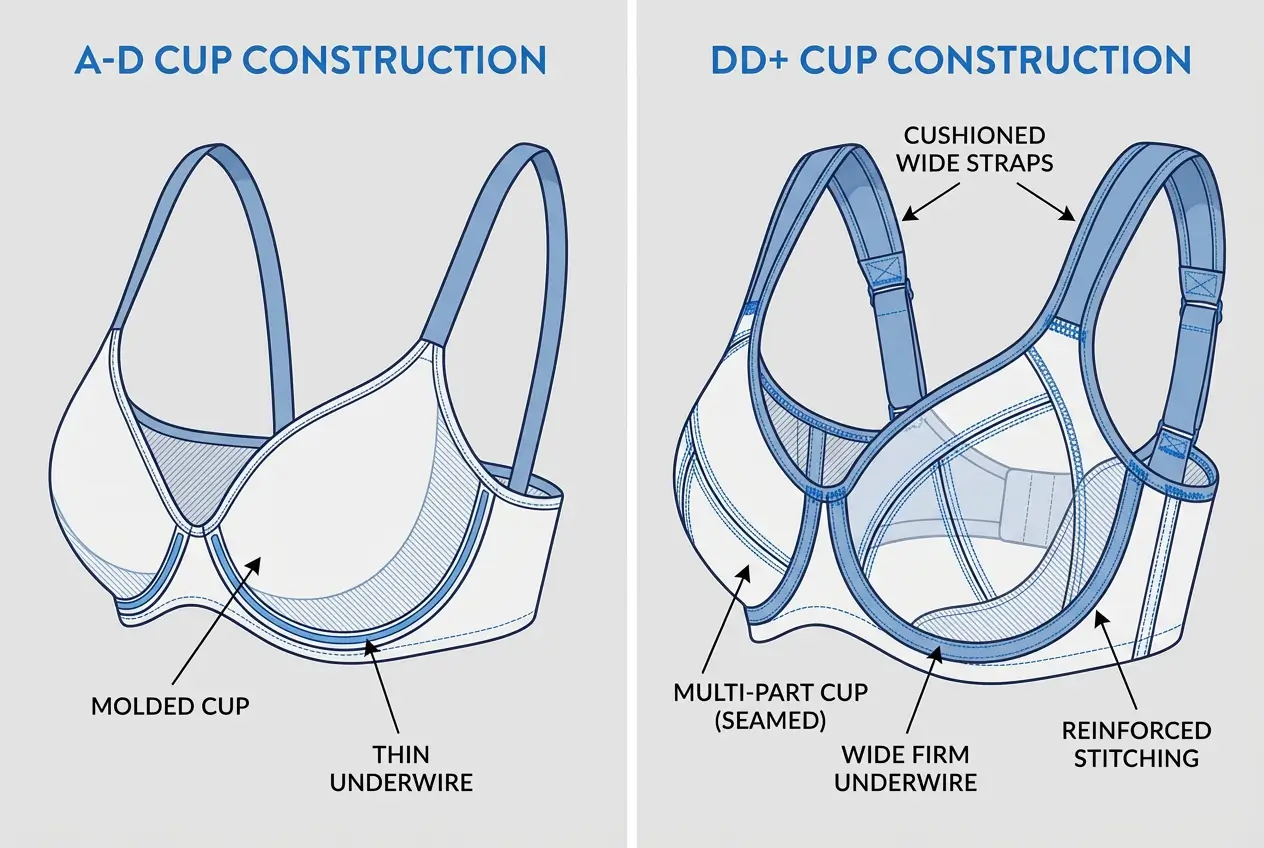
Bras designed for DD+ cup sizes (generally starting around 5″ bust-to-underbust difference) incorporate structural features rarely found in A–D bras:
- Firmer, wider underwires that fully encase breast tissue without collapsing under weight
- Additional pattern pieces in the cup (3-part or 4-part cups vs. single-piece molded cups) for better shape accommodation
- Stronger elastics in wings and bands to prevent ride-up under heavier loads
- Wider, cushioned straps that distribute weight without digging
- Reinforced stitching at stress points (strap joins, gore center)
- Sturdier fabrics with less stretch in critical support zones
These aren’t “industrial” features—they’re engineering solutions for physics. Larger breast volumes exert more downward and outward force; bras must counteract this with intelligent design. An A-cup bra doesn’t need these reinforcements because the forces involved are minimal.
Importantly: DD+ doesn’t automatically mean “large breasts.” A 28DD contains less absolute volume than a 38C. DD+ simply indicates the ratio between bust and band has reached a threshold where specialized construction improves comfort and support. Many women between 30D–34DD benefit from DD+ specialist brands even if they don’t consider themselves “full busted.”
Band Sizing Systems (+4 vs +0 Explained)
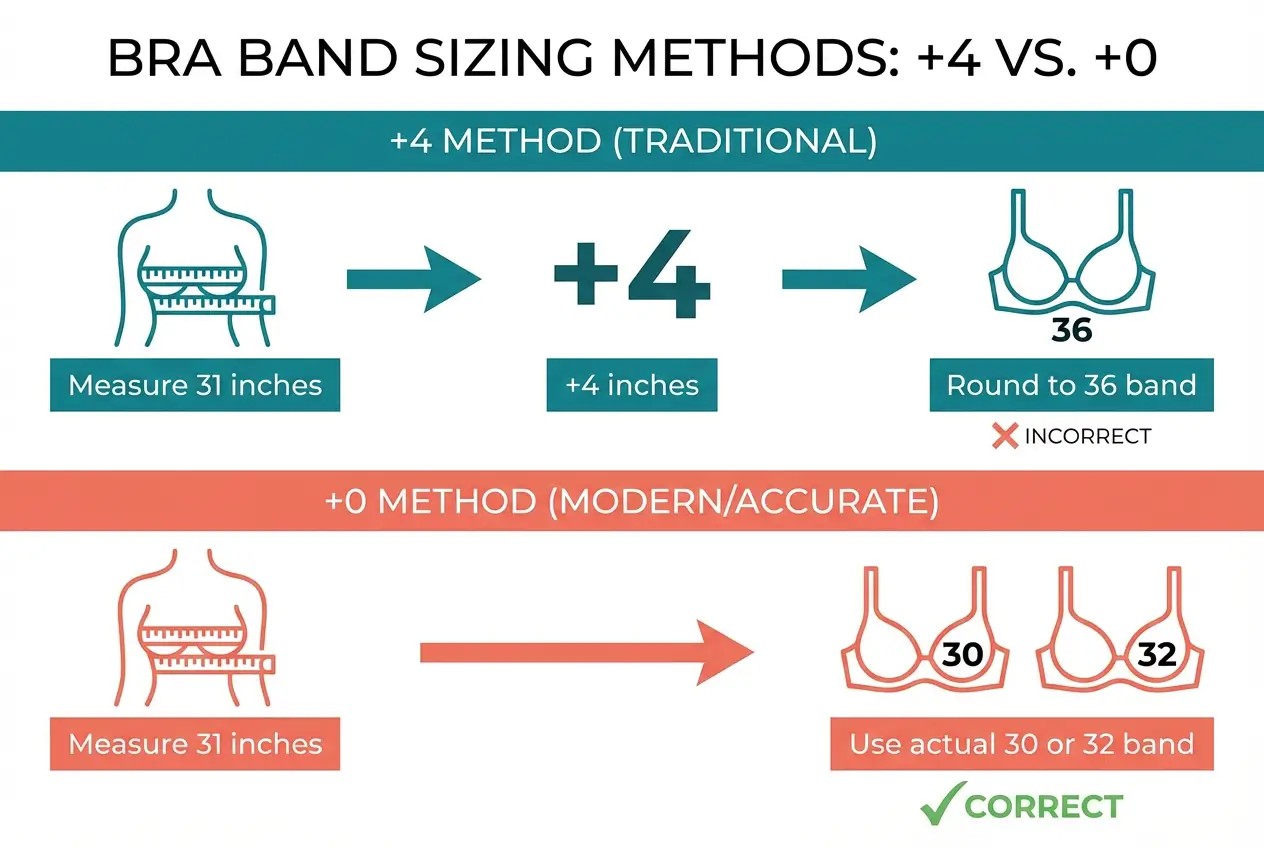
One of the most confusing aspects of bra sizing—especially when moving between D and DD cups—is the band sizing method used by different brands. Two primary systems exist:
The +4 Method (Traditional US/Core Sizing):
- Measure underbust (e.g., 31 inches)
- d 4 inches → 35 inches
- Round to nearest even number → 36 band
The +0 Method (DD+ Specialist/UK Standard):
- Measure underbust (e.g., 31 inches)
- Use actual measurement or round to nearest standard size → 30 or 32 band
Why does this matter for D vs. DD? Because changing band sizing systems changes your cup size too.
Example: You measure 31″ underbust, 38″ bust (7″ difference).
- Using +4 method: 31″ + 4 = 35″ → 36 band. 7″ difference = 36F/DDD
- Using +0 method: 31″ → 30 band (rounded down for snug fit). 7″ difference = 30F
Same body. Same measurements. Two completely different size labels—yet both could fit correctly depending on the brand’s construction.
Most mainstream brands (Victoria’s Secret, H&M, Target basics) use +4 sizing up to DD cups, then often switch to +0 for larger sizes—creating massive confusion when women try to size up beyond DD. True DD+ specialist brands (Panache, Freya, Curvy Kate) typically use +0 sizing consistently across all cup sizes.
How to identify which system a brand uses:
- If their size range tops out at 38DD or 40DD, they likely use +4
- If they offer 28 bands and go up to J/K/L cups consistently, they likely use +0
- Check their size chart: Do they instruct you to “add 4 inches” to underbust? That’s +4.
When converting between systems, remember the golden rule of sister sizing: When band size increases by one step, cup size decreases by one letter—and vice versa. Our detailed explanation of what bra sizes actually mean includes conversion charts to navigate these differences confidently.
When to Choose D vs DD (Decision Block)
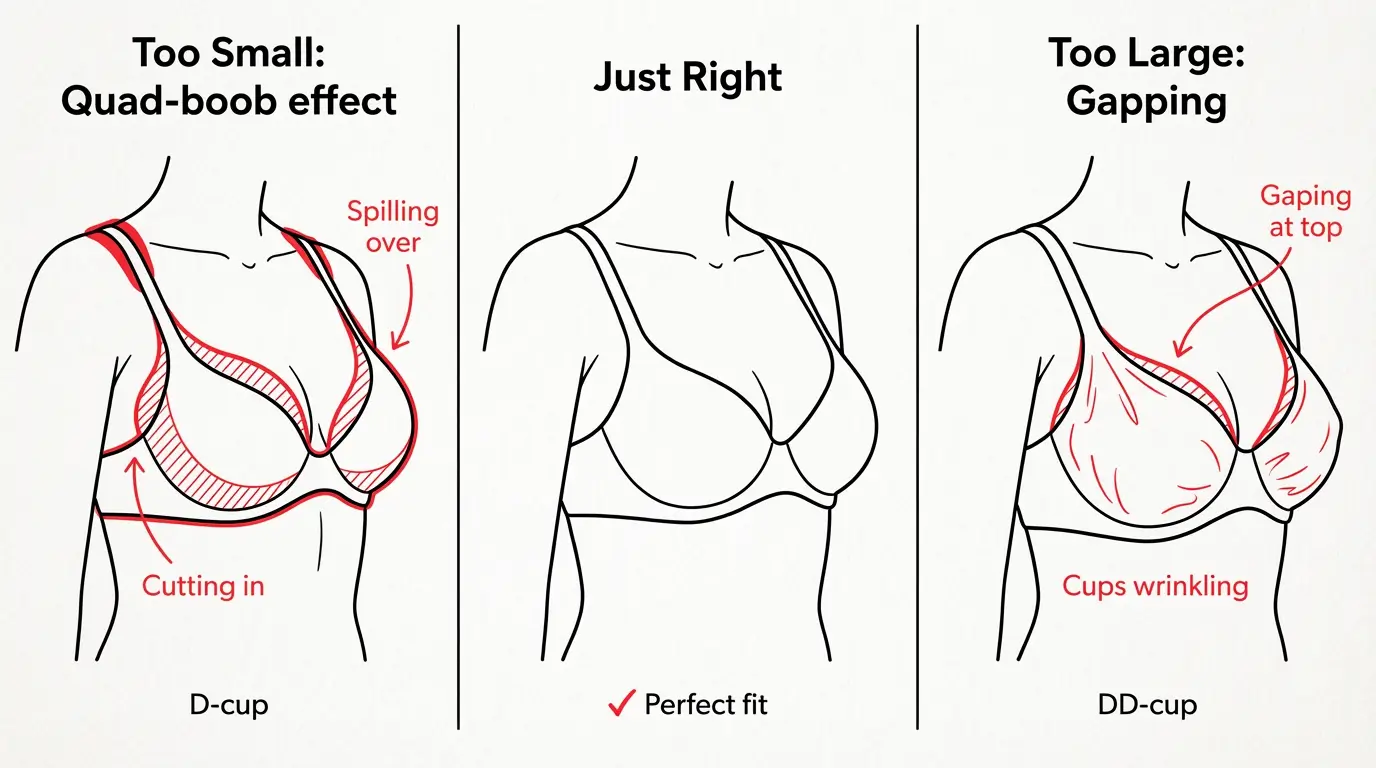
Still unsure whether to reach for D or DD? Consider these practical scenarios:
Choose a D cup if:
- Your current C cups show overflow at the top or sides
- DD cups in the same band create persistent gaps at the top of the cup (after proper “scoop and swoop”)
- You’re between sizes and prefer slightly more uplift/cleavage over absolute containment
- Your breast tissue feels fully encased without spillage in D cups across multiple brands
Choose a DD cup if:
- D cups consistently cut into breast tissue at the sides or top (“quad-boob” effect)
- You experience underwire digging because the cup is too shallow for your projection
- Your bust measurement is consistently 5 inches greater than your underbust measurement
- You’ve tried properly fitted D cups across multiple styles and still experience tissue escape
Critical reminder: Always assess fit after adjusting straps and ensuring all breast tissue is centered in the cup (“scoop and swoop”). Many women blame cup size when the real issue is improper positioning or band tightness.
Common Myths & Misconceptions About DD
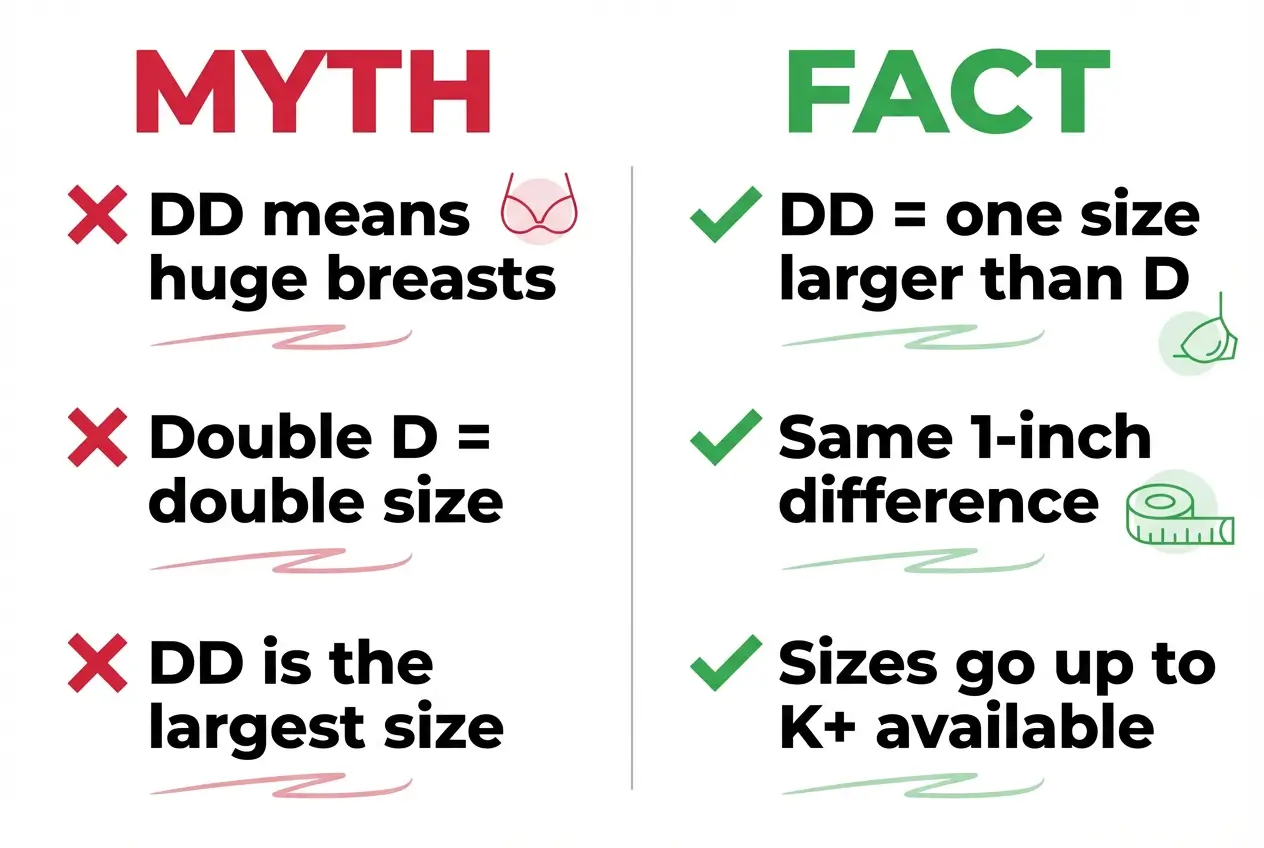
Myth 1: “DD means you have huge breasts.”
Reality: DD is simply the next size after D. With band sizes ranging from 28–44+, DD encompasses everything from modest proportions on petite frames to substantial volume on larger frames. Many women wear DD not because they’re exceptionally full-busted, but because mainstream retailers historically capped their size ranges at DD—leading to systematic misfitting.
Myth 2: “Double D means double the size of D.”
Reality: The “double” refers only to letter duplication in labeling—not volume doubling. The increase from D to DD equals the same 1-inch difference as from A to B or C to D.
Myth 3: “If I wear DD, I should shop in the ‘full-figure’ section.”
Reality: “Full-figure” traditionally referred to band sizes 40+ regardless of cup. A 32DD wearer has a small band with moderate cup volume—not “full-figure” proportions. Modern retailers increasingly separate “plus-size bands” from “full-cup” categories, but confusion persists.
Myth 4: “DD cups are hard to find.”
Reality: While true 15 years ago, today’s market offers abundant DD options—from mainstream retailers to specialist brands. The real challenge remains *accurate fitting*, not availability. Many women still default to DD because it was the largest size stocked locally, not because it measured correctly.
These myths persist partly due to media portrayal—where “DD” became shorthand for exaggerated curves in film and advertising—and partly due to retail limitations that treated DD as a ceiling rather than a midpoint in the sizing spectrum.
FAQs
Yes—DD is exactly one cup size larger than D within the same band size, representing approximately one additional inch of bust-to-underbust difference.
Not necessarily. A 30DD contains less volume than a 38D. Cup size is relative to band size—DD simply indicates a 5-inch bust-to-underbust difference regardless of frame size.
Yes. “Double D” is simply the spoken form of “DD”—just as “Double F” means FF and “Double G” means GG. There is no sizing difference.
DDD (Triple D) is commonly used in US sizing and typically converts to an F cup in UK sizing—one full size larger than DD/E. Always check a brand’s specific size chart, as labeling varies.
This reflects regional sizing conventions. US brands often use DD where UK/European brands use E for the same bust-to-underbust difference. Neither is “correct”—they’re different labeling systems. Always check the brand’s measurement chart rather than assuming letter equivalence.
Not necessarily. Brand grading varies significantly—what one brand calls DD, another might grade as D or E. Additionally, breast shape affects fit: shallow breasts might fit better in a smaller cup with less projection; projected breasts might need the next size up even with “correct” measurements.
Only if they actually fit. Wearing too-small cups compromises support, causes tissue migration (“uniboob” or quad-boob), and accelerates breast sagging. Your size isn’t a judgment—it’s a tool for finding comfort. Prioritize fit over label perception.
US DD typically converts to UK E—but always verify with a brand-specific chart. For comprehensive international conversions between American, European, and UK systems, use our bra size converter tool or consult our detailed US to UK sizing guide.
Gapping often indicates style mismatch rather than incorrect size. Molded/t-shirt bras gap more easily than seamed cups. Try a different style (e.g., three-part cup with side support) before downsizing. Also ensure you’re “scooping” all breast tissue into the cup before fastening.
Finding your true size between D and DD comes down to three principles:
- Cup size is relative: DD in a 30 band holds far less volume than DD in a 40 band—measure both bust and underbust.
- One size step = one inch: DD is precisely one cup size larger than D (≈1 inch bust-to-underbust difference), not “double” anything.
- Fit beats labels: Prioritize how the bra feels—no spillage, no gaping, band parallel to floor—over the letter on the tag.
Guessing between D and DD wastes time and money on bras that don’t support your body properly. Instead, let precise measurements guide your starting point—then adjust for your unique shape and preferred styles.
👉 Ready to find your perfect fit?
Calculate your accurate international bra size now with our free converter tool—then explore bras that actually fit your proportions, not arbitrary labels.
Have questions about your measurements or need personalized recommendations? Our team is happy to help—contact us anytime. And to learn more about our mission to simplify bra sizing for women worldwide, visit our About Us page.
Note: Bra sizing varies significantly by brand and style. These guidelines provide a starting point—always try bras on when possible and prioritize comfort and support over strict adherence to measurement charts.