
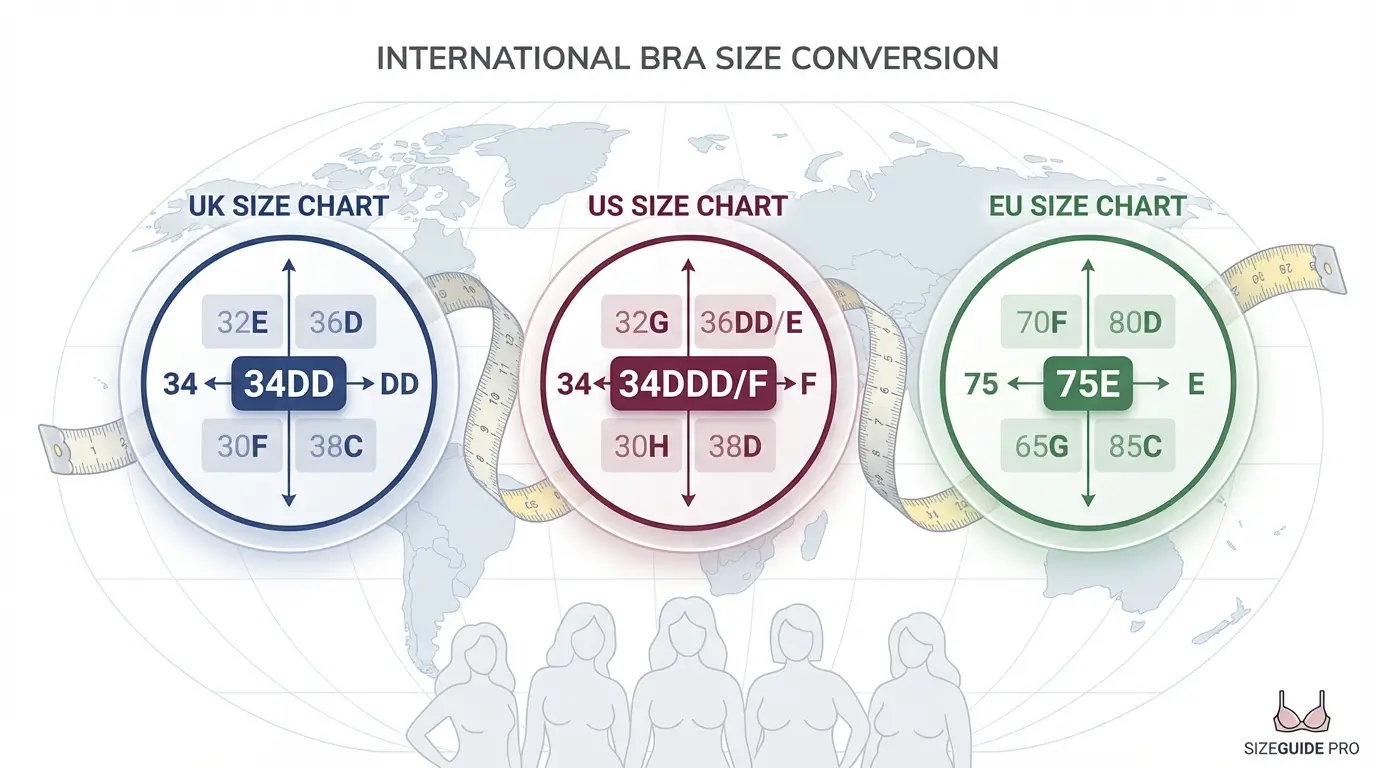
Let me tell you a story about Sarah, one of my clients who came to me completely frustrated with her bra shopping experience. She’d ordered what she thought was her size from a UK brand, only to find the cups were drowning her while the band cut into her ribs like a vice. She’s not alone—studies show that a staggering 70-85% of women wear the wrong bra size every single day, often because international sizing feels like trying to decode a secret language. The UK bra sizing system, with its double letters and inch-based measurements, can be particularly bewildering when you’re used to US or European sizing. I remember my own “aha moment” when I finally understood how UK cup sizes actually work—it was like someone had turned on the lights in a dark room. If you’re tired of guessing and returning bras that don’t fit, our free International Bra Size Converter can help you find your perfect fit in seconds. Let’s unravel the mystery of UK cup size conversion together.
Understanding UK Bra Sizing
When we talk about UK bra sizes, we’re referring to a system that many lingerie experts consider the gold standard, especially for fuller busts. Unlike some other sizing systems that get fuzzy with larger cup sizes, the UK system maintains consistency and precision throughout its entire range. Let me break it down for you.
Band Sizes: The Foundation of Support
In the UK system, band sizes are measured in inches and typically range from 28 to 48, with the most common being 30, 32, 34, 36, 38, and 40. This measurement goes around your ribcage, just under your bust. What makes UK band sizing unique is that it’s always an even number—you’ll never see a 33 or 35 band in proper UK sizing. This standardization helps ensure that the band provides about 80% of your bra’s support, which is crucial for comfort and proper lift.
Cup Progression: Where UK Shines
Now, here’s where UK sizing gets interesting—and where most confusion happens. While many countries use single letters all the way through (A, B, C, D, E, F, G), the UK system introduces double letters after DD. So the progression looks like this: A, B, C, D, DD, E, F, FF, G, GG, H, HH, J, JJ, and so on.
I’ll never forget the first time I encountered this while fitting a client who thought she was a 34G in US sizing. When we measured her properly, she was actually a 32GG in UK sizing—a revelation that completely transformed her comfort and confidence. The UK system’s use of double letters (DD, FF, GG) creates smaller increments between cup sizes, which is particularly beneficial for women with fuller busts who need that extra precision.
Why UK Sizing is Considered the Gold Standard
The UK sizing system has earned its reputation as the gold standard for several reasons. First, it maintains consistent cup volume progression—each step up represents approximately the same increase in volume. Second, UK manufacturers like Panache, Freya, and Curvy Kate have pioneered designs specifically for fuller busts, using the precise sizing system to create bras that actually fit real women’s bodies.
In my years as a bra fitting specialist, I’ve seen countless women discover that their “problem” wasn’t their body—it was that they’d been wearing the wrong size system all along. The UK system’s attention to detail in cup progression means that whether you’re an A cup or a JJ cup, there’s a specific size designed for your unique shape.
The key takeaway? Don’t be intimidated by those double letters—they’re actually working in your favor to give you that perfect, supportive fit you’ve been searching for.
How to Measure for UK Bra Size
Proper measurement is the foundation of finding your perfect UK bra size. I’ve lost count of how many women have come to me thinking they know their size, only to discover they’ve been wearing the wrong measurements for years. Let me walk you through the process step-by-step—this is the same method I use in my professional fitting sessions.
Tools You'll Need
- A soft, flexible measuring tape (not metal!)
- A mirror
- A pen and paper to record measurements
- A well-fitting non-padded bra (or no bra at all)
Step-by-Step Measuring Guide
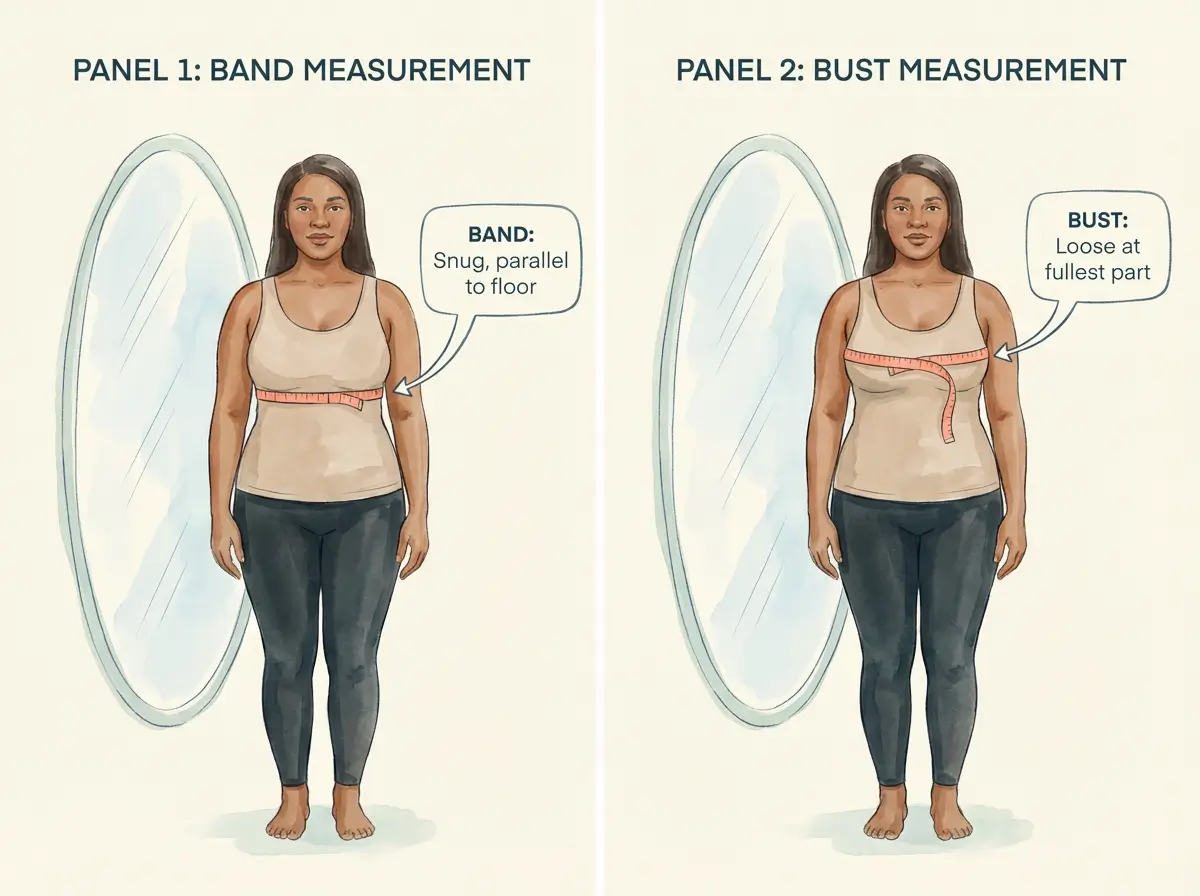
- Band Measurement (Underbust)
Stand in front of the mirror with your arms at your sides. Place the measuring tape around your ribcage, just under your bust where the bra band would sit. The tape should be parallel to the floor and snug—but not tight enough to dig in. Breathe normally. This measurement, rounded to the nearest whole inch, is your band size. Remember: UK band sizes are always even numbers, so if you measure 33 inches, round up to 34.
2. Bust Measurement (Overbust)
Now, measure around the fullest part of your bust. Keep the tape parallel to the floor and don’t pull it tight—this should be a loose, comfortable measurement. If you’re wearing a bra, make sure it’s not padded or push-up style. Record this measurement.
- Calculate Your Cup Size
Subtract your band measurement from your bust measurement. The difference corresponds to your cup size:
- 1 inch difference = A cup
- 2 inches = B cup
- 3 inches = C cup
- 4 inches = D cup
- 5 inches = DD cup
- 6 inches = E cup
- 7 inches = F cup
- 8 inches = FF cup
- 9 inches = G cup
- 10 inches = GG cup
- And so on…
I remember when I first learned to measure myself properly. I was so focused on getting the “perfect” number that I kept pulling the tape too tight. My mentor had to remind me: “The tape should be firm enough to stay in place, but loose enough to slide a finger underneath.” That advice changed everything for me.
Tips for Accurate Measurement
- Measure at the end of your menstrual cycle when your breasts are least swollen
- Wear the same type of bra each time you measure
- Stand straight with good posture—no slouching!
- Take measurements at the same time of day
- If between sizes, try both and see which fits better
- Have someone help you if possible—it’s much more accurate
Common Measuring Mistakes to Avoid:
- Measuring over bulky clothing
- Letting the tape sag or tilt
- Pulling too tight on the underbust measurement
- Not measuring at the fullest part of the bust
- Rounding incorrectly (UK bands must be even numbers)
Or skip the math entirely and use our instant bra size calculator—it does all the calculations for you in seconds!
UK to US Cup Size Conversion
This is where things get tricky—and where most of my clients get completely confused. I’ve seen so many women order US-sized bras thinking they’re the same as UK sizes, only to end up with cups that are either swimming on them or cutting off circulation. Let me clear up the confusion once and for all.
The Good News: Band Sizes Are the Same
First, the easy part—band sizes are identical between UK and US systems. A 34 band in the UK is the same as a 34 band in the US. This consistency makes the conversion much simpler than you might think.
The Tricky Part: Cup Size Differences
Here’s where the real confusion happens. While both systems start the same (A, B, C, D, DD), they diverge completely after that point. The US system typically uses triple D (DDD) instead of E, and then jumps to F, G, H, I, etc. The UK system, as we discussed earlier, uses E, F, FF, G, GG, etc.
Let me give you a clear conversion chart:
| UK Cup Size | US Cup Size Equivalent |
|---|---|
| A | A |
| B | B |
| C | C |
| D | D |
| DD | DD |
| E | DDD or F |
| F | G |
| FF | H |
| G | I |
| GG | J |
| H | K |
I’ll never forget helping my friend Emma shop for her wedding dress. She found the perfect gown from a US designer but needed a supportive bra underneath. She was a 34E in UK sizing, but when she ordered a 34E from a US brand, the cups were way too small. That’s because in the US system, 34E doesn’t really exist—they use 34DDD or 34F instead. We ended up having to order three different sizes before finding the right fit.
Real-Life Shopping Scenarios
Imagine you’re shopping online and see a beautiful bra labeled as 36F UK. What would that be in US sizing? Using our conversion chart, 36F UK equals 36G US. But here’s the catch—many US brands don’t carry sizes above DD or DDD, making it nearly impossible to find your true size without knowing these conversions.
Another example: If you typically wear a 32DD in the UK, you’d need a 32DD in the US as well—no conversion needed up to this point. But if you’re a 32E UK, you’d need a 32DDD or 32F US.
Pro Tips for US to UK Shopping:
- Always check the brand’s specific size chart—some US brands use European sizing
- When in doubt, order two sizes: your calculated size and the sister size up
- Read customer reviews specifically mentioning fit and sizing
- Look for brands that specialize in fuller busts (like Wacoal or Elomi in the US)
For more detailed information about English bra sizing, check out our comprehensive guide on English bra sizes and UK bra sizing systems.
UK to EU (European) Cup Size Conversion
European bra sizing operates on a completely different system than UK sizing, which can make conversions feel like solving a complex puzzle. I remember my first trip to Paris—I was so excited to shop at the famous Galeries Lafayette, only to be completely baffled by the sizing on the bras. Let me help you navigate this system with confidence.
Understanding EU Band Sizes
The biggest difference is that European sizing uses centimeters instead of inches. EU band sizes are typically 65, 70, 75, 80, 85, 90, 95, 100, 105, and 110. To convert from UK to EU band size, you can use this approximate formula:
EU Band Size = (UK Band Size + 4) × 2.54
But here’s a simpler way to remember it—just add 30-35 to your UK band size and round to the nearest EU size:
- 30 UK = 65-70 EU
- 32 UK = 70-75 EU
- 34 UK = 75 EU
- 36 UK = 80 EU
- 38 UK = 85 EU
- 40 UK = 90 EU
- 42 UK = 95 EU
EU Cup Size System
European cup sizing is generally simpler than UK sizing because it doesn’t use double letters. The progression is typically A, B, C, D, E, F, G, H. However, different European countries have their own variations:
- French sizing: Adds 15 to the EU band measurement (so a 75 EU band would be 90 French)
- German/Belgian/Dutch sizing: Generally follows standard EU sizing
- Italian/Spanish sizing: Sometimes runs smaller than standard EU sizing
Conversion Examples
Let me give you some real-world examples that I use every day in my fitting sessions:
- 34DD UK = 75E EU (or 90 French)
- 36B UK = 80B EU (or 95 French)
- 32F UK = 70G EU (or 85 French)
- 38C UK = 85C EU (or 100 French)
- 30GG UK = 65H EU (or 80 French)
I had a client named Lisa who ordered bras from a German website. She was a 34E UK and calculated she needed a 75F EU. But the German brand’s size chart showed their F cup was actually smaller than standard EU sizing. We ended up having to order a 75G instead. This is why understanding the nuances matters so much.
Important Considerations
- EU cup sizes can vary significantly between brands and countries
- French sizing (adding 15) is particularly confusing for many shoppers
- Scandinavian brands often run larger in the cup than standard EU sizing
- Spanish and Italian brands may run smaller in the band
- Always check the specific brand’s size chart before ordering
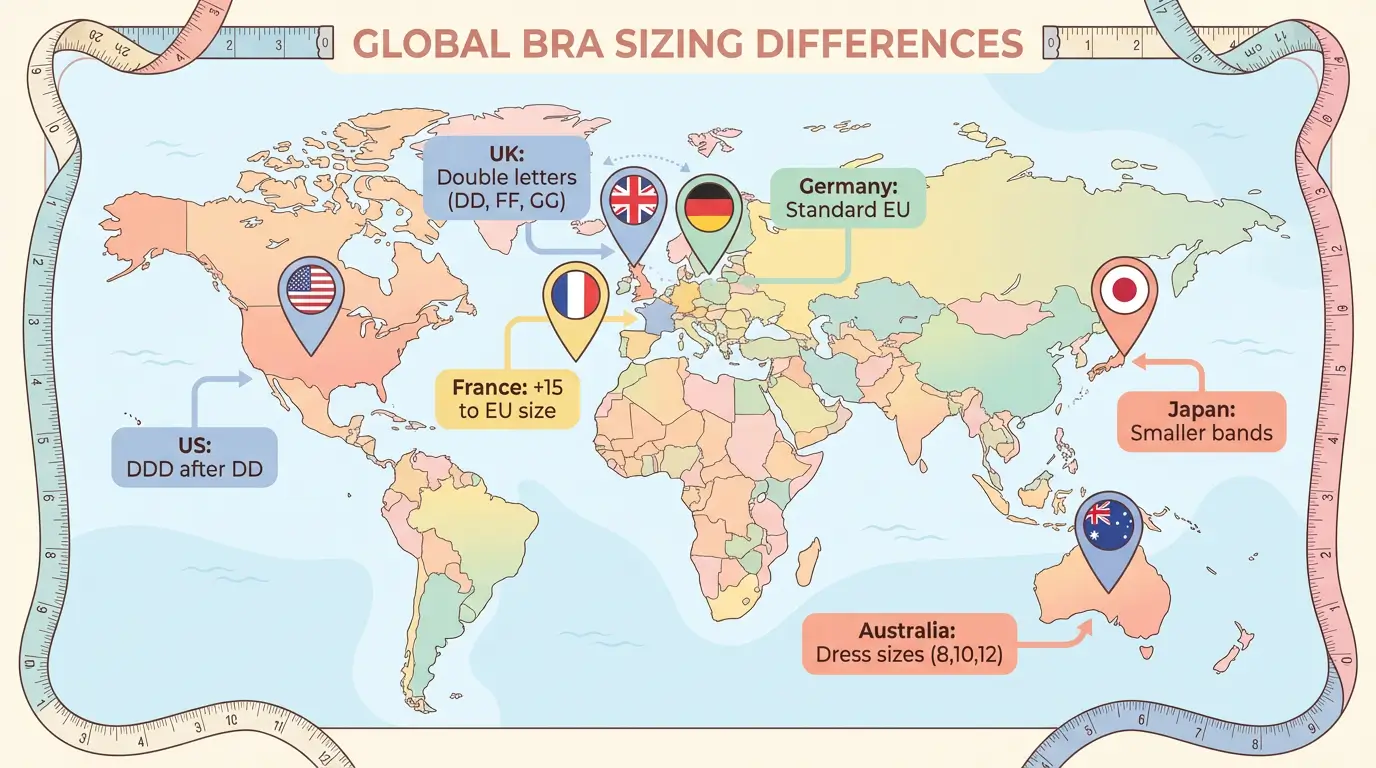
The key to successful EU shopping is knowing your exact measurements in centimeters. If you measure 75cm underbust and 93cm overbust, that’s a 75E EU (18cm difference = E cup).
When shopping European brands online, I always recommend using our international bra size converter tool to double-check your calculations—it’s saved me (and my clients) countless returns and frustrations.
UK to Australian/NZ Cup Size Conversion
Australian and New Zealand bra sizing presents another unique challenge for UK shoppers. When I first started working with clients who had moved from Australia to the UK, I was surprised by how different the systems were. Let me demystify this conversion for you.
Understanding Australian Band Sizing
Australia and New Zealand use dress sizes for their band measurements, which can be completely confusing if you’re used to the UK system. Instead of numbers like 32, 34, 36, they use dress sizes: 8, 10, 12, 14, 16, 18, 20, etc.
The conversion formula is relatively straightforward:
Australian Band Size = UK Band Size – 22
So:
- 30 UK = 8 AU
- 32 UK = 10 AU
- 34 UK = 12 AU
- 36 UK = 14 AU
- 38 UK = 16 AU
- 40 UK = 18 AU
- 42 UK = 20 AU
Australian Cup Sizing
The good news is that Australian cup sizing is very similar to UK sizing. They use the same progression with double letters: A, B, C, D, DD, E, F, FF, G, GG, etc. This makes cup conversion much simpler than with US or EU sizing.
Conversion Examples
Let me give you some practical examples from my fitting experience:
- 34DD UK = 12DD AU
- 36B UK = 14B AU
- 32F UK = 10F AU
- 38C UK = 16C AU
- 30GG UK = 8GG AU
I remember helping a client named Sarah who had moved from Sydney to London. She was used to buying 14E bras in Australia and was completely confused when UK shops kept giving her 36E bras (which were actually the same size). Once she understood the conversion, she could shop confidently in both countries.
New Zealand Sizing
New Zealand generally follows the same sizing system as Australia, so the conversions are identical. However, I’ve noticed that some New Zealand brands tend to run slightly smaller in the band than Australian brands, so you might want to size up if you’re between sizes.
Shopping Tips for Australia/NZ
- Australian brands like Berlei and Bendon tend to run true to size
- New Zealand brands like Pleasure State often run slightly smaller
- When ordering online, always check if the brand uses UK or Australian sizing
- Many Australian online retailers now offer dual sizing charts
- Consider that Australian sizing may be affected by body shape differences (Australian women tend to have broader shoulders and shorter torsos on average)
One of the most common mistakes I see is women assuming their Australian dress size equals their bra band size. A size 12 dress doesn’t necessarily mean a 12-band bra—you still need to measure properly.
For accurate conversions when shopping Australian or New Zealand brands, I always recommend using our International Bra Size Converter—it handles all these conversions automatically so you don’t have to do the math yourself.
Understanding Sister Sizes
Sister sizing is one of the most powerful concepts in bra fitting, yet it remains one of the most misunderstood. I’ve seen it transform countless women’s bra shopping experiences from frustrating to fabulous. Let me explain this game-changing concept in simple terms.
What Are Sister Sizes?
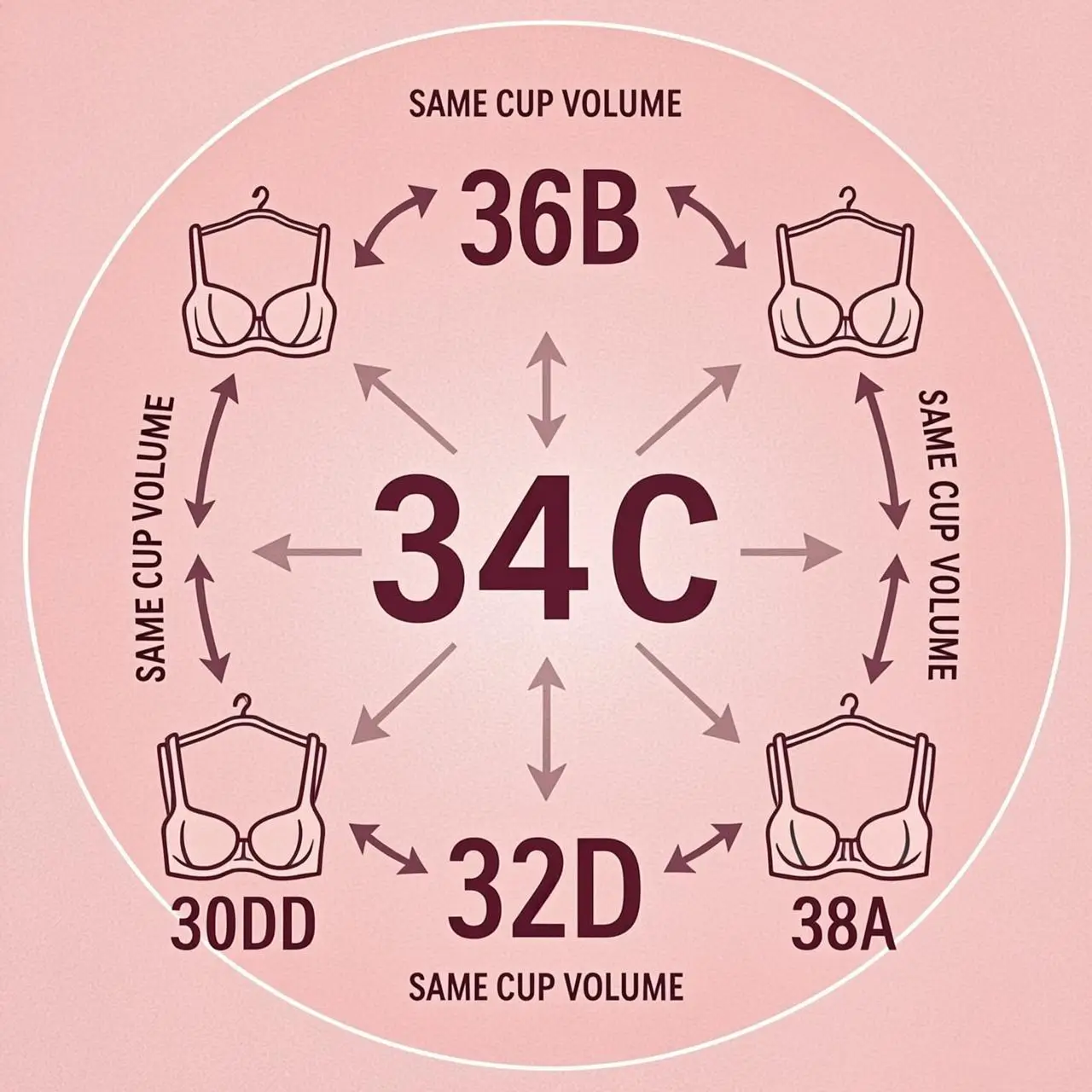
Sister sizes are different bra sizes that have the same cup volume but different band sizes. When you move to a sister size, you’re essentially keeping the same amount of breast tissue support but changing how the band fits around your body.
The basic rule is:
- Go up one band size = Go down one cup size
- Go down one band size = Go up one cup size
For example:
- 34C = 36B = 32D = 38A = 30DD
- 36DD = 38D = 34E = 40C = 32F
Why Sister Sizing Matters
I discovered sister sizing the hard way. Years ago, I was fitted for a 34D bra, but the band was cutting into my ribs while the cups fit perfectly. My fitter suggested trying the sister size down: 32DD. The band fit snugly but comfortably, and the cups—though labeled differently—contained exactly the same volume of breast tissue. It was a revelation!
Sister sizing is particularly useful when:
- Your band is too loose but cups fit perfectly
- Your band is too tight but cups are too big
- A specific size is out of stock but you need the same cup volume
- You’re between band sizes and need flexibility
- Different brands run differently in sizing
How to Calculate Sister Sizes
Let me walk you through the calculation process:
Starting with 34C:
- Sister size up: 36B (band +2, cup -1)
- Sister size down: 32D (band -2, cup +1)
- Next sister up: 38A (band +4, cup -2)
- Next sister down: 30DD (band -4, cup +2)
Starting with 36DD:
- Sister size up: 38D (band +2, cup -1)
- Sister size down: 34E (band -2, cup +1)
- Next sister up: 40C (band +4, cup -2)
- Next sister down: 32F (band -4, cup +2)
Sister Size Limitations
While sister sizing is incredibly useful, there are limits. I generally recommend only going 1-2 sizes up or down from your true size. Going beyond this can lead to fit problems:
- Too many sizes up: The band becomes loose and rides up, while the cups become too shallow
- Too many sizes down: The band cuts in and restricts breathing, while the cups become too deep and gape
I had a client who was a true 34F but tried to wear a 30FF because it was the only size available. The band was so tight it left red marks, and the cups were completely empty at the bottom. We found her perfect fit at 32G—the sister size down from her true size.
When to Use Sister Sizes
Here are the most common scenarios where sister sizing saves the day:
- Brand Variations: Some brands run small in the band (like Freya) while others run large (like some US brands). Sister sizing helps you adapt.
- Between Sizes: If you measure as a 33-band, you might be equally comfortable in 32DD and 34D.
- Band Issues: If your band rides up but cups fit, try sister size down. If band is too tight but cups overflow, try sister size up.
Style Differences: Plunge bras often need sister sizing down compared to full-cup bras for the same person.
Real-Life Sister Size Examples
Let me share a story about my client Emma. She was measured as a 36E, but found that most brands in that size had bands that were too loose. We discovered that her perfect fit was actually the sister size down: 34F. The band fit snugly where it should, and the cups held her breast tissue perfectly.
Another client, Lisa, was a 32G but found that sports bras in her size were too tight in the band. We tried the sister size up (34FF) and it was perfect—the band had enough stretch for movement while the cups still contained everything properly.
Understanding sister sizing opens up a world of possibilities. Instead of being limited to your exact size, you have flexibility to find what works best for your body and the specific bra style. This knowledge alone has saved my clients hundreds of dollars in returns and replacements.
Common UK Bra Fitting Problems & Solutions
Even with perfect measurements and conversions, fit problems can still occur. In my years as a bra fitting expert, I’ve seen every possible issue—and I’m here to help you solve them. Let’s tackle the most common UK bra fitting problems head-on.
Band Problems
Problem: Band Rides Up in Back
This is the most common issue I see. If your bra band creeps up your back throughout the day, it’s almost always too big. Many women think a loose band is comfortable, but it actually forces the cups to do all the work, leading to poor support.
Solution: Try going down one band size and up one cup size (sister size down). For example, if you’re wearing 36C and the band rides up, try 34D instead. The smaller band will stay in place, and the larger cup will compensate for the reduced band size.
Problem: Band Too Tight, Leaves Red Marks
If your band leaves deep red marks or you can’t fit two fingers underneath it, it’s too tight. This restricts breathing and circulation.
Solution: Try sister size up—go up one band size and down one cup size. If you’re in 34D and it’s too tight, try 36C. Make sure you’re fastening on the loosest hook initially—bras stretch over time.
Cup Problems
Problem: Cup Spillage/Overflow
If breast tissue is spilling out of the top, sides, or bottom of your cups, you need more cup volume. This is often called “quad-boob” or “uniboob” when it happens on the sides.
Solution: Go up one cup size while keeping the same band, or try sister size down (smaller band, larger cup). For example, if 34D overflows, try 34DD or 32E.
Problem: Gaping Cups
If there’s empty space in your cups, especially at the top or sides, your cups are too big. This often happens when women buy based on band size alone.
Solution: Go down one cup size while keeping the same band, or try sister size up. If 34F gaps, try 34E or 36DD.
Strap and Support Problems
Problem: Straps Dig Into Shoulders
This painful issue is almost always caused by insufficient band support. When the band is too loose, the straps have to carry all the weight.
Solution: First address the band fit (see above). Properly fitting bands should provide 80% of support, leaving straps just for stability. Also ensure straps are adjusted correctly—not too tight, not too loose.
Problem: Straps Keep Falling Down
Slippery straps often indicate that the band is too loose or the cup is too small. The bra is trying to find its natural position.
Solution: Check band fit first. If the band is correct, you may need a different style with wider, more grippy straps. Some women need “J-hook” converters for strapless occasions.
Center Panel and Wire Issues
Problem: Underwire Digging or Poking
If the underwire is uncomfortable or poking you, it’s likely the wrong shape or size for your breast root (where your breast meets your chest wall).
Solution: Try a different cup size or brand. Some brands have wider wires (good for wide-set breasts) while others have narrower wires (good for close-set breasts). Non-wired bras may be more comfortable if you have sensitive skin.
Problem: Center Panel (Gore) Doesn’t Lie Flat
The center panel between the cups should lie flat against your sternum. If it lifts away, your cups are likely too small or the wrong shape.
Solution: Go up one cup size or try a different bra style. Plunge bras often work better for women with close-set breasts, while full-cup bras work better for wide-set breasts.
Troubleshooting Chart
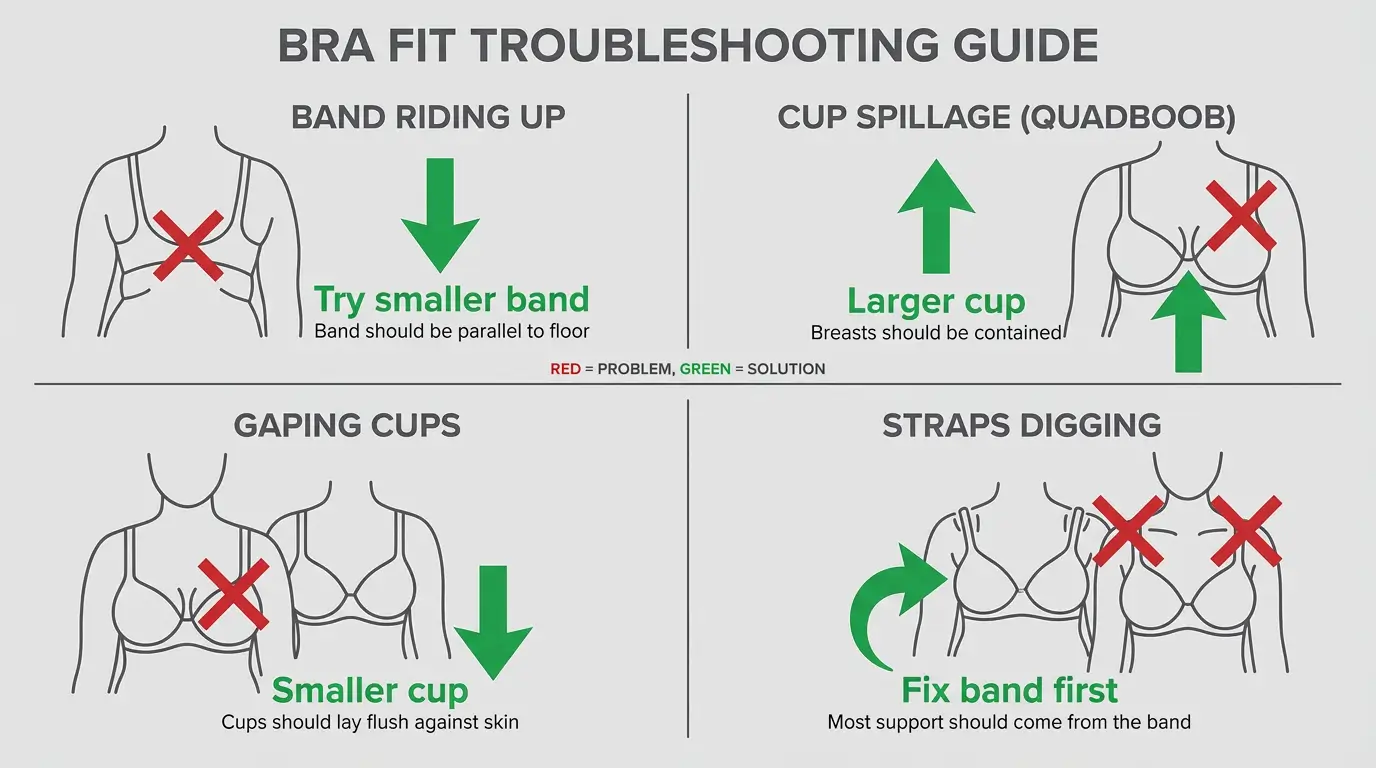
| Problem | Likely Cause | Solution |
|---|---|---|
| Band rides up | Band too big | Sister size down (smaller band, larger cup) |
| Band too tight | Band too small | Sister size up (larger band, smaller cup) |
| Cup spillage | Cup too small | Go up one cup size or sister size down |
| Gaping cups | Cup too big | Go down one cup size or sister size up |
| Straps dig in | Band too loose | Fix band fit first, then adjust straps |
| Straps slip | Band too loose or cup too small | Check band fit, try different strap style |
| Wire digs | Wrong wire shape/size | Try different brand or cup size |
| Center panel lifts | Cup too small or wrong shape | Go up cup size or try different style |
| Back pain | Poor support distribution | Ensure proper band fit, check cup volume |
I remember one client who came to me with chronic back pain. She’d been wearing 38B bras for years because that’s what her mother told her to buy. When we measured her properly, she was actually 34F. The difference was night and day—her back pain disappeared within weeks of wearing properly fitted bras.
The most important thing to remember is that fit problems are rarely your fault—they’re usually a result of incorrect sizing or poor bra design. Your body is perfect; you just need the right tools to fit it properly.
Ready to solve your bra fit problems once and for all? Use our International Bra Size Converter tool to find your true size and eliminate these frustrating issues.
Tips for Shopping UK Bras Online
Online bra shopping can be intimidating, especially when you’re dealing with international sizing. I’ve made plenty of expensive mistakes over the years, and I want to help you avoid them. Here are my top tips for successful UK bra shopping from anywhere in the world.
Know Your Measurements In Multiple Systems
Before you even start shopping, know your size in all relevant systems:
- UK size (your primary reference)
- US equivalent
- EU equivalent
- Australian equivalent
- Your exact underbust and overbust measurements in both inches and centimeters
I keep a note on my phone with all my measurements and conversions. It’s saved me countless times when I’m tempted by a sale or new brand.
Research Brand-Specific Sizing
This is crucial—sizing varies dramatically between UK brands. From my experience:
- Marks & Spencer: Generally true to size, good for beginners
- Bravissimo: Specializes in DD+ cups, tends to run true to size
- Freya: Known for running small in the band, often need sister size up
- Panache: Generally true to size, excellent for fuller busts
- Curvy Kate: Runs small in bands, generous in cups
- Goddess: American brand but popular in UK, runs large in bands
I learned this the hard way when I ordered a Freya bra in my usual 34E, only to find the band was impossibly tight. Turns out Freya bands run about one size smaller than standard.
Read Customer Reviews Strategically
Don’t just read reviews—analyze them for sizing information. Look for comments like:
- “I normally wear 34F but needed 36E in this style”
- “Runs small in the band”
- “Cups run large”
- “True to size for me”
I always sort reviews by “most recent” and look for reviewers with similar measurements to mine. One of my clients found her perfect fit by noticing that several reviewers with her exact measurements all recommended sizing up one band.
Check Return Policies Thoroughly
Before ordering, verify:
- Free returns or paid returns?
- How long do you have to return?
- Do they provide return labels?
- Are there any restrictions on worn items?
- Do they charge restocking fees?
UK retailers like Bravissimo and Panache offer free returns with pre-paid labels, which makes trying multiple sizes risk-free. I always order two sizes when possible—my true size and the sister size.
Use the International Bra Size Converter
Before adding anything to your cart, double-check the size conversions using our International Bra Size Converter. This tool has saved me hundreds of dollars in returns and replacements by ensuring I order the right size the first time.
Timing Your Purchases
UK bra sales follow predictable patterns:
- January: Post-Christmas sales (up to 70% off)
- June/July: Summer sales
- November: Black Friday deals
- End of season: March and September
I always stock up during January sales—quality UK bras are investment pieces, and buying during sales makes them much more affordable.
My Personal Online Shopping Routine
Let me share my exact process for stress-free UK bra shopping:
- Measure myself (underbust and overbust) before shopping
- Use the converter tool at “My Bra Size Converter” to get my UK size and sister sizes
- Check the brand’s specific size chart on their website
- Read recent customer reviews focusing on sizing comments
- Order two sizes when possible (my calculated size and sister size)
- Try them on immediately upon arrival with a form-fitting top
- Return what doesn’t work using the pre-paid label
I remember my first successful online UK bra purchase—I was so nervous, but following this process meant I got it right on the first try. That Panache bra still fits perfectly three years later.
The key to successful online bra shopping is preparation. Take the time to understand your measurements, research brands, and use the right tools. Your perfect fit is worth the effort.
Conclusion
Navigating UK cup size conversion doesn’t have to be confusing or intimidating. As we’ve explored throughout this guide, understanding the UK sizing system—with its precise band measurements and logical cup progression—can actually be your greatest ally in finding bras that fit perfectly and feel amazing. Whether you’re converting from US, EU, or Australian sizing, the key is knowing your true measurements and understanding how sister sizing can give you flexibility when shopping different brands.
I’ve seen firsthand how a properly fitted bra can transform not just your appearance, but your confidence, comfort, and even your posture. Remember that 70-85% of women wear the wrong size—don’t let that be you. Take the time to measure yourself properly, use the conversion tools available to you, and don’t be afraid to experiment with sister sizes when needed.

Ready to find your perfect fit? Use our International Bra Size Converter tool and discover the difference that proper sizing can make. For more about our mission to help women find their perfect fit, visit our About page, and if you have any questions, our team is always here to help on our Contact page.
I’ll leave you with this thought: Your body is unique and beautiful exactly as it is. The right bra shouldn’t fight against your shape—it should celebrate it. Here’s to finding that perfect fit that makes you feel confident, supported, and completely yourself.
Frequently Asked Questions: UK Cup Size Conversion
Your UK cup size depends on the difference between your bust and band measurements. Measure snugly under your bust (round to nearest even inch for band size), then loosely around your fullest bust. Subtract band from bust: 1″ = A, 2″ = B, 3″ = C, 4″ = D, 5″ = DD, 6″ = E, 7″ = F. For accurate results, use our free International Bra Size Converter tool.
UK and US band sizes are identical (34 UK = 34 US). Cup sizes match through DD, then diverge: UK E = US DDD/F, UK F = US G, UK FF = US H, UK G = US I. Always check brand-specific charts since US sizing varies widely. When ordering US bras as a UK shopper, size up one cup after DD for proper fit.
UK and US cup sizes are identical only through DD. After that point, they diverge significantly. UK sizing continues with E, F, FF, G, GG while US typically uses DDD, F, G, H, I. This causes frequent confusion—many women order US bras thinking sizes are universal. Always convert after DD: UK E equals US DDD/F, not US E (which rarely exists).
A 34DDD in US sizing equals a 34E in UK sizing. Some UK retailers may label this as 34F depending on their specific grading system, but 34E is the standard conversion. This difference happens because US sizing uses “DDD” where UK sizing simply progresses to “E.” When shopping UK brands with a US 34DDD size, always select 34E for equivalent cup volume.
Wrap a soft measuring tape snugly around your ribcage under your bust—breathe normally and round to the nearest even inch (UK bands are always even numbers). Then measure loosely around your fullest bust. Subtract the band measurement from your bust measurement: each inch difference equals one cup size (1″ = A, 2″ = B, etc.).
Sister sizes share identical cup volume but different band sizes. Move up one band size and down one cup size (34C → 36B), or down one band and up one cup (34C → 32D). Use sister sizing when your band is too tight/loose but cups fit perfectly. This technique solves 80% of common fit problems without changing cup capacity.
UK sizing uses double letters to maintain consistent cup volume progression, especially crucial for fuller busts. Single-letter jumps (E to F) would create too large a volume increase. Double letters (E to FF) provide smaller, more precise increments—making UK sizing the gold standard for accurate fit above DD cup. This system ensures women with larger busts get properly engineered support.
Convert UK band to EU by adding approximately 30-35 to your UK band number (34 UK ≈ 75 EU). Cup conversion: UK DD = EU E, UK E = EU F, UK F = EU G. Note that EU sizing uses centimeters and typically avoids double letters. French sizing adds 15 to EU bands (75 EU = 90 French), creating additional complexity for international shoppers.
Even within UK sizing, brands engineer bras differently based on target body shapes. Freya runs small in bands, Panache fits true-to-size, and Curvy Kate offers generous cups. Manufacturing standards aren’t legally regulated—each brand creates its own block patterns. Always check specific brand size charts and read customer reviews mentioning fit before ordering, especially when shopping online internationally.
No—your size varies by bra style due to engineering differences. Plunge bras often require one cup size larger than full-cup styles. Balconette bras may need a smaller band for the same cup volume. Sports bras typically run smaller in bands for compression. Always get fitted separately for different styles, or use sister sizing to adjust when your usual size feels off in a new style.