I’ll never forget the first time I got professionally fitted at a bra specialty store. The fitter took one look at me in my 36C and said, “Honey, you’re nowhere near that size.” Turns out, I was actually a 32G. My jaw dropped. A G cup? That sounded enormous! But when I tried it on, everything finally made sense. The band actually stayed in place, my straps stopped digging into my shoulders, and for the first time in years, I felt genuinely comfortable.
If you’ve ever stood in the lingerie department feeling completely confused by bra sizes, you’re definitely not alone. Studies have found that about 25% of bra-wearing women have a difficult time finding a properly fitted bra, and many of us spend years wearing the wrong size without even realizing it. The truth is, bra sizing can seem like it’s written in some secret code that nobody ever bothered to teach us.
So what do bra sizes mean, really? In this guide, I’m going to break down everything you need to know about bra sizing, from the numbers to the letters, and why understanding both is absolutely crucial for finding bras that actually fit. And if you’re ready to discover your true size right now, you can try our International Bra Size Converter to get started.
A Brief History of Bras
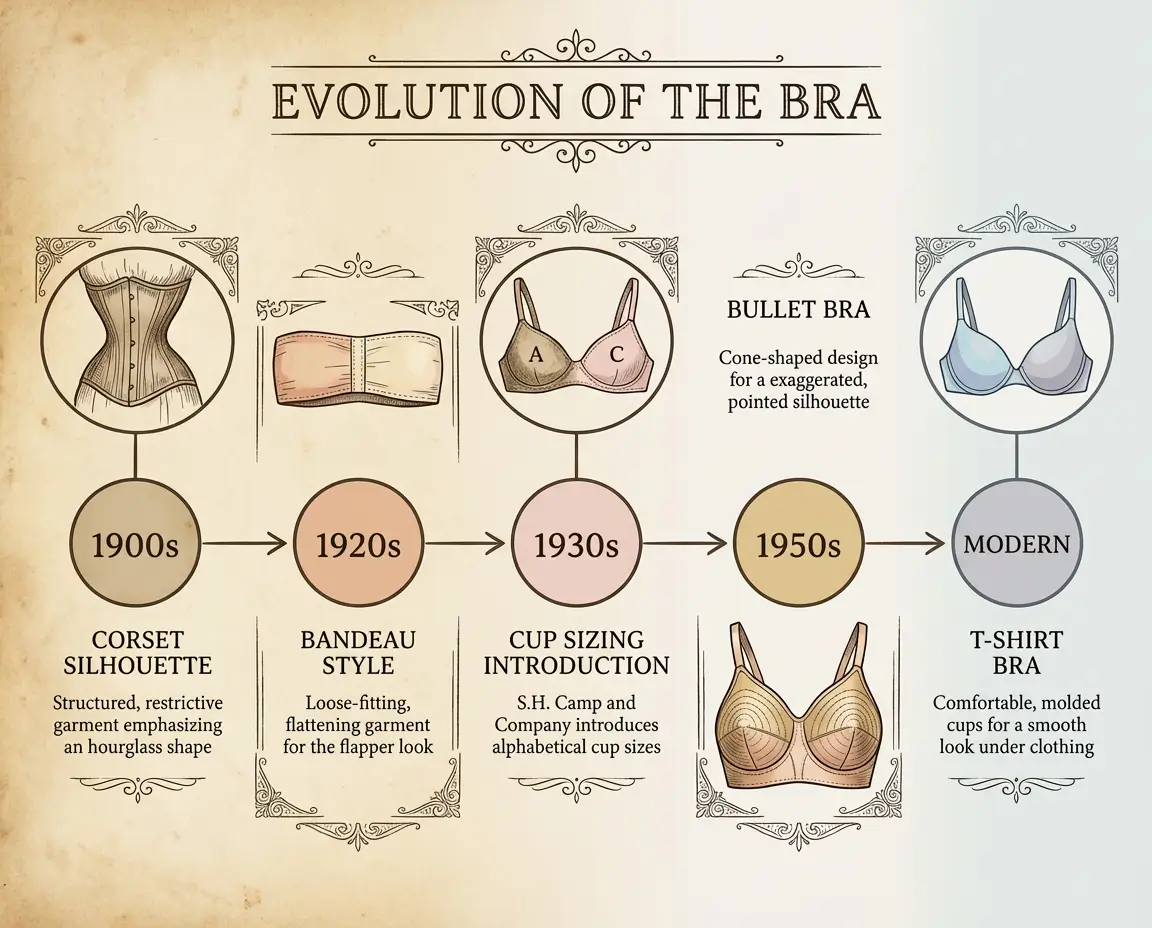
Before we dive into what bra sizes mean today, it helps to understand where they came from. For hundreds of years, women didn’t wear bras at all. Instead, they wore corsets that pushed their breasts up and together. It wasn’t until the late 1800s that the corset was divided into two pieces. The upper half was held by straps, while the lower part focused on cinching the waist.
In 1907, American Vogue first used the term “brassiere” when referring to this split design. But the modern bra as we know it was invented in 1914 by Mary Phelps Jacob, who patented her design made from silk handkerchiefs and ribbons. Talk about innovation! In the 1920s, the bandeau style rose to match the fashion of the era, and by the 1930s, the cup size system was introduced.
Adjustable and padded cups became popular, and the hook-and-eye closure we still use today also emerged during this time. Since then, bras have evolved not only with the fashions of each decade but also through advancements in technology. The bra size system itself was invented in 1932 and became popular in the 1940s, largely due to the convenience of standardized sizing (though, as we’ll discuss, the impracticality of determining exact dimensions and volume still causes confusion today).
Understanding the Basics of Bra Sizing
Here’s the thing about bra sizes: they indicate specific characteristics of how a bra will fit your breasts. When you see a bra size like 34C or 40DD, that combination of a number and letter tells manufacturers how to design and manufacture bras that will correctly fit wearers. But for individuals trying to identify their fitting size, things can get confusing fast.
Bra sizes consist of two main components that work together. Usually, a bra size consists of a number (the band that wraps around your torso) and letters that indicate the breast cup size. Multiple sizing systems exist around the world, and there’s no comprehensive international standard that exists across all countries. This is why you might find that your bra size label isn’t consistently measured across different brands or regions.
The reality is that breast styles, shape, position, symmetry, spacing, firmness, and sag vary considerably from person to person. What fits one woman perfectly might be completely wrong for another, even if they technically measure the same. This is one of the factors that makes finding a properly fitted bra so challenging, and why some women choose to buy custom-made bras for their unique shape.
Now that you understand a bit more about the complexity of bra sizing, let me break down what those numbers and letters actually mean.
What Does the Number Mean? Understanding Band Size
The band size is the number you see printed on the bra tag, like 36, 38, or 40. This number tells you what size band wraps around your rib cage. In American stores, bands typically range from 28 through 56, though the most commonly produced sizes are 32-42. Some brands like Glamorise offer extensive sizing, with bands from 30 through 58 in the United States.
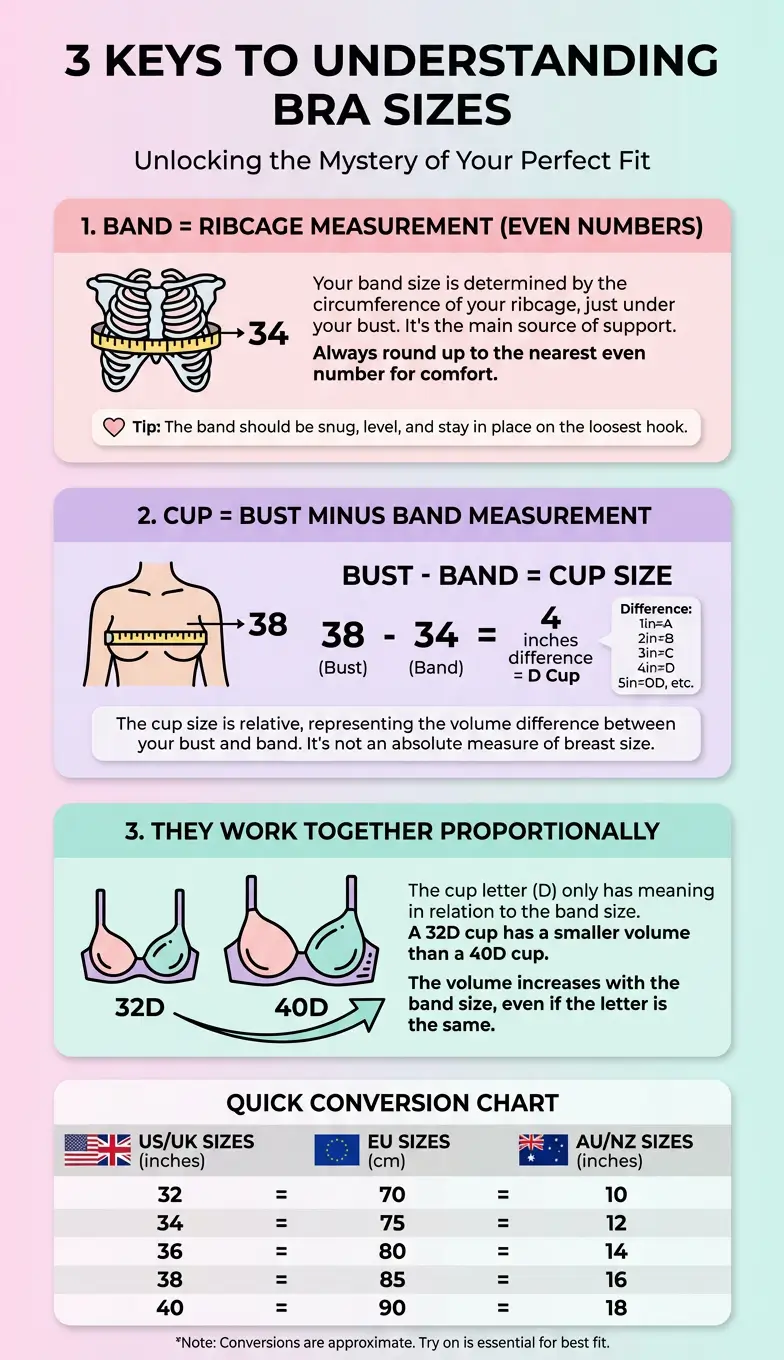
Here’s something important to know: all band sizes are even numbers. So what happens if you measure yourself and get 35 inches or 39 inches? The recommended approach is to round up to the next even number. Generally speaking, your band should fit snugly on the loosest hook when you first wear it. This allows you to adjust to the tightest hooks as the band inevitably stretches with washing and regular wear.
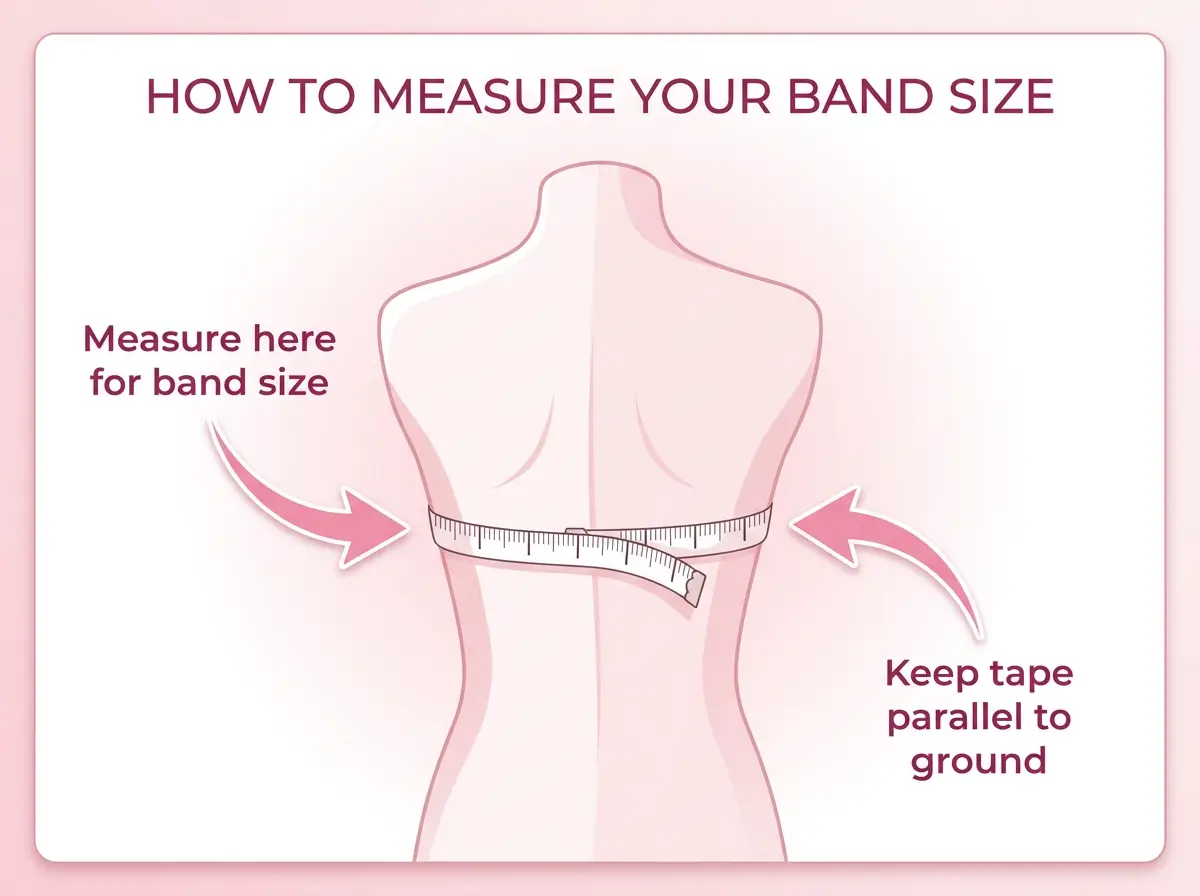
The band size is a representation of your ribcage girth. You get this by taking a measurement around your torso, right about where the band of the bra sits. This measurement is taken in inches in the United States and UK (they use the same inch-based system). For example, if you measure 32 inches, then your band size would be 32.
In Australia, however, things translate a bit differently. For example, a 32-inch measurement converts to a size 10, a 34-inch measurement becomes a 12, and a 36-inch measurement correlates to a 14. These numbers somewhat correlate to t-shirt sizes in Australia.
There’s a common misconception about what the band size component actually represents. Some people think it has to do with shoulder width, but as I mentioned, it gives you a guide for what you need to accommodate the circumference of your ribcage, including the overlying skin and subcutaneous tissue.
Want to find out what band size you need in different countries? Check out our guide on the difference between US and UK bra sizing for detailed comparisons.
What Does the Letter Mean? Understanding Cup Size
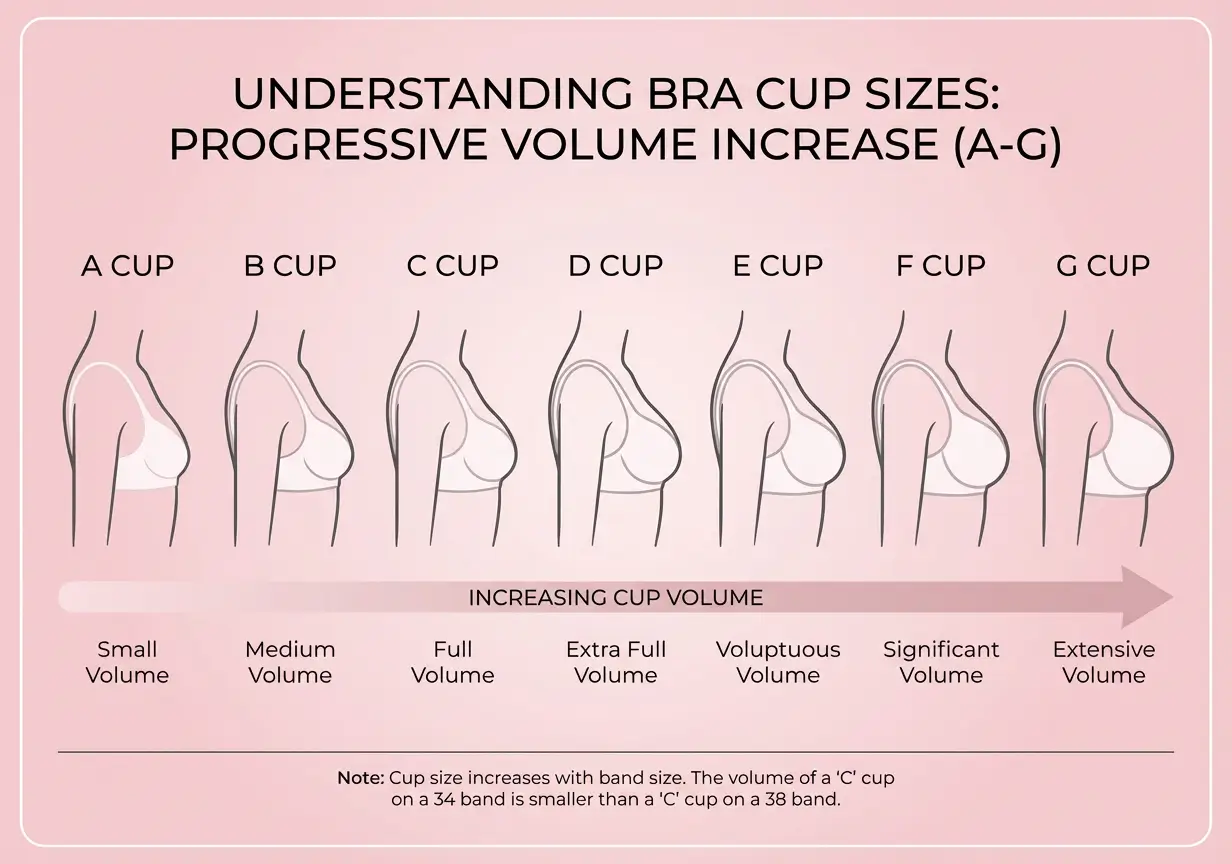
Now let’s talk about the letter, which is an indication of cup volume. The cup size represents the amount of actual breast tissue and fat that needs to be contained in each cup. The biggest letters you’ll commonly come across are C, D, and G, though cup sizes extend well beyond that in specialty stores.
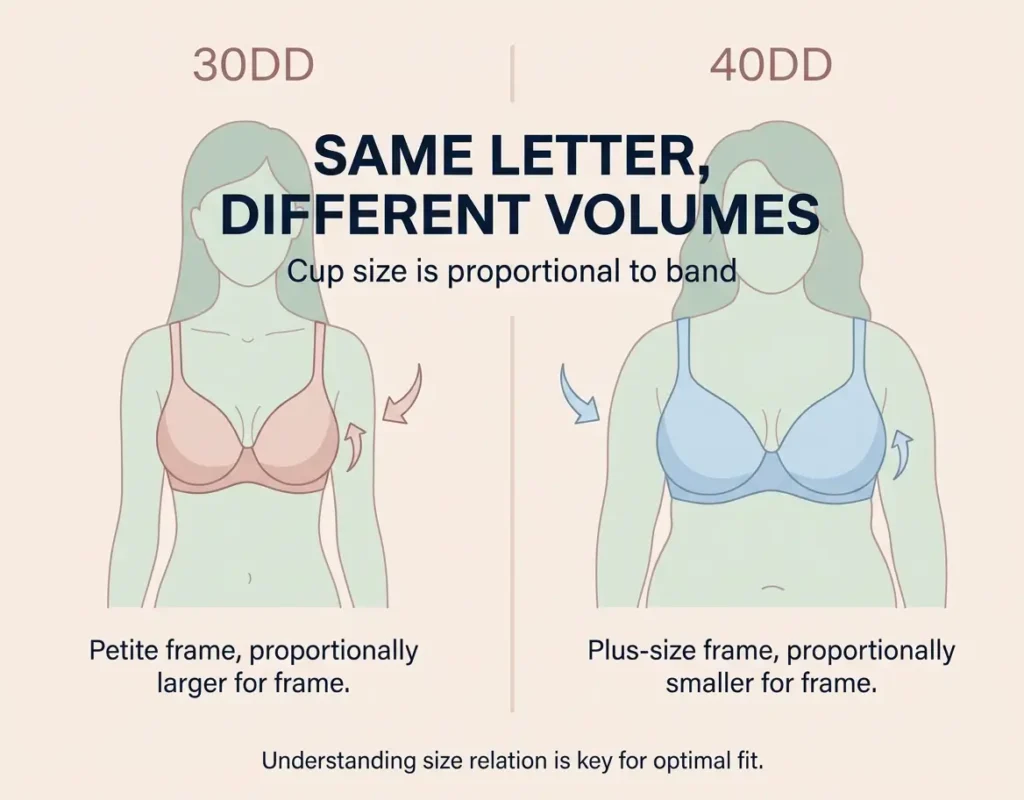
Here’s where bra sizing gets really interesting, and this is the part that trips up most people. Cup size is not a set unit of measurement on its own. A 10B is completely different from a 16B. They might both be B cups, but they’re actually 4 cup sizes apart in terms of volume. That’s because cup size is proportional to your ribcage or band size.
Read that again, because it’s crucial to wrap your head around this concept. The cup volume increases as the band size increases, even if the letter stays the same.
How Band Size and Cup Size Work Together
Understanding how these two components work together is where the magic happens when you’re shopping. Have you ever heard of sister sizing? It’s all about understanding how the band and cup dictate each other and how much breast volume each combination can hold.
So when someone says they’re a D cup, that doesn’t actually give you any useful information unless you know their band size. You can see in any bra size chart that a 24D and an 8D both have “D” cups. But the actual breast volume in a 24D would be roughly the size of small melons, yet an 8D would only be about the size of small apples.
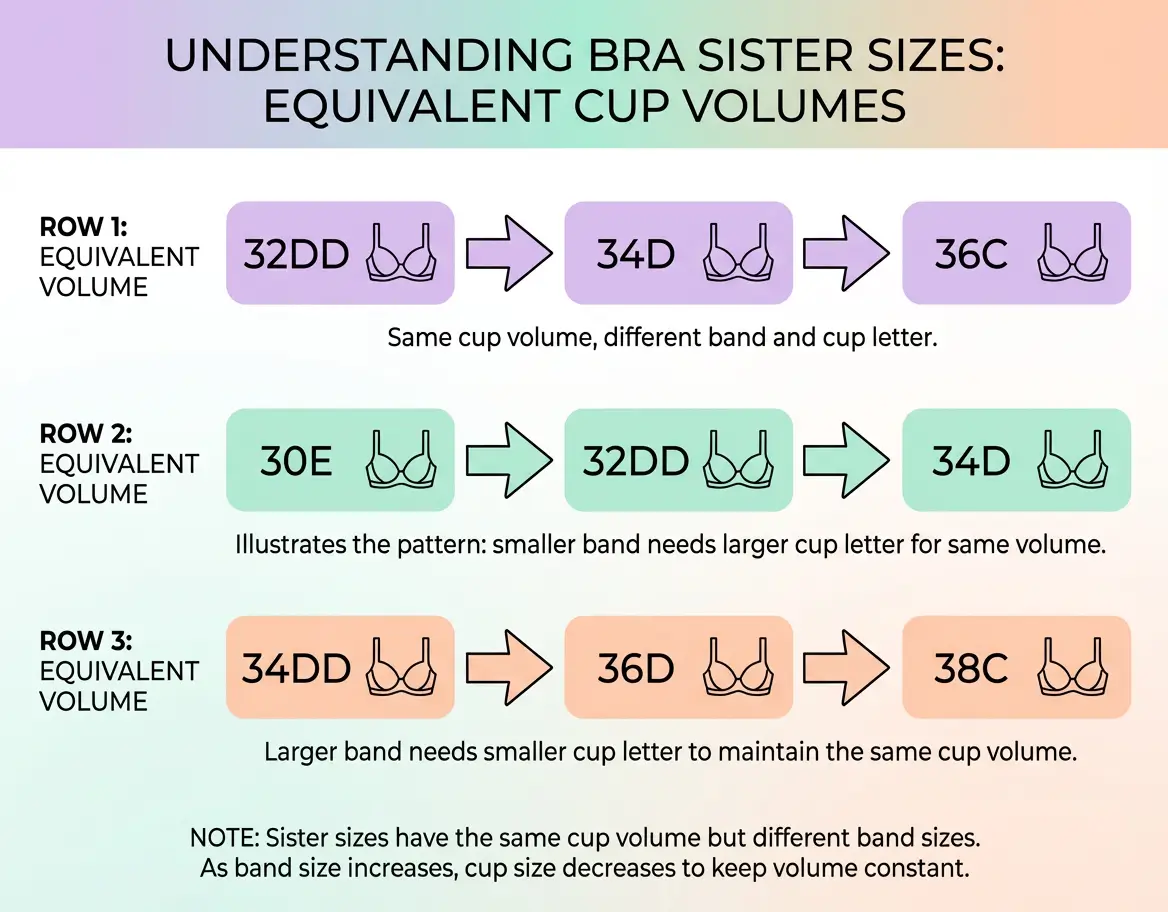
For each increase in band size, the cup volume increases by one letter. Likewise, for each decrease in band size, the cup volume decreases by one letter. This is why sister sizing works: a 32DD has the same cup volume as a 34D, which has the same volume as a 36C, and so on.
Think of it this way: the circumference of a circle changes based on the radius. If your band (circumference) goes up by 2 inches, and you want to maintain the same cup volume, you need to go down one cup letter. It’s all about maintaining that same proportional difference between your underbust and overbust measurements.
Our International Bra Size Converter can help you find your sister sizes instantly, which is incredibly useful when a bra you love doesn’t quite fit right in your usual size.
International Bra Sizing Systems: A World of Differences
Here’s something that catches a lot of women off guard: the European bra industry doesn’t have fully standardized sizing. Your bra size is different from country to country. So what if you’re on holiday in Germany and want to buy some lingerie? Are the sizes the same as back home? Nope, not at all.
United Kingdom Sizing
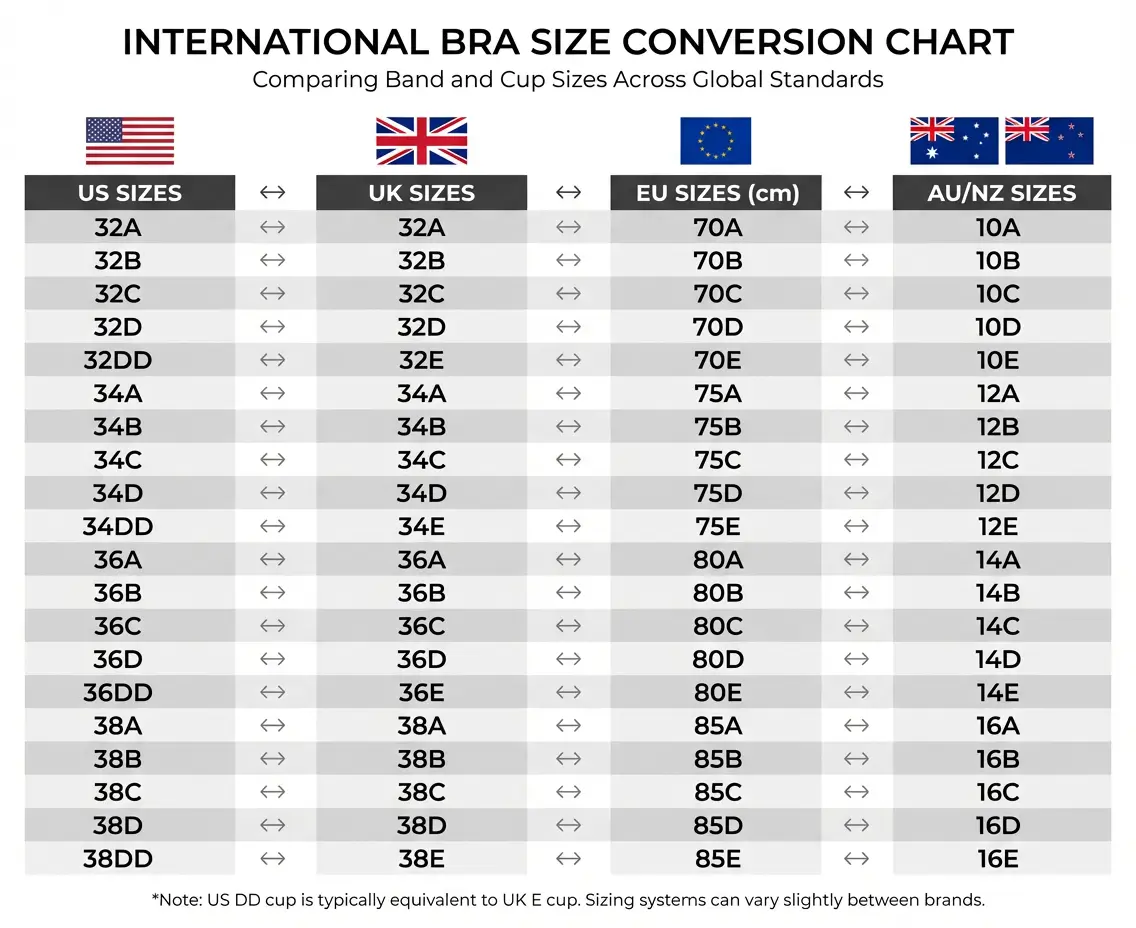
The United Kingdom also uses numbers and letters, but they handle double letters like DD differently. Their cup progression goes A, B, C, D, DD, E, F, FF, G, GG, and so on. Notice how they use double letters consistently after D? A UK 32DD would be equivalent to a US 32DD, but sizing diverges as you go up.
If you’re shopping for English bra sizes, it’s essential to understand these differences. We have a comprehensive UK cup size conversion guide that breaks down exactly how UK sizing works.
European Sizing (France, Spain, Belgium)
European sizing uses centimeters instead of inches. A 32DD in US sizing would be a 70E in European sizing. See the difference? Other notable differences: France and Spain use numbers that go by 5s. For example, you’ll see band sizes like 80, 85, and 90.
The European system is based on your underbust measurement in centimeters, rounded to the nearest multiple of 5 cm. So bands run 65, 70, 75, 80, and so on, increasing in steps of 5. This is similar to the English inch system, just using a different unit of measurement.
Here’s a breakdown of how European band sizes work:
Band Size (FR/BE/ES) | Underbust Circumference (cm)
- 75: 58–62 cm
- 80: 63–67 cm
- 85: 68–72 cm
- 90: 73–77 cm
- 95: 78–82 cm
- 100: 83–87 cm
- 105: 88–92 cm
- 110: 93–97 cm
- 115: 98–102 cm
- 120: 103–107 cm
- 125: 108–112 cm
A person with a measured underbust circumference of 78–82 cm should wear a size 80 band. However, the tightness or snugness of the tape measure depends on the adipose tissue softness around the ribcage. Softer tissue may require tightening the tape when measuring to ensure the band will fit snugly on the body and stay in place without being too loose.
This often causes confusion. Someone who measures 84 cm might think they need an 85 band due to rounding, but if they have a lot of soft tissue, they might need the same band size as someone who measures 79 cm but needs a snugger fit. Some people even choose an appropriate band size even smaller than their measurement suggests.
For European cup sizes, the difference between your underbust and bust measurements determines your cup:
Cup Size | Difference (cm)
- AA: 10–12 cm
- A: 12–14 cm
- B: 14–16 cm
- C: 16–18 cm
- D: 18–20 cm
- E: 20–22 cm
- F: 22–24 cm
- G: 24–26 cm
- H: 26–28 cm
European cup sizes normally begin at AA for a 13±1 cm difference between your bust (measured loosely, i.e., not pulled tightly) and the band size (measured snugly). Cup sizes that require a much tighter underbust measurement while determining cups can confuse people, since the two measurements might seem identical.
In this sense, the method used to determine European cup sizes differs compared to other systems where cup size is determined by the difference between measurements. European cups increase every 2 cm instead of the 2.5 cm (1-inch) intervals used in US/UK sizing. Also, except for the initial AA cup, European letters are neither doubled nor skipped, which makes their cups very slightly smaller than their US/UK counterparts.
This system has been somewhat standardized through the dress size standard EN 13402, which was introduced in 2006, though many countries used similar systems before that date. These are known as “International” sizes, with abbreviations such as EU, Intl, or Int all referring to this convention. These labels are used in most large parts of the world.
Need to convert from European to UK bra sizes? Our converter makes it simple.
Italy
Italy uses numbers for their band sizes in a completely different system: 1, 2, 3, and so on. In the Italian system, 1 equals a 32 band, 2 equals a 34 band, and they continue from there.
IT Size | Band Size
- I (1): 32
- II (2): 34
- III (3): 36
- IV/IIII (4): 38
- V (5): 40
- VI (6): 42
- VII (7): 44
- VIII (8): 46
- IX/VIIII (9): 48
- X (10): 50
Australia and New Zealand
Australia and New Zealand use a band sizing system that starts at 8. An Australian 8 would be equal to a US/UK 30, a 10 equals 32, a 12 equals 34, and so on. If you’re converting between American and UK bra sizes, remember that the band numbers are the same, but cup letters may differ.
How to Accurately Calculate Your Bra Size
Different brands tend to use different methods for determining bra sizing, which adds to the confusion. To determine your size in most brands (like Glamorise bras), you’ll want to take your band measurement by wrapping a tape measure above your bust, just under your arms. Then measure around the fullest part of your bust.
Once you have both measurements, you can plug them into our Bra Size Calculator to see what size is best for you. Then treat yourself to a new bra—you deserve it!
Here’s my recommended method for measuring at home:
Finding Your Band Size
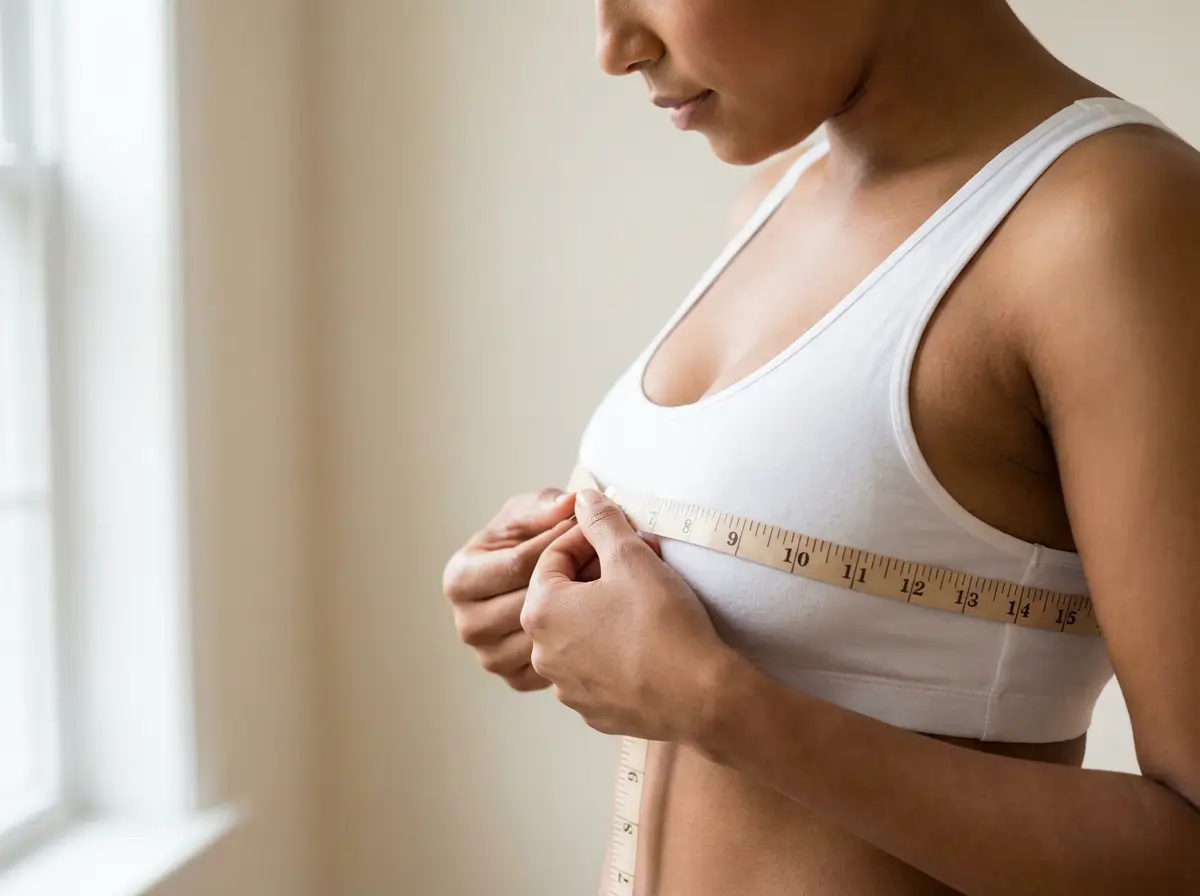
Measure snugly around your ribcage, directly under your breasts. The tape should be parallel to the ground, not twisted up or twisted down. Make sure it’s straight across your back. If you get an odd number (like 31 inches or 35 inches), round UP to the next even number. So 31 becomes 32, and 35 becomes 36. That’s your band size.
Some guides add 3 or 4 inches to your underbust measurement, but at our site, we recommend measuring above the bust to get an even number already. This makes the calculation easier because the measurement is simply rounded to the nearest even number, which is an industry norm. The older method was to measure the underbust and add 4 inches—if you got 32 inches, you’d add 4 inches to get 36. But measuring over the bust makes this unnecessary, and it’s why we use that method.
Finding Your Cup Size
Measure loosely around the fullest part of your bust. Make sure the tape measure wraps around your back at the same height as the front—it should create a complete circle around your body. Subtract your band size from this measurement. The difference tells you your cup size.
Here’s the table for cup size differences:
Difference | Cup Size
- 0-1 inch: AA
- 1 inch: A
- 2 inches: B
- 3 inches: C
- 4 inches: D
- 5 inches: DD/E
- 6 inches: DDD/F
- 7 inches: G
For example, if your ribcage measurement is 31 inches (round to 32 for band size) and your bust measurement is 37 inches, your bra size would be 34C. Wait, you might be thinking—didn’t we just say the band was 32? Here’s the thing: you take your original measurement of 31, add 3 inches to get 34 as your band size, then the 3-inch difference between 34 and 37 gives you a C cup. Different methods yield slightly different results, which is why trying on bras is still essential.
Actually, let me clarify the simpler modern method: if you measure 32 inches under your bust and 35 inches at the fullest part, the difference is 3 inches, making you a 32C. One inch difference equals an A cup, 2 inches equals a B cup, 3 inches equals a C cup, and so on.
What If You Don't Have a Tape Measure?
How do you measure bra size at home if you don’t have a soft measuring tape? If you don’t have one but want to measure at home, use a piece of string or non-stretchy ribbon instead. Simply wrap it around yourself and mark where the ends meet. Then lie it flat against a ruler to determine the length in inches for each measurement.
How to Know If Your Bra Fits Correctly
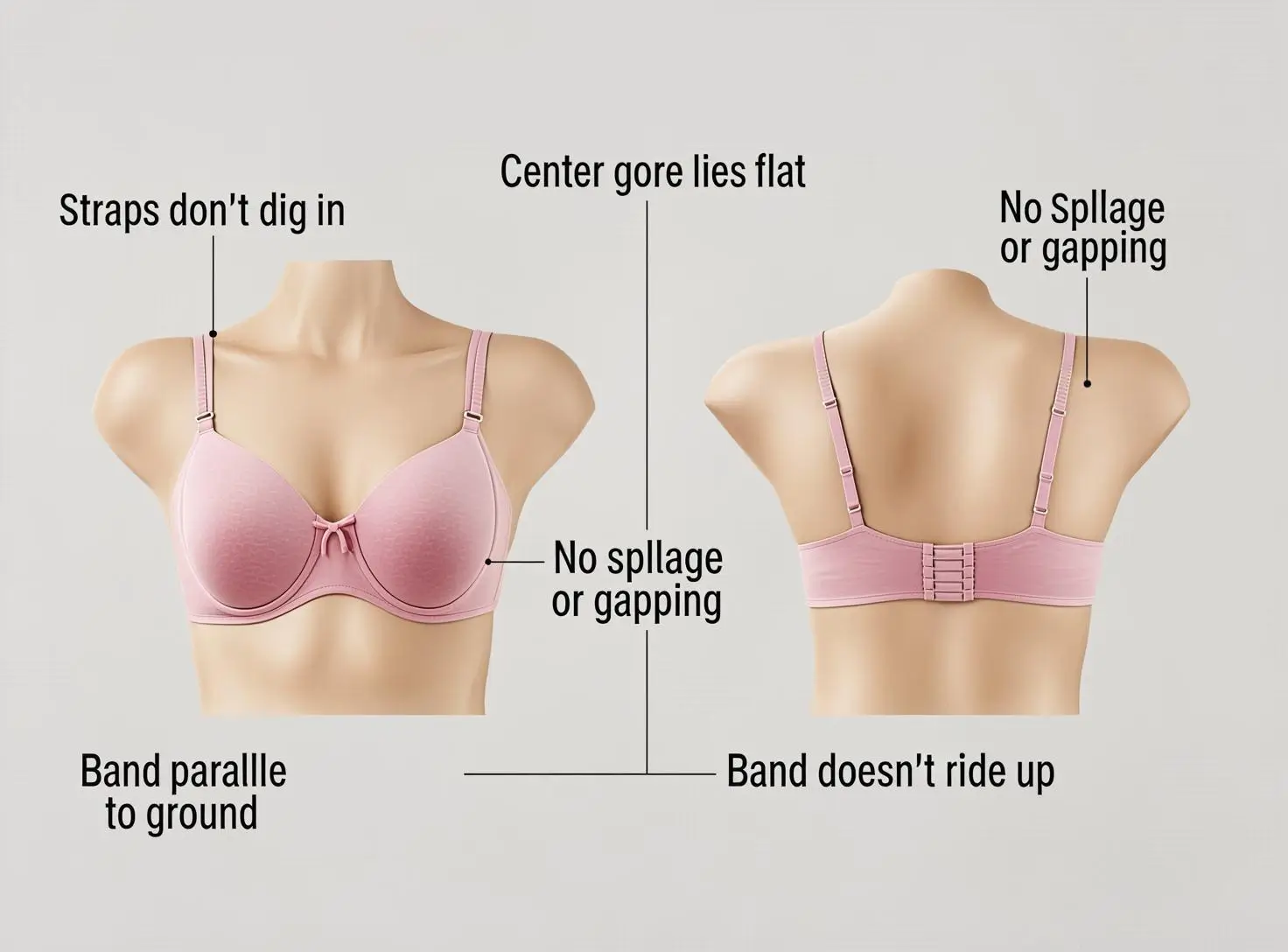
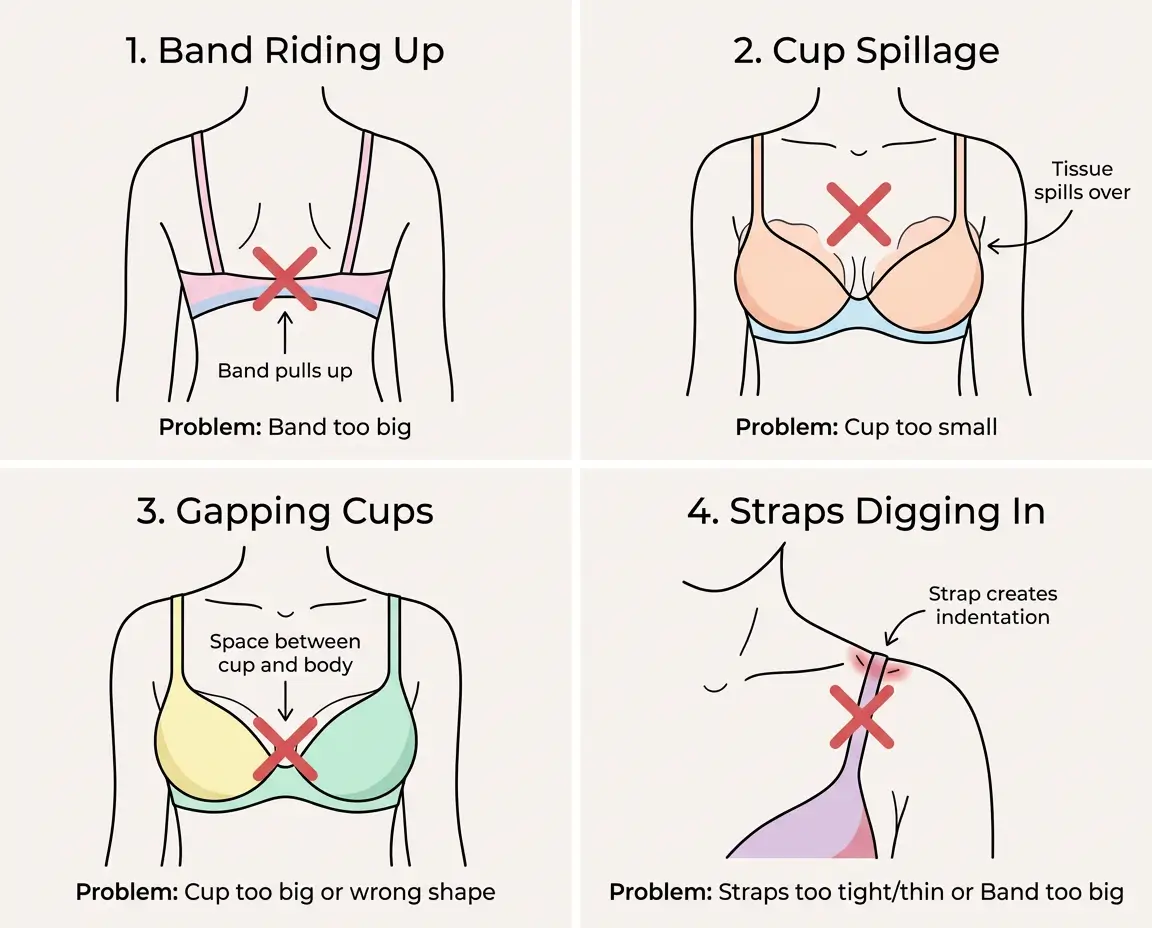
One of the most important factors in determining if your bra fits correctly is whether the band should fit snugly enough to provide proper support. You should be able to slide one or two fingers underneath the band, but it shouldn’t be so loose that you can fit your whole hand under there. A snug band means the band is actually providing the support your breasts need.
The cups should also fully encapsulate your breast tissue. A well-fitting bra will have no spillage over the top or sides, and no gapping where the cup is too large. Your straps should sit comfortably on your shoulders without digging in or sliding off.
Here’s a quick checklist to see if your bra fits well:
The band sits firmly in place around your ribcage. It doesn’t ride up your back. If it does, you need a smaller band size.
The center of the bra (between the cups) should lie flat against your breastbone. If it doesn’t, your cups are too small.
The cups completely contain your breasts with no spillage over the top or sides. Push back against the cups—if they move or there’s gaping, the cups are way too big. But if your boobs spill out, the cups are too small. When the cups fit perfectly, your breasts look amazing and feel supported.
The straps provide some additional support and lift, but they shouldn’t be doing all the work. The band should be carrying about 80% of the weight of your breasts. If your straps are digging into your shoulders painfully, it often means your band is too loose and the straps are compensating. Try tightening the band or going down a band size.
Overall comfort is foremost—your bra should feel comfortable and supportive without being tight or restrictive.
Common Problems and Solutions
Why Is It Bad to Wear a Bra That Is Too Tight?
A bra that’s too tight is just plain uncomfortable. It’s not likely to cause any serious health problems, but it won’t provide ample support either and will definitely cause discomfort and pain. Wearing a bra that’s too tight can leave painful red marks on your skin, cause irritation, and create the appearance of bumps and bulges under your clothes.
My Straps Are Digging In—Do I Need a Bigger Size?
If your straps are digging in, the first thing to try is loosening or tightening them. If neither of those adjustments helps, you actually need a smaller band size, not a bigger one. This is a common misconception about bra fit.
Remember, the straps shouldn’t be holding all the weight of your breasts. In reality, the band should offer the majority of support, with the straps providing some additional lift. If your band is too loose, it falls down on your back, which is what causes the straps to dig in uncomfortably as they try to do all the lifting work.
Larger breasts benefit from broader, non-stretchy straps that distribute weight more evenly through a cantilevering effect on the shoulders (kind of like a suspension bridge). The structure of the band and properly fitted cups can relieve pressure on the straps.
How Often Should I Measure Myself for a New Bra?
It’s a good idea to remeasure yourself at least once a year to ensure you’re wearing the correct size. Bra sizes and our bodies change over time, so if your current bras don’t seem like they are supporting you as well as they should, it’s a good idea to take fresh measurements. The most important factor in having a supportive bra is making sure it’s properly fitted to your current body.
Why Do Some Guides Say to Measure Under the Bust and Others Say Above the Bust?
There is no single standardized way to measure for bras. Some brands recommend measuring the rib cage directly underneath the breasts, whereas others (like us at our site) suggest measuring above the bust. We do this to get an even number without having to add 4 or 5 inches to an odd measurement.
This difference in methods is part of what makes bra sizing so confusing. The older method was to measure your underbust and add 4 inches—so if you got 32 inches, you’d add 4 to get 36 as your band size. Taking your measurement over the bust makes this calculation easier because the measurement is simply rounded to the nearest even number, which has become the industry norm in many places.
Understanding Bra Technology and Design
Now that we’ve covered the basics of what bra sizes mean, let’s talk briefly about how different bra technologies work with your size to provide support.
Compression vs. Encapsulation
Compression uses elastic support fabrics to compress the breasts against the body, reducing bounce and creating what’s sometimes called a “uniboob” appearance. This is common in sports bras, especially for smaller-breasted women.
Encapsulation works by reducing bounce through individual molded or semi-rigid cups that contain and support each breast separately, maintaining the natural shape of each cup. Most built-in bras use this approach, as it limits independent movement while providing better shape definition.
Many modern bras use a combination of compression and encapsulation support for optimal comfort and function.
Underwire and Support Systems
An underwire is a semi-circular frame sewn into the support system under each breast. These stiffening components help hold the breast tissue in place and provide shaping and overall support. Not everyone needs or likes underwire, but it’s particularly helpful for larger cup sizes.
Closures and Fasteners
Smaller cup sizes (A/B) often feature pull-over styles with no closures, since the difference between band size and bust size isn’t as significant. Getting a suitably sized band over your head is much more difficult when there’s a bigger difference.
C, D, and DD cup bras typically have either a front closure or rear closure. The hook-and-eye closure (usually at the back) is most common. Some bras have the closure covered to make it invisible against the skin and prevent chafing.
Breaking Down the Biggest Misconceptions About Bra Sizing
Let me be honest with you: the majority of women in Australia, the US, the UK, and pretty much everywhere don’t truly understand how bra sizing works. There are three main points that are hard to wrap your head around when it comes to understanding the truth of bra sizes. Once you know these, you’ll comprehensively understand bra sizing better than most people. It may seem weird at first, but it all makes sense by the end, so make sure you read until the end. Let’s go through this together.
Misconception #1: Cup Size Has a Fixed Volume
People think a D cup is a D cup is a D cup. But that’s 100% wrong. As I explained earlier, cup size is proportional to band size. A person wearing a 30DD might be a petite, slim person with relatively large breasts visually, while a 40DD might be a larger, plus-size person with relatively small breasts visually. The breasts on the second person are actually larger in total volume—they’re just proportionally smaller for that person’s larger body frame.
You simply can’t judge someone’s cup size by looking at them. A woman in a bra with an F cup might appear to have smaller breasts than someone in a D cup if their breasts are shaped differently or if they have a smaller band size. Breast shape matters enormously. Full-on-top breasts make the volume more visible and appear more supported vertically, while breasts with tall roots have more projection at the upper part, which slopes forward and protrudes more than the whole breast volume might suggest when comparing to others.
Misconception #2: D and DD Are "Huge"
This misconception comes from decades of ill-fitting bras and poor education. Back in the 50s and 60s, people would joke about DD cups being enormous—”DD” sounded existentially horrifying and big to most people. The great irony? Most of those women joking about DD cups were probably quietly wearing the wrong size themselves, likely needing a 32G or larger.
Let me explain this to a younger generation who might still think this way: a B cup isn’t automatically flat or small. A C cup isn’t automatically medium. A D cup isn’t automatically big, and DD definitely isn’t huge. These are not descriptions of absolute size. A cup size is just a letter that indicates volume relative to band size.
Think about it this way: if the circumference of a circle (your band) changes by 5 inches, the change in radius is only about 0.8 inches (using the equation circumference = 2πr). Double that for diameter, and you get about 1.6 inches of additional projection. So a D cup (4 inches of difference) means the breast protrudes about 1.6 inches (4 cm) from the chest wall. An FF cup (7 inches difference in UK sizing) means about 2.5 inches (6.5 cm) of projection. This is not MASSIVE—it’s just geometry!
Of course, this is a rough estimation since our underbust and overbust measurements aren’t perfect circles, and body shape changes everything. But it’s a good example of why a change in 8 inches of bust circumference (UK FF cup range) only creates a change in diameter of about 2.5 inches when you think of breasts as circles. The numbers are smaller than most people think.
Misconception #3: The Band Doesn't Matter Much
Wrong, wrong, wrong! The band does about 80% of the work in supporting your breasts. If your band is too big, everything else falls apart. Your cups won’t fit right, your straps will dig in, and you’ll be constantly adjusting throughout the day.
This is why sister sizing works as a temporary fix but isn’t ideal long-term. If you’re wearing a 38DD but you should actually be in a 34G, you might sister-size to a 36DDD/F to get a somewhat better fit. But you’d still be better off in the correct 34G because the band would actually provide proper support.
I’ve seen so many women discover they need a much smaller band and much larger cup than they ever imagined. Someone wearing a 38C might actually be a 32F. The difference in comfort and support is absolutely life-changing. Pre-ABTF (that’s “A Bra That Fits,” a popular Reddit community dedicated to proper bra fitting), many women wore bands that were way too big and cups that were way too small, compensating through sister sizing without even realizing it.
The Importance of Wearing the Right Size
Now that you understand what bra sizes mean and how they work, I want to emphasize why this matters so much. An ill-fitting bra will never provide the support you need. Your breasts can’t be properly supported if the band is too big or the cups are too small.
Wearing the wrong size can cause many problems beyond just discomfort. You might experience:
- Back pain and shoulder pain from poor support
- Breast pain from inadequate containment
- Poor posture as you compensate for lack of support
- Skin irritation and chafing
- Visible bulges and unflattering silhouette under clothing
- Reduced confidence in how you look and feel
It’s also important to note that every bra style won’t work for every breast shape. If you have wide-set breasts, you might prefer a bra that pulls them together, versus one that provides more encapsulation and separation. Someone with very projected breasts might need different cup construction than someone with shallow breast shape, even if they technically wear the same size.
The term “cup size” isn’t even commonly used in some European countries—they measure breasts in liters rather than using letter-based cups like we do in the USA. It’s all just different ways of describing the same thing: the volume of breast tissue that needs support.
Finding Your Perfect Fit
Bra sizing might seem confusing at first, but once you understand the competing methods for determining the best bra size and why the method we use has the most success, it becomes much clearer. The key is to measure yourself while wearing your best-fitting bra (or no bra, or a sports bra or non-padded lingerie-style bra or even a blouse—just something that doesn’t add extra volume).
If you have uneven breasts (and most women do—our breasts are often two different sizes), fit the smaller breast. You can always add a pad or insert for the larger side if needed.
Here are some fitting hints if you’re in-between sizes or having difficulty finding the correct fit using our method:
- If your usual size feels snug in the band, try going up one cup size and down one band size. For example, if a 42D feels too snug in the band, try a 44C instead.
- If you’re between band sizes, choose the smaller band for better support
- If cups feel slightly small, go up one cup size before going up in band
Remember: the band should feel snug but comfortable on your body, never tight. The cups should completely contain your breasts with no spill-over on the top or sides, but also no gaps or puckering if the cup is too large. The back of the bra should stay in place and not ride up. The center of the bra (the gore) should lie flat against your breastbone—if it doesn’t, the cups are too small. Finally, the straps should support your breasts without digging into your shoulders.
Wrapping It All Up
Bra sizing is definitely a weird thing that the bra industry hasn’t fully standardized, even within individual countries. I know it seems weird that cup sizes go from C to D to DD to DDD/E, skipping around in the alphabet. D is the 4th letter, so it makes sense that it would be a relatively small size, while G is the 7th letter, so it sounds big to most people. But that’s not how it works at all—at least not in any logical, standardized way.
The reality is that what we were taught about bra sizing isn’t 100% correct. D cups aren’t automatically small, and G cups aren’t automatically huge for big women. The band size and cup size work together proportionally. Once you realize this, you’ll understand why someone can get breast reduction surgery due to back pain and still wear a G cup afterward—it’s all about the relationship between band and cup.
I definitely agree that in real life, many women start out thinking they’re 32DDs or similar sizes, only to discover they have various fit issues: the band riding up, cup spillage, the underwire sliding down. When they finally get properly fitted, they often discover they’re actually closer to a 28GG or similar size. That might sound huge when first discussed, but thanks to sister sizing (as I explained earlier), a 28GG is actually the same cup volume as a 38DD or 40D. The difference is just in the proportions—smaller band width, but the same amount of breast volume.
The most important thing is to focus on how the bra fits, not what the size says on the tag. If you can see that it fits well, that’s what matters. The cups should support your breasts in a way that makes them look amazing. Your bra should feel comfortable enough that you almost forget you’re wearing it.
Ready to Find Your Perfect Size?
If you’re ready to stop guessing and start wearing bras that actually fit, I encourage you to use our International Bra Size Converter right now. It takes just a few seconds to input your measurements and get accurate sizing for every major international system.
And if you want to dive deeper into regional sizing differences, check out these helpful resources:
The importance of wearing a properly fitted bra can’t be overstated. Making sure you’re in the right size will transform how you feel every single day. No more adjusting, no more pain, no more wondering why nothing fits right.
Want to learn more about proper bra fitting or have questions? Visit our About page to learn more about
Frequently Asked Questions About Bra Sizes